

THE CAPITAL STACK PLATFORM™
How to Raise Venture Capital: The Complete Startup Fundraising System
Different depths. Same discipline.
Capital Intelligence: The structured system behind venture capital, investor evaluation, and startup funding.

Raising venture capital is a structured process. Startups raise funding when they meet investor criteria across market size, traction, financial performance, capital structure, and execution capability.
The MoonshotNX platform brings this system together into a structured capital framework, aligning founders with how investors actually evaluate companies.
Startups raise venture capital by meeting investor expectations before outreach begins. Funding happens when a company can be evaluated clearly across market opportunity, growth, and financial signals.
Startup fundraising is not driven by outreach. It is driven by alignment. Most founders focus on finding investors, sending pitch decks, and increasing meetings. Venture capital does not work this way. Investors fund companies that already meet their investment criteria, not companies that simply reach out.
This is why some startups raise capital quickly while others fail to convert investor interest into funding. The full process is explained in Startup Fundraising Explained, where the venture capital system is mapped from preparation through to deal close.
The venture capital process follows a consistent structure. Startups move through capital preparation, investor targeting, fundraising execution, due diligence, and deal structuring before capital is deployed.
Venture capital firms operate as filtering systems. Large volumes of companies are reviewed and a small number are selected based on structured evaluation. Companies are assessed on data, structure, and execution signals before formal investor discussions begin. This is why preparation determines outcome.
Understanding how venture capital works requires understanding both the system and the execution layer behind it. The system is defined within the Platform Stack, and executed through Capital Execution, where fundraising is managed from investor engagement through to deal close.
This page explains how to raise venture capital, how startup fundraising works, where to find investors, what investors evaluate, and how capital is structured across equity, debt, and hybrid financing models.
Startup Fundraising Guide: Navigate the Capital System
How to Raise Capital?
Raising capital is not limited to venture capital. Startups raise funding through equity, debt, hybrid instruments, and non-dilutive capital, each with different implications for ownership, control, and risk.
Startups raise capital by selecting the correct funding structure based on stage, growth profile, and investor expectations. The funding type determines dilution, repayment obligations, and long-term outcomes.
Most founders default to venture capital without understanding alternatives. This limits flexibility and often results in misaligned funding strategies.
Equity Financing (Venture Capital and Angel Investment)
Equity financing involves raising capital by selling ownership in the company. This includes angel investment at early stages and venture capital at scale.
The differences between investor types and funding expectations are explained in Angel Investors vs Venture Capital Firms, while how investors identify opportunities is covered in How Venture Capital Firms Source Deals.
For founders actively pursuing venture capital, the full process is outlined in How to Raise Venture Capital in 2026, where investor expectations, preparation, and execution are defined.
Equity funding enables rapid growth but introduces dilution and governance constraints.
Debt and Structured Capital
Debt financing allows startups to raise capital without giving up equity. Instead, capital is repaid over time, often with structured terms linked to performance.
Venture debt is typically used alongside equity rounds and is explained in Venture Debt for Startups, where repayment structures and use cases are defined.
More advanced funding structures are covered in Structured Venture Capital Fundraising, while the broader concept of layered financing is explained in Capital Stack Meaning.
Debt reduces dilution but introduces financial obligations that must be managed carefully.
Hybrid Instruments (SAFE, Convertible Notes, Structured Notes)
Hybrid instruments combine elements of equity and debt. These are commonly used in early-stage fundraising where valuation is uncertain.
SAFEs and convertible notes allow capital to be raised before pricing a round, with conversion into equity at a later stage. These are explained in SAFE Notes and Convertible Notes.
More complex structures, including structured notes, are defined in What Is a Stack Note and compared in Convertible Notes vs Structured Venture Notes.
Hybrid financing simplifies early fundraising but can create complexity in ownership if not structured properly.
Non-Dilutive Funding and Alternative Capital
Non-dilutive funding allows startups to raise capital without giving up equity or taking on debt.
This includes grants and structured funding programmes. Opportunities are outlined in Moonbase and expanded in The Best Global Startup Grants in 2025.
Access to alternative capital sources and investor channels is further explained in Investor Access Overview.
Non-dilutive funding reduces dilution but is often limited in scale and availability.
Raising capital is a strategic decision, not a single path. Equity, debt, hybrid instruments, and non-dilutive funding each serve different roles within a company’s growth journey.
Founders who understand these options structure capital intentionally. Founders who do not default to a single funding model and limit their flexibility.
The next step is understanding how venture capital fundraising works in practice, and how startups move through the process from preparation to deal close.
The Capital Preparation Framework
Raising venture capital follows a structured sequence used by institutional investors when evaluating startup opportunities. Each stage of the fundraising journey introduces different expectations around preparation, engagement, diligence, and deal execution.
Startup Fundraising Process Framework.
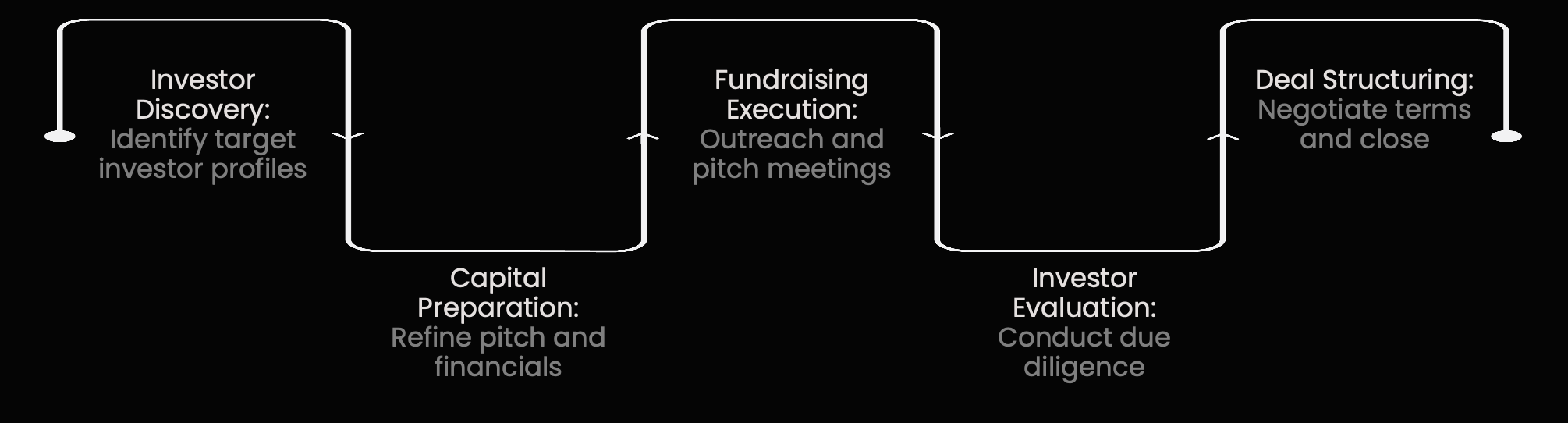
From Investor Discovery to Deal Structuring
Institutional funding rarely happens through a single conversation. Founders typically begin by identifying aligned investors before preparing investor materials and financial models that meet venture capital diligence standards. Once outreach begins, investors evaluate the company through meetings, data room review, and investment committee processes before negotiating final deal terms. Understanding this progression helps founders approach fundraising with greater clarity and institutional readiness.
How to Raise Venture Capital Step by Step?
Raising venture capital is a structured execution process. Startups that move through each stage correctly convert investor interest into funding. Startups that do not lose momentum before capital is deployed.
The process moves through preparation, investor readiness, execution, diligence, and deal structuring. Each stage builds on the previous one.
Preparation and Investor Readiness
Before engaging investors, startups must be structured for evaluation. This includes a clear narrative, financial model, and defined capital strategy.
Preparation is defined in Prepare Your Startup for Investors, while the full approach to planning a raise is outlined in Startup Fundraising Strategy. The underlying system is structured through Manage Capital Preparation, where readiness is aligned with investor expectations.
Without preparation, fundraising does not progress.
Build the Data Room and Supporting Materials
Investors expect structured documentation before moving into serious discussions. This includes financials, legal materials, and supporting data that validate the investment case.
Data room standards are outlined in Startup Data Room Guide and expanded in Startup Data Rooms, where required documents and structure are defined. Founders can assess completeness using the Dataroom Readiness Test.
Missing or inconsistent information slows down investor decisions.
Define Timeline and Fundraising Process
Fundraising operates on timing and sequencing. Founders must understand how long each stage takes and how to manage investor engagement across the process.
The expected timeline is explained in Startup Fundraising Timeline, while the full institutional process is outlined in Institutional Fundraising Process.
Poor timing reduces momentum. Structured timelines improve conversion.
Execute Fundraising and Manage Investor Pipeline
Fundraising is an active process. Founders must run multiple investor conversations in parallel, maintain engagement, and build momentum.
Execution frameworks are defined in How Startup Fundraising Works, while process control is supported through Generate Momentum and Activate and Reactivate, where investor engagement is managed across the pipeline.
Momentum determines outcome.
Structure the Deal and Close the Round
The final stage of fundraising is structuring the deal. This includes defining valuation, ownership, and legal agreements.
Deal mechanics are explained in How to Structure a Seed Round, while pooled investment structures are covered in SPV Formation Explained.
The structure of the deal determines long-term outcomes for founders and investors.
Raising venture capital is not a single event. It is a structured process where preparation, execution, and timing determine whether capital is secured.
Startups that move through this process with discipline convert investor interest into funding. Startups that do not fail before reaching a decision.
The next step is understanding why most startups fail to raise capital, and where this process breaks down in practice.
Why Most Startups Fail to Raise Capital.
Most startups do not fail to raise capital because of a lack of ideas. They fail because they enter the fundraising process without meeting investor requirements.
Why do startups fail to raise venture capital?
Startups fail to raise capital because they are not structured for investor evaluation. They lack readiness, credible traction, strong positioning, or a clear capital strategy.
Venture capital is not unpredictable. It is a filtering system. Companies that meet investor criteria progress. Companies that do not are filtered out early.
Lack of Capital Readiness
Many startups enter fundraising before they are ready. They lack structured financials, clear narratives, or defined capital strategies.
Investors expect companies to be prepared before engagement begins. When readiness is missing, conversations stall or end quickly.
Readiness gaps can be identified through Fundability Screen, supported by Capital Readiness Snapshot, and validated in detail through the Capital Readiness Audit.
Without readiness, fundraising does not start.
Weak or Unverifiable Traction
Traction must be measurable and credible. Many startups present metrics that do not reflect real growth or market validation.
Investors evaluate whether growth signals indicate product-market fit and repeatable demand. Surface-level metrics do not meet this standard.
Traction quality can be tested using Traction Credibility Test, while overall market viability is assessed through Market Opportunity Stress Test.
Without credible traction, the investment case weakens immediately.
Poor Positioning and Lack of Defensibility
Startups fail when they cannot clearly explain why they win. Weak differentiation, unclear markets, or easily replicated products reduce investor confidence.
Investors prioritise companies that can sustain growth and defend their position over time.
Positioning strength can be evaluated through Moat Strength Test, while common rejection patterns are outlined in Why Venture Capital Firms Reject Startups.
Without defensibility, growth is not sustainable.
Structural Weakness in the Business
Some startups fail because of deeper structural issues. These include unclear capital allocation, misaligned growth strategies, or incomplete business models.
These issues are not always visible to founders but are immediately visible to investors.
Structural weaknesses are defined through Enablers and Blockers, while capital alignment is clarified in Scope Capital, where strategy and structure are connected.
Without structural alignment, funding does not convert.
Startups do not fail randomly. They fail at specific points where investor expectations are not met.
Understanding these failure points allows founders to correct them before entering the market.
The next step is understanding what investors look for in startups, and how investment decisions are made.
What Do Investors Look for in Startups?
Venture capital investors evaluate startups using structured frameworks. Investment decisions are based on whether a company meets defined criteria that support high-growth outcomes.
Investors look for market opportunity, traction, financial performance, business model strength, defensibility, and execution capability.
These criteria are not optional. They determine whether a company progresses through evaluation or is filtered out early.
Market Opportunity
Investors prioritise companies operating in large and expanding markets. Venture capital requires significant outcomes, which means the market must support scale.
Market evaluation is not only about size. It includes growth rate, demand, and the company’s ability to capture meaningful share. This is defined in How Venture Evaluates Startups, where market assessment is central to investment decisions.
Without a large and accessible market, the investment case weakens regardless of execution.
Traction and Growth Quality
Traction signals whether a company is gaining real momentum. Investors assess growth consistency, customer behaviour, and revenue development.
This includes acquisition, retention, engagement, and conversion metrics. Investors prioritise companies where growth is repeatable and driven by real demand.
Evaluation frameworks are outlined in What Venture Capital Investors Look For, where traction is assessed as a primary indicator of product-market fit.
Without strong traction, investor confidence does not build.
Financial Performance and Capital Efficiency
Investors evaluate how effectively capital is used to generate growth. This includes analysing burn rate, runway, margins, and scalability.
Companies that require excessive capital for limited outcomes are considered high risk. Investors prioritise efficient growth and disciplined capital allocation.
Financial expectations at scale are outlined in Series A Readiness Guide, where performance thresholds are clearly defined.
Without financial discipline, the path to scale becomes uncertain.
Business Model and Revenue Structure
The business model determines how revenue is generated and sustained. Investors assess whether revenue is predictable, repeatable, and scalable.
This includes pricing strategy, unit economics, and customer lifetime value. Strong business models align growth with long-term sustainability.
Revenue structures are analysed in How Venture Capital Investors Evaluate Startups, where business model clarity directly impacts valuation and investment decisions.
Weak models reduce scalability and increase risk.
Defensibility and Competitive Positioning
Investors assess whether a company can maintain its position in the market. This includes competitive advantage and barriers to entry.
Defensibility may come from technology, distribution, network effects, or operational strength. Without it, growth can be replicated.
Competitive strength is evaluated as part of Institutional Fundraising Readiness, where positioning determines long-term viability.
Without defensibility, value is not sustained.
Execution Capability
Execution reflects the ability of the team to deliver outcomes. Investors assess decision-making, operational discipline, and the ability to scale.
This includes hiring, strategy, and adaptability under pressure. Strong execution reduces risk and increases the probability of success.
Execution is validated during Startup Due Diligence Investor Process, where investor review moves beyond narrative into verification.
Investors do not evaluate startups based on a single factor. They assess the entire system across market, traction, financials, business model, defensibility, and execution.
Startups that align across these dimensions are considered investable. Startups that do not are filtered out before capital is deployed.
The next step is understanding where to find investors and how to access them once your company meets these criteria.
Where to Find Investors for a Startup.
Finding investors is not about searching broadly. It is about identifying where capital is actively deployed and positioning a company within those channels.
Startups find investors through venture capital firms, angel networks, investor databases, and structured capital platforms where investment activity is already taking place.
Access to investors is not the primary constraint. Alignment is.
Venture Capital Firms and Investor Networks
Venture capital firms operate within defined mandates, investing at specific stages, sectors, and cheque sizes. Founders must identify firms that actively invest in companies like theirs.
Investor sourcing is structured, not random. This is explained in How to Find Startup Investors, where targeting replaces broad outreach.
Investor discovery is further supported by Investor Databases Founders Find Venture Capital and the aggregated listings in Investor Databases, where investors are filtered by stage, geography, and sector.
Without targeting, outreach does not convert.
Investor Platforms and Capital Distribution Channels
Investor platforms aggregate deal flow and provide access to capital networks. These platforms enable founders to connect with investors based on structured filters rather than cold outreach.
The leading platforms and how they function are outlined in Best Venture Capital Platforms 2026, while real capital allocation trends are shown in Where Venture Capital Invested in 2025.
Understanding where capital is actively being deployed improves targeting and increases the probability of engagement.
Comparing Investor Access Platforms
Not all platforms operate in the same way. Some focus on listing startups, others on syndication, and others on structured investor access.
These differences are critical when selecting how to engage with investors. Platform comparisons are detailed in Moonshot vs AngelList, Moonshot vs Y Combinator, Moonshot vs OpenVC, and Moonshot vs SeedInvest, where access models, investor behaviour, and outcomes are compared directly.
Choosing the wrong channel reduces visibility. Choosing the correct one improves alignment and access.
Investors are not hidden. They are structured across defined platforms, networks, and capital flows.
Startups that understand where investors operate position themselves to be selected. Startups that do not rely on outreach without conversion.
The next step is understanding how venture capital funding actually works, and how investor decisions are made from evaluation through to capital deployment.
How Venture Capital Funding Actually Works.
Venture capital funding operates as a structured system. Capital is not deployed randomly. It flows through defined processes, investment mandates, and decision frameworks inside venture capital firms.
Venture capital funding works through a process where funds source deals, evaluate companies, conduct due diligence, and deploy capital based on expected returns and portfolio strategy.
Understanding this system is critical. Founders who understand how venture capital works position themselves to move through it efficiently. Founders who do not remain outside of it.
The Venture Capital Stack
Venture capital is structured as a layered system. Capital flows from limited partners into funds, which then deploy capital into startups across defined stages and strategies.
This structure is explained in Venture Capital Stack, where the full capital flow from investor to startup is mapped.
Understanding the stack clarifies:
where capital originates
how it is allocated
how decisions are made
Without this, fundraising is approached without context.
Venture Capital Infrastructure
Beyond the capital itself, venture capital operates on infrastructure. This includes sourcing systems, evaluation frameworks, due diligence processes, and portfolio management structures.
These components are defined in Venture Capital Infrastructure, where the operational systems behind venture investing are outlined.
Infrastructure determines how quickly decisions are made and how consistently companies are evaluated.
Evaluation and Risk Management Systems
Venture capital firms manage risk across portfolios. They invest in a small number of companies expected to generate outsized returns, while most investments do not.
To manage this, firms rely on structured evaluation systems that assess probability, risk, and upside.
These systems are evolving. This is explored in Venture Rating Agencies 2026, where investment decisions are increasingly supported by structured rating models.
The Shift Toward Structured Evaluation
The venture capital industry is moving toward more systematic evaluation. Data, benchmarks, and structured scoring models are becoming more central to investment decisions.
This shift is explained in Why Venture Capital Is Moving Toward Startup Rating Agencies, where investor behaviour is transitioning from subjective judgment to structured analysis.
For founders, this means:
evaluation is becoming more standardised
expectations are becoming clearer
outcomes are becoming more predictable
Venture capital funding is not driven by individual decisions alone. It is driven by structured systems that govern how capital is sourced, evaluated, and deployed.
Startups that understand this system position themselves within it. Startups that do not remain outside of it.
The next step is understanding how capital structures and financing instruments shape ownership, dilution, and long-term outcomes.
Startup Financing Instruments and Capital Structures.
Capital structure defines how a startup is financed and how ownership is distributed over time. Every funding decision impacts dilution, control, and long-term outcomes.
A startup capital structure is the combination of equity, debt, and hybrid instruments used to fund a company, along with how ownership is allocated across founders and investors.
Understanding capital structure is critical to fundraising. It determines not only how capital is raised, but how value is retained.
The full system is explained in Startup Financing Instruments and Capital Structures Explained, where funding mechanisms and ownership implications are mapped in detail.
Capital Stack Design
The capital stack defines how different forms of capital sit within a company’s structure. This includes founder equity, investor equity, debt layers, and option pools.
Designing this stack correctly is essential. Poor structure leads to excessive dilution, investor misalignment, or constraints in future funding rounds.
Capital layering and structure are defined in Capital Stack Design, where each component of the stack is mapped, and further refined in Capital Stack Strategy, where capital decisions are aligned with growth objectives.
Ownership and Dilution
Every funding round changes ownership. Founders must understand how dilution occurs and how it compounds over time.
This includes:
equity issued to investors
option pools
future financing rounds
Ownership outcomes are not theoretical. They are calculated and predictable based on structure.
These outcomes are explored in Cap Tables, Ownership and Exit Outcomes, where dilution scenarios and ownership distribution are analysed.
Equity Structures and Incentives
Equity is not only allocated to investors. It is also used to attract and retain talent through structured incentive plans.
Employee stock option plans (ESOPs) form a critical part of the capital structure, particularly as companies scale.
These structures are defined in ESOP Design for Startups, where equity incentives are aligned with growth and retention.
Capital structure is not a technical detail. It is a core component of fundraising that determines ownership, control, and long-term outcomes.
Startups that design their capital structure intentionally maintain flexibility and alignment. Startups that do not create constraints that affect future growth and funding.
The next step is understanding how valuation and financial planning interact with capital structure to define funding outcomes.
Startup Valuation, Financial Planning, and Capital Strategy.
Valuation and financial planning define how much capital a startup can raise, how ownership is distributed, and how long the company can operate before requiring additional funding.
How is startup valuation determined?
Startup valuation is determined by market opportunity, traction, financial performance, growth potential, and comparable company benchmarks.
Understanding valuation is critical to fundraising outcomes. It directly impacts dilution, investor expectations, and future funding flexibility.
The full framework is explained in Startup Valuation, Equity and Dilution Explained, where valuation mechanics and ownership outcomes are mapped.
Financial Planning and Capital Allocation
Financial planning determines how capital is deployed and how long it sustains the business. This includes runway, burn rate, and the milestones required to justify the next funding round.
Investors assess whether a company can use capital efficiently to reach meaningful growth outcomes.
Financial strategy is defined in Startup Financial Planning, Runway, Burn and Capital Strategy, where capital allocation and growth planning are aligned.
Without clear financial planning, valuation does not hold.
Valuation Mechanics and Investor Expectations
Valuation is not arbitrary. It is based on structured inputs including growth metrics, market conditions, and comparable companies.
Investors assess whether valuation aligns with risk and expected return. Overvaluation reduces investor interest. Undervaluation increases dilution unnecessarily.
These mechanics are explained in Startup Valuation Explained, while pricing differences across funding rounds are clarified in Pre-Money vs Post-Money Valuation.
Valuation must align with both market conditions and company performance.
Benchmarking and Comparables
Investors evaluate startups relative to comparable companies. This includes analysing similar businesses in terms of growth, revenue, and valuation multiples.
Platform Comparables provide context for pricing and help investors assess whether valuation is reasonable.
Benchmarking frameworks are explored in Comparables, where valuation is grounded in market data rather than assumptions.
Without comparables, valuation lacks credibility.
Structuring Investment and Pricing
Investment structures affect how capital enters the company and how ownership is allocated across investors.
This includes pooled investment vehicles, pricing structures, and investor participation models.
These mechanisms are explained in Funding SPV Pricing, where investment structures and pricing models are defined.
Structuring decisions directly affect dilution, governance, and investor alignment.
Valuation and financial planning are not separate from fundraising. They define the terms under which capital is raised and the outcomes that follow.
Startups that align valuation with financial strategy maintain flexibility and credibility. Startups that do not create constraints that affect future funding and ownership.
The next step is understanding the tools and systems used to model, test, and manage these decisions in practice.
Startup Fundraising Tools and Calculators.
Fundraising decisions are not theoretical. They are modelled, tested, and validated through data.
What tools do startups use for fundraising?
Startups use financial calculators and modelling tools to estimate valuation, dilution, runway, capital requirements, and ownership outcomes.
These tools translate strategy into measurable outcomes.
Valuation and Dilution Modelling
Understanding valuation and dilution is critical before raising capital. Founders must know how much equity they are giving up and how it changes over multiple funding rounds.
This can be modelled using the Startup Valuation Calculator and Startup Dilution Calculator, where ownership changes are calculated based on investment size and valuation.
Without modelling dilution, founders lose control of long-term outcomes.
Runway and Capital Planning
Runway determines how long a company can operate before requiring additional funding. This is driven by burn rate and capital allocation.
Runway and funding requirements can be calculated using the Startup Runway Calculator and Fundraising Needs Calculator, where capital requirements are aligned with growth plans.
Without runway visibility, fundraising becomes reactive.
Ownership and Cap Table Management
Ownership must be tracked across founders, investors, and option pools. Cap tables define how equity is distributed and how it evolves over time.
These structures can be built and analysed using the Cap Table Outcome Calculator, Basic Cap Table Builder, and Ownership Visualiser Pie Chart, where ownership scenarios are mapped clearly.
Unstructured cap tables create long-term problems in fundraising and exits.
Equity Splits and Incentives
Equity allocation between founders and team members must be structured early. Misaligned equity splits create internal risk and investor concern.
This can be assessed using the Founder Equity Split Tool, while employee incentives can be modelled through the Option Plan Impact Viewer, where dilution and allocation are quantified.
Equity structure affects both control and execution.
SAFE and Hybrid Instrument Modelling
Hybrid instruments such as SAFEs require specific modelling to understand conversion impact and dilution.
These effects can be calculated using the SAFE Note Calculator and visualised through SAFE Impact Preview, where future ownership changes are mapped.
Without modelling hybrid instruments, dilution is often underestimated. Tools convert fundraising strategy into measurable outcomes. They allow founders to understand valuation, dilution, runway, and ownership before engaging investors.
Startups that model these decisions operate with clarity. Startups that do not rely on assumptions and react to outcomes after they occur. Access all fundraising tools and calculators through the Accelerate platform, where founders model valuation, dilution, runway, and capital strategy in one system.
The next step is understanding the broader Capital Intelligence knowledge system and how each component connects across fundraising, valuation, and execution.
The Capital Framework Behind Successful Fundraising
Fundraising outcomes are not determined by effort. They are determined by structure.
Most startups approach fundraising as a sequence of actions. They build a pitch deck, contact investors, and attempt to generate interest. This approach does not align with how capital is evaluated.
What determines whether a startup raises capital?
A startup raises capital when its structure aligns with investor evaluation frameworks across market, traction, financials, and execution.
This alignment is not accidental. It is built.
Transparency and Investor Clarity
Investors do not respond to incomplete or unclear information. They prioritise companies that can be understood quickly and evaluated with confidence.
Transparency is the foundation of this process. Companies must present clear financials, structured narratives, and consistent data across all materials.
This is defined in Transparency, where investor-facing clarity is treated as a requirement, not an enhancement.
Without transparency, evaluation slows or stops.
Structural Actions Over Activity
Fundraising is not driven by activity volume. More outreach does not create better outcomes.
What matters is whether the company has taken the structural actions required to become investable. This includes building financial models, defining capital strategy, and aligning narrative with performance.
These actions are defined in Write Structural Actions, where fundraising is treated as a system to be built rather than a process to be attempted.
Without structure, activity does not convert.
Building with the Market
Startups do not operate in isolation. They are evaluated within the context of market conditions, investor behaviour, and capital flows.
Companies must build in alignment with these external factors. This includes understanding where capital is being deployed, how investors are allocating funds, and what signals drive investment decisions.
This is defined in Build with the Market, where companies are positioned within real capital environments rather than theoretical ones.
Without market alignment, positioning fails.
Principles and Practices of Capital Alignment
The capital framework is not a checklist. It is a set of principles that govern how companies are structured for investment.
These principles define:
how capital is raised
how risk is managed
how growth is evaluated
how outcomes are achieved
This is formalised in Principles and Practices, where the framework is defined as a repeatable system rather than a set of isolated tactics.
Fundraising is not unpredictable. It follows defined patterns based on how companies are structured and evaluated.
Startups that build within these patterns raise capital. Startups that do not operate outside of them.
The next step is understanding how the platform and execution layer bring this framework into practice.
From Capital Intelligence to Capital Execution.
Capital Intelligence explains how startup capital works. The MoonshotNX platform provides the infrastructure founders use to apply these frameworks in practice, moving from understanding to action with the tools, workflows, and support structures that institutional fundraising requires.
Platform Stack
The full suite of MoonshotNX tools and modules designed to support founders through every stage of capital preparation and execution.
Venture Stack
A dedicated layer of the platform built for venture-backed startups navigating institutional fundraising from seed through Series B and beyond.
Capital Execution
The operational infrastructure for running a structured, professional capital raise, from investor CRM to data room management and deal tracking.
Assess Your Capital Readiness
Founders preparing to raise venture capital can begin by evaluating their company’s readiness for institutional investors.
MoonshotNX provides a structured capital readiness assessment designed to identify preparation gaps before entering the investor room.
Understanding how venture capital works is only part of the process. Execution determines whether capital is actually raised.
Most startups fail not because they lack knowledge, but because they cannot apply it in a structured way across preparation, investor engagement, and deal execution.
How do startups execute a venture capital raise?
Startups execute a raise by aligning their structure, running a managed investor process, and progressing through evaluation, diligence, and deal structuring with consistency.
This requires more than individual tools or isolated actions. It requires a system.
How the Platform Works
The full fundraising system is brought together in How MoonshotNX Works, where preparation, evaluation, and execution are structured into a single workflow.
This connects:
capital readiness
investor targeting
fundraising execution
deal closing
Without system integration, these stages remain fragmented.
Structured Evaluation and Rating
Investor decisions are increasingly driven by structured evaluation. Companies are assessed across defined criteria rather than subjective judgment alone.
This is reflected in Independent Ratings Overview, where startups are evaluated using consistent frameworks that align with investor expectations.
Structured evaluation reduces uncertainty and improves decision speed.
Capital Allocation and Investment Flow
Capital does not move randomly. It is deployed through structured allocation processes across funds, mandates, and investor groups.
This is reflected in M1 Fund, where capital is allocated based on defined criteria and investment theses.
Understanding how capital is deployed improves positioning and increases the probability of engagement.
Investment Outcomes and Performance
Execution is measured by outcomes. Investor engagement, deal progression, and capital deployment determine whether a raise is successful.
This is explored in M1 Fund Review, where investment activity and outcomes are assessed.
Execution quality determines results.
Fundraising success is not determined by knowledge alone. It is determined by how effectively that knowledge is executed within a structured system.
Startups that integrate preparation, evaluation, and execution move efficiently through fundraising. Startups that do not remain fragmented and fail to convert.
The next step is assessing your readiness to raise capital and identifying where your company stands within this system.
Capital Intelligence Knowledge Library.
Capital Intelligence is a structured knowledge library designed to explain how venture capital actually works. These resources break down fundraising, investor expectations, valuation, ownership and financial planning into clear, practical frameworks that founders can use to prepare for capital.
Alongside these guides, MoonshotNX provides a suite of free, founder-facing tools designed to translate theory into action. Each tool connects directly to the concepts explained within this library, allowing founders to test assumptions, model outcomes and evaluate readiness before engaging with investors. We took the most asked questions, turned them into tools and placed those tools in HUBS to make them easily available to all founders. Please click the HUB below that interests you.
Visit the Platform Tool Stack. These guides answer the most searched questions founders ask before raising venture capital, including how fundraising works, how investors evaluate startups, and how to prepare for institutional funding.
Startup Fundraising Principles.
Core foundations for raising startup funding. These articles define fundraising strategy, capital direction, investor readiness and execution discipline for founders preparing to raise angel, venture capital or early-stage growth funding.
How to Discover Investors.
Before you can raise capital, you need to know where it lives. Investor Discovery covers how founders identify, evaluate, and access investors across the full spectrum of capital sources, including venture capital firms, angel networks, family offices, and institutional capital platforms. Understanding where investors operate, what they fund, and how to reach them is the foundation of any successful raise.
Startup Intelligence - Read more:
How to Prepare for a Capital Raise.
Institutional investors apply rigorous standards before committing capital. Capital Preparation covers everything a startup must have in place before entering a fundraise, from investor-grade financial models and data room architecture to governance structures and readiness benchmarks. Founders who prepare systematically dramatically increase their credibility and conversion rate with institutional investors.
How Fundraising is Executed.
Running a capital raise with institutional investors is a structured, high-stakes process. Fundraising Execution explains how to design and manage that process, from building your investor pipeline and managing parallel conversations, to navigating term sheets and closing a round on your terms. Founders who treat fundraising as a managed process consistently outperform those who approach it opportunistically.
How Investors Evaluate Startups.
Understanding how investors think is as important as knowing what to build. Investor Evaluation pulls back the curtain on the frameworks, filters, and internal processes that venture capital firms use to assess startups before committing capital. From initial screening through to investment committee, founders who understand the investor's perspective are far better equipped to present compellingly and navigate rejection constructively.
How to Structure the Deal.
How a deal is structured has long-term consequences for founder equity, governance, and future financing flexibility. Deal Structuring covers the legal and financial mechanics of startup investment, from instrument selection and valuation methodology to equity incentive design and special purpose vehicle formation. Understanding these mechanics before entering negotiations gives founders a significant structural advantage.
Beyond Analysis
Capital Intelligence provides the structural research layer behind the applied capital sequencing within MoonshotNX. Founders who require structured assessment can engage the Capital Readiness Audit or review the Funding & SPV framework for deployment pathways.
Archive Structure
Capital Intelligence is maintained as a structured methodology archive. Articles are updated periodically to reflect regulatory shifts, capital deployment trends, and evolving institutional standards.
Each entry is designed to stand independently while contributing to a coherent analytical framework.
Startup Fundraising Frequently Asked Questions.
What is the startup fundraising process?
The startup fundraising process is a structured sequence through which startups raise capital from investors by preparing their business for evaluation, engaging investors, completing due diligence, and closing a funding round.
In practice, fundraising moves through preparation, investor targeting, outreach, diligence, and deal execution. Each stage increases the level of scrutiny and requires stronger financial clarity and documentation.
This full system is broken down in Startup Fundraising Explained, where the process is mapped from preparation through to capital deployment.
How do startups raise venture capital?
Startups raise venture capital by exchanging equity for capital from investors expecting high-growth outcomes.
To do this successfully, founders must align their company with investor expectations before outreach begins. This includes demonstrating market opportunity, traction, financial structure, and execution capability.
The concept of readiness is explored in Investor Readiness: What It Means and How Founders Get There, where founders can understand when they are actually prepared to raise capital.
How can I raise funding for my startup?
Startups raise funding by selecting the correct capital structure and aligning with investor expectations.
This includes building a strong narrative, preparing financial models, structuring ownership correctly, and ensuring the business can withstand investor evaluation.
The different funding paths available are explained in Startup Financing Instruments and Capital Structures Explained, where equity, debt, and hybrid options are mapped.
What do investors look for in startups?
Investors evaluate startups based on market size, traction, financial performance, business model strength, defensibility, and execution capability.
These factors are assessed as a system, not individually. A company must demonstrate alignment across all dimensions to be considered investable.
Why do startups fail to raise capital?
Startups fail to raise capital because they enter the market without meeting investor requirements.
Common issues include weak financials, unclear valuation, poor targeting, incomplete data rooms, and lack of defensibility.
Most failures occur before meaningful investor engagement begins, due to gaps in readiness and positioning.
How are startups valued?
Startups are valued based on market opportunity, growth potential, traction, financial performance, and comparable companies.
Early-stage valuation combines data with investor perception, while later-stage valuation becomes more structured and metrics-driven.
This is explained in Startup Valuation, Equity and Dilution Explained, where valuation and ownership outcomes are connected.
What makes a valuation defensible?
A valuation is defensible when it is supported by evidence.
This includes credible projections, realistic growth assumptions, comparable benchmarks, and a clear use of funds.
A defensible valuation reduces friction in investor discussions and accelerates decision-making.
What is a cap table and why does it matter?
A cap table shows ownership distribution across founders, investors, and stakeholders.
Investors analyse cap tables to assess dilution, governance, and future fundraising flexibility.
This is explored in Cap Tables, Ownership and Exit Outcomes, where ownership scenarios and long-term impacts are analysed.
How does dilution work in startup fundraising?
Dilution occurs when new shares are issued to investors, reducing existing ownership percentages.
While dilution is expected, poor planning can result in excessive loss of control or unattractive ownership structures for future investors.
What is runway and why is it important?
Runway is the amount of time a startup can operate before needing additional capital.
It is determined by burn rate and available cash. Managing runway effectively ensures that startups raise capital from a position of strength rather than urgency.
This is explained in Startup Financial Planning, Runway, Burn and Capital Strategy, where financial planning is aligned with fundraising strategy.
What are SAFEs and convertible notes?
SAFEs and convertible notes are early-stage funding instruments that convert into equity at a later stage.
They allow startups to raise capital before setting a valuation but introduce complexity in future ownership structures.
What is due diligence in venture capital?
Due diligence is the process investors use to verify a company before committing capital.
It includes reviewing financials, legal structure, traction, governance, and operational risks.
This stage determines whether an investment proceeds or stops.
How long does it take to raise venture capital?
Raising venture capital typically takes between six and nine months.
This includes preparation, outreach, meetings, due diligence, and closing. Companies that start with stronger preparation move faster.
What is venture capital infrastructure?
Venture capital infrastructure refers to the systems used to prepare, evaluate, and execute fundraising.
This includes readiness diagnostics, financial models, data rooms, and investor processes that allow companies to be assessed efficiently.
Who is Capital Intelligence for?
Capital Intelligence is designed for founders raising pre-seed, seed, or Series A funding who want to understand how fundraising actually works before going to market.
Is Capital Intelligence free?
Yes. Capital Intelligence is a free knowledge system that explains startup fundraising, valuation, capital structure, and execution.
How do startups find investors?
Startups find investors by aligning with investor mandates and positioning themselves within active capital channels.
Investor access is not the starting point. It is the result of readiness and alignment.
What is the difference between angel investors and venture capital firms?
Angel investors typically invest earlier and in smaller amounts, while venture capital firms deploy larger amounts with structured mandates and return expectations.
What happens after a startup raises capital?
After raising capital, startups are expected to deploy funds efficiently, achieve growth milestones, and prepare for the next funding round.
Execution after funding is as important as raising the capital itself.
Startup fundraising is a structured system. Founders who understand how capital works move through the process with clarity and control.
For deeper answers across all topics, explore MoonshotNX.
How much funding should a startup raise?
Startups should raise enough capital to reach the next meaningful milestone that increases valuation or reduces risk.
This typically includes achieving product-market fit, scaling revenue, or preparing for the next funding round. Raising too little creates pressure, while raising too much increases dilution unnecessarily.
This can be modelled using Fundraising Needs Calculator, where capital requirements are aligned with growth milestones.
When should a startup raise venture capital?
A startup should raise venture capital when it can demonstrate clear market opportunity, credible traction, and a defined path to scale.
Raising too early reduces valuation and increases dilution, while raising too late risks running out of capital before reaching key milestones.
This is explained in How to Know if Your Startup Is Ready to Raise Venture Capital, where readiness is defined against investor expectations.
What is investor readiness?
Investor readiness refers to how prepared a startup is to be evaluated by investors.
It includes structured financials, a clear narrative, credible traction, a defined capital strategy, and a complete data room. Without investor readiness, fundraising efforts do not convert.
This is explained in Investor Readiness: What It Means and How Founders Get There.
What is product-market fit and why does it matter for fundraising?
Product-market fit occurs when a startup’s product meets real market demand and demonstrates consistent customer adoption.
Investors prioritise companies with product-market fit because it reduces risk and increases the probability of scalable growth.
This is a key component of evaluation in How Venture Evaluates Startups.
What is a venture capital fund and how does it work?
A venture capital fund is a pooled investment vehicle where capital from investors is deployed into startups.
Fund managers allocate capital across multiple companies, expecting a small number of high-performing investments to generate returns for the fund.
This is explained in Venture Capital Stack, where capital flow and allocation are mapped.
What is the difference between pre-seed, seed, and Series A funding?
Pre-seed funding supports early validation, seed funding supports initial traction, and Series A funding supports scaling.
Each stage has increasing expectations for revenue, growth consistency, financial structure, and operational maturity.
These expectations are outlined in Series A Readiness Guide.
What is a term sheet in venture capital?
A term sheet is a non-binding agreement outlining the key terms of an investment.
It includes valuation, ownership, investor rights, and governance structure, and forms the basis for final legal agreements.
This is explained in How to Structure a Seed Round, where deal mechanics are defined.
What is an SPV in venture capital?
An SPV (Special Purpose Vehicle) is a legal entity used to pool investor capital into a single investment.
It allows multiple investors to participate in a deal while appearing as a single entity on the cap table.
This is explained in SPV Formation Explained.
How do venture capital firms make money?
Venture capital firms make money through management fees and carried interest.
Management fees cover operating costs, while carried interest represents a share of profits from successful investments.
This is explained in Venture Capital Infrastructure, where fund economics are defined.
What is a lead investor and why are they important?
A lead investor is the primary investor in a funding round who sets the terms and commits significant capital.
They provide validation, structure the round, and attract additional investors.
This role is explained in How Startup Fundraising Works.
How do investors evaluate risk in startups?
Investors evaluate risk across market size, execution capability, financial performance, competition, and scalability.
They invest where potential returns justify the risk of failure.
This evaluation process is explained in How Venture Evaluates Startups.
What is a data room and what should it include?
A startup data room is a structured repository of documents used during fundraising.
It typically includes financial models, legal documents, cap tables, traction data, and operational information required for due diligence.
This is explained in Startup Data Room Guide.
What is burn rate in a startup?
Burn rate is the rate at which a startup spends its capital over time.
It determines how quickly funds are used and directly impacts runway and fundraising timing.
This is explained in Startup Financial Planning, Runway, Burn and Capital Strategy.
How do startups prepare for due diligence?
Startups prepare for due diligence by organising financials, legal documents, traction data, and operational information into a structured data room.
Preparation reduces friction, increases investor confidence, and speeds up decision-making.
This is explained in Startup Due Diligence Investor Process.
What is a down round and why does it happen?
A down round occurs when a startup raises capital at a lower valuation than its previous round.
This typically happens due to weak performance, poor market conditions, or overvaluation in earlier rounds.
This is explained in Pre-Money vs Post-Money Valuation.
How do market conditions affect fundraising?
Market conditions influence investor behaviour, capital availability, and valuation levels.
In strong markets, capital is more accessible and valuations increase. In weaker markets, investors become more selective and pricing becomes more conservative.
This is explained in Where Venture Capital Invested in 2025, where capital flow trends are analysed.