

THE CAPITAL STACK PLATFORM™
How Venture Capital Works.
Venture Capital. Decoded.
Venture capital is a structured investment system used by investors to evaluate, fund, and manage startups. This page explains how venture capital works, how capital flows through funding stages, how investors process opportunities, and how venture capital firms make investment decisions.The Venture Capital Stack explains how venture capital works across sourcing, evaluation, and capital deployment. The venture capital process sits between capital structure and execution, linking how financing is organised through the capital stack, how companies prepare for funding, how platforms structure investment, and how deals are closed.
What Is Venture Capital?
Venture capital is a form of institutional investment where investors fund startups in exchange for equity. Venture capital works through a structured process that includes deal sourcing, startup evaluation, due diligence, investment decision-making, and capital deployment across defined funding stages.
The venture capital system is used by venture capital firms, angel investors, family offices, and institutional allocators to identify high-growth companies, assess risk, and construct investment portfolios designed to generate outsized returns.
Understanding how venture capital works is essential for founders because it explains how investors evaluate companies, structure decisions, and deploy capital across funding stages.
The venture capital process explained step by step. If you are looking for how to raise venture capital rather than how it works, see the startup fundraising guide. For a complete breakdown of how startups raise capital, how investors evaluate opportunities, and how funding rounds are structured and closed, see Startup Fundraising Explained.
How Venture Capital Works (Simple Explanation)
Venture capital works as a system for allocating capital into high-growth companies. Investors do not fund startups randomly. They evaluate companies using a structured process that compares risk, return potential, and alignment with their investment mandate.
At a high level, venture capital works in three layers:
– sourcing opportunities
– evaluating and pricing risk
– structuring and deploying capital
Startups enter this system through funding stages, typically pre-seed, seed, and Series A. At each stage, investors expect stronger evidence, clearer financial logic, and more structured companies before committing capital.
Understanding how venture capital works means understanding how investors make decisions, not just how founders raise money.
The Venture Capital Process Step by Step
The venture capital process follows a structured sequence used across the industry:
1. Deal sourcing
Investors identify startups through networks, inbound applications, and market scanning.
2. Initial screening
Investors assess whether a company fits their stage, sector, and investment mandate.
3. Deep evaluation
This includes financial model review, market analysis, product differentiation, and team assessment.
4. Due diligence
Investors validate the business through data room review, legal checks, and operational analysis.
5. Investment decision
The opportunity is reviewed internally against portfolio strategy and return expectations.
6. Deal structuring
Terms are defined, including valuation, ownership, governance rights, and investment instruments.
7. Capital deployment
Funds are transferred and the company becomes part of the investor’s portfolio.
This process is consistent across venture capital firms globally, regardless of geography or stage focus.
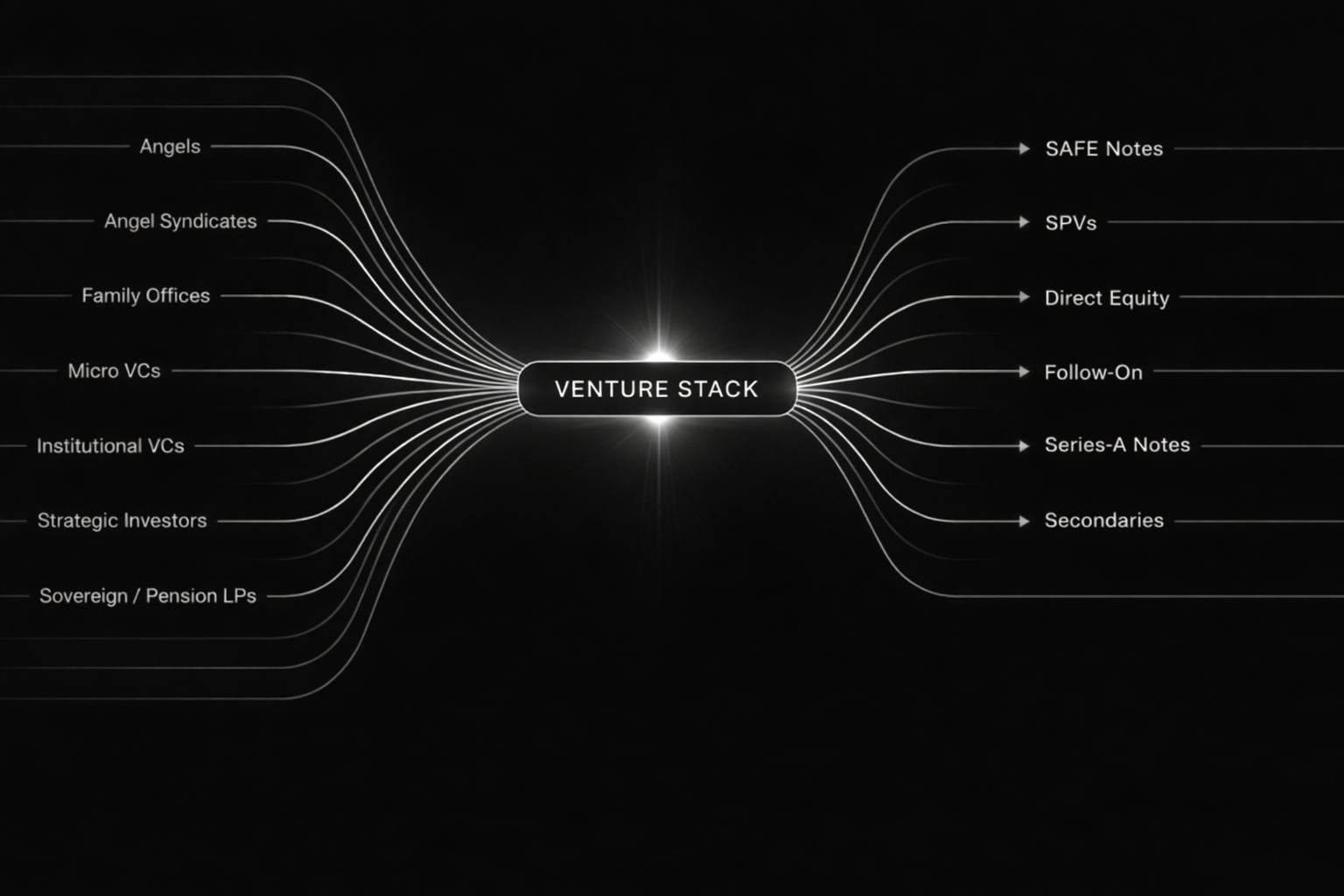
MoonshotNX Venture capital stack process.
The MoonshotNX Capital Stack maps how capital actually flows through startups, from pre-seed funding and seed funding to Series A funding, institutional diligence, and final venture capital deal structuring.
This framework shows how investors process opportunities, structure decisions, and deploy capital across funding stages.
For deeper reference, explore our hubs: Capital Intelligence, the Platform Stack, and external venture capital market data from PitchBook and Preqin.
What is venture capital and how does it work?
Venture capital is a form of institutional investment in which investors fund startups in exchange for equity based on expected future growth, portfolio return construction, and risk-adjusted outcomes.
Venture capital works through a structured investment process. Investors evaluate startups against market size, product differentiation, financial model quality, valuation logic, governance structure, ownership design, and due diligence readiness before committing capital.
This means venture capital does not operate as a series of isolated conversations. It operates as a system used by venture capital firms, angel investors, family offices, and institutional allocators to compare companies and make portfolio decisions.
The venture capital system typically includes:
investor mandate alignment
financial modelling and valuation discipline
structured due diligence
legal and capital structuring
portfolio construction logic
Understanding how venture capital works requires understanding how investors process startups, price risk, and structure ownership over time.
To go deeper, see How Venture Capital Investors Evaluate Startups, What Venture Capital Investors Look For, and Startup Valuation Methods.
Where Startup Fundraising Fits Within Venture Capital?
Startup fundraising is one component within the broader venture capital system. While founders experience fundraising as a process of raising capital, investors experience it as part of a structured evaluation and allocation system used to compare opportunities and deploy capital across a portfolio.
From an investor perspective, this process is part of a broader evaluation system. This startup fundraising process is not improvised. It reflects how venture capital investors evaluate opportunities, manage diligence, and deploy capital into portfolio companies.
Founders who want the full operating sequence should read How Venture Capital Works, The Institutional Fundraising Process, and Startup Fundraising Timeline. Founders preparing to enter the market should also review Startup Fundraising Strategy and How to Raise Capital in 2026.
Why Startups Fail to Raise Venture Capital?
Most startups fail to raise venture capital because they approach investors before achieving institutional readiness.
Common failure points include:
incomplete financial models
weak or unclear valuation logic
poor governance structure
unstructured data rooms
misaligned investor targeting
Investors evaluate structure, not narrative. A startup may have a compelling story, but if the company lacks investor readiness across financials, ownership, documentation, and diligence preparation, capital usually does not move.
For a deeper explanation, read Why Venture Capital Firms Reject Startups, How Venture Capital Investors Evaluate Startups, Startup Due Diligence: How Investors Investigate Companies, and Series A Readiness Guide.
The Venture Capital Framework
The venture capital system can be understood as a structured framework used by investors to evaluate, fund, and manage startups across different stages of growth. The venture capital process follows a four-stage system used by institutional investors:
Investor Discovery
Capital Preparation
Fundraising Execution
Deal Structuring
Each stage introduces new expectations, documentation requirements, and evaluation criteria.
The Four Stages of Venture Capital
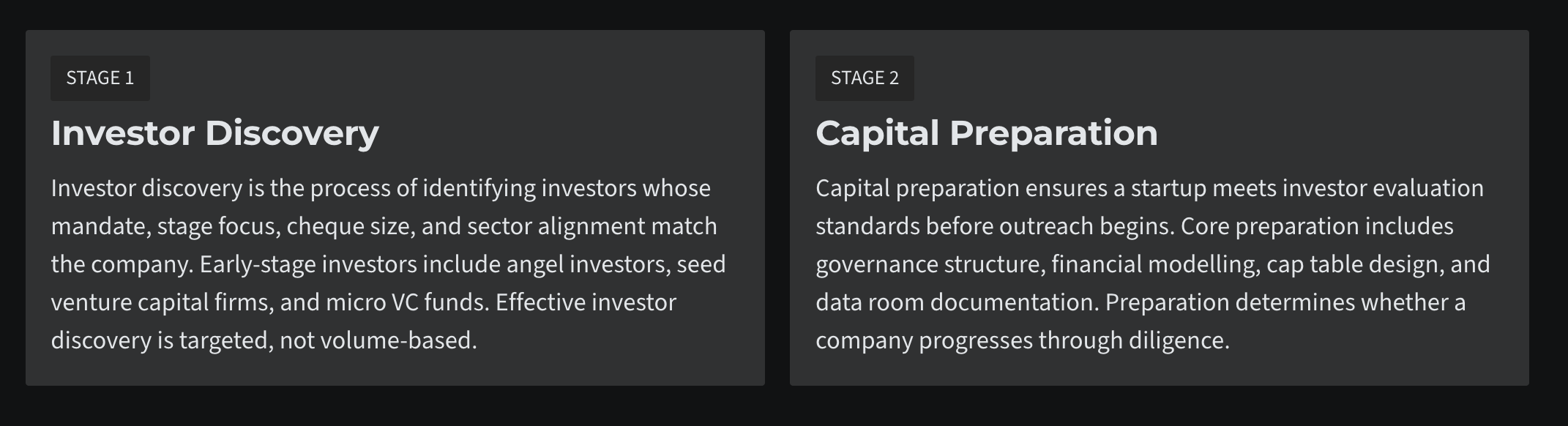
Investor discovery and capital preparation form the foundation of the startup fundraising process. Founders must identify aligned venture capital investors and prepare institutional-grade financial models, governance structures, and data room documentation before engaging in fundraising.
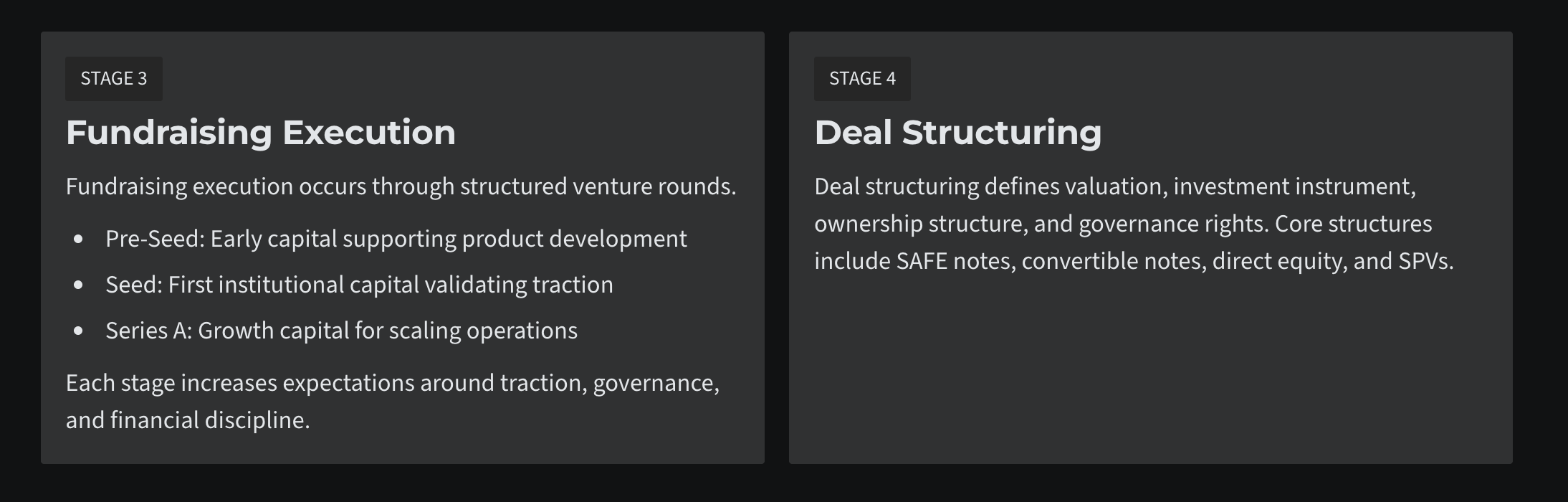
Fundraising execution and deal structuring define how startups raise capital through venture capital rounds and formalise investment terms, including valuation, ownership, and governance rights.
The Startup Capital Stack
The startup capital stack describes how:
funding rounds
financial instruments
ownership structures
interact across a company’s lifecycle. The startup capital stack defines how startup funding rounds, venture capital investment structures, ownership dilution, and financial instruments such as SAFE notes, SPVs, and equity financing interact across the startup lifecycle.
Understanding the capital stack allows founders to:
plan fundraising strategy
avoid dilution mistakes
structure capital efficiently
Understanding this structure is critical for founders. See the full breakdown in Startup Capital Stack Explained.
Investor Discovery
Investor discovery is a strategic process of identifying aligned capital. Investor discovery is how startups find venture capital investors, angel investors, and institutional capital aligned with their stage, sector, and funding requirements.
Mass outreach signals poor preparation.
Targeted investor selection improves:
response rates
meeting quality
funding outcomes
Founders building an investor pipeline should understand how venture capital firms source deals, where to access investors using investor databases, and how to identify aligned capital through startup investor platforms. Market activity can be analysed through platforms such as Preqin and Where Venture Capital Invested in 2025
Fundraising Execution
Fundraising execution is the process by which startups raise venture capital through structured funding rounds including pre-seed, seed, and Series A.
Founders must align:
narrative
traction
capital requirements
with investor expectations at each stage.
Founders should understand startup fundraising strategy, how rounds are sequenced in the startup fundraising timeline, and how to approach investors using how to raise venture capital in 2026.
Deal Structuring
Deal structuring determines long-term outcomes. Deal structuring determines startup valuation, ownership distribution, investor rights, and how capital is deployed through venture capital investment instruments.
Poor structuring leads to:
dilution issues
governance conflicts
future fundraising constraints
Founders must understand pre-money vs post-money valuation, SAFE vs convertible notes, startup valuation methods, and how investment structures such as SPVs impact ownership and governance.
These structures follow frameworks defined by organisations such as Y Combinator and regulated environments such as the U.S. Securities and Exchange Commission.
Capital Preparation
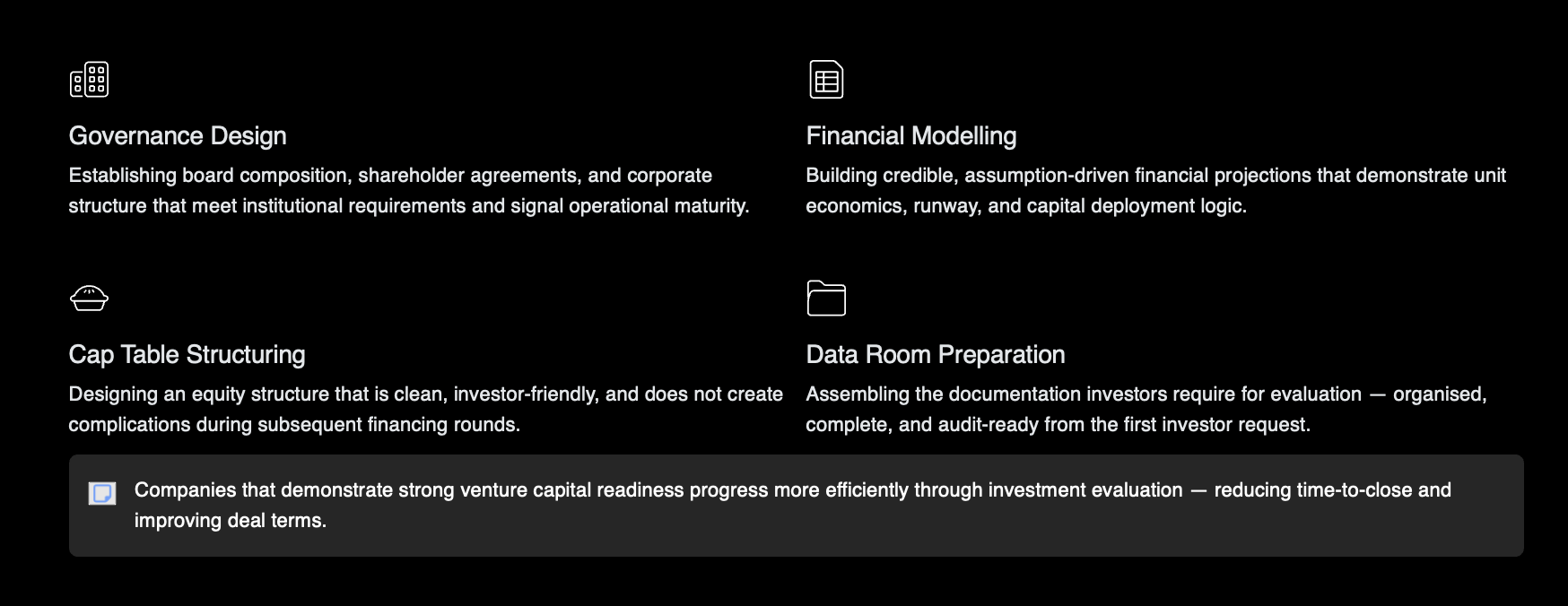
Capital preparation is the process of ensuring that every structural signal a company sends is aligned with investor expectations before the first conversation begins.
Venture Capital Stages Explained
Venture capital funding is structured into stages that reflect increasing levels of company maturity and investor expectations:
Pre-seed
Early validation stage where investors fund the initial concept, team, and early product development.
Seed
Investors fund companies with early traction, focusing on product-market fit and initial growth.
Series A
Institutional investors fund companies with proven traction, scalable models, and clear growth pathways.
Each stage introduces stricter expectations around financial performance, governance, capital efficiency, and execution. Founders must align their company to the correct stage before raising capital, as mismatched positioning is one of the most common reasons fundraising fails.
Investor Readiness Foundations.
Investor readiness is one of the most important factors in determining whether a startup successfully raises venture capital.
Venture-backed startups typically progress through three early capital stages: Pre-Seed, Seed, and Series A. Each stage reflects increasing levels of product validation, market traction, and institutional investor participation. Understanding these stages helps founders position their fundraising strategy and align with the expectations of venture capital investors.
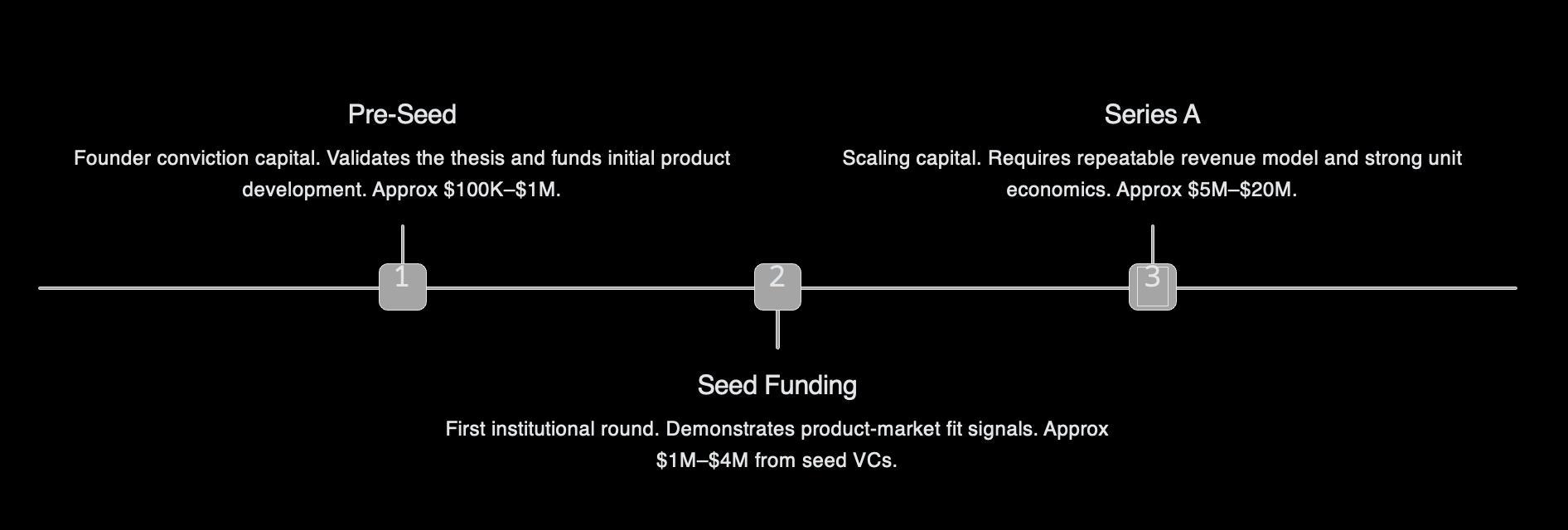
Each stage introduces progressively more rigorous expectations around governance, traction evidence, and capital efficiency. Founders who understand the structural logic of each round avoid the common mistake of raising the wrong amount from the wrong investors at the wrong moment in their company's development.
Venture Capital Explained
Venture capital is not a single transaction. It is a structured system used to evaluate and fund startups across multiple stages of growth. The venture capital process includes sourcing opportunities, evaluating companies, conducting due diligence, structuring deals, and deploying capital.
Understanding how venture capital works requires understanding how investors think, how funding stages are structured, and how capital flows through startups over time.
The following questions reflect the most common queries founders ask about venture capital, startup fundraising, investor readiness, and funding stages.
What is venture capital and how does it work?
Venture capital is a form of institutional investment where investors fund startups in exchange for equity. It works through a structured system of evaluation, due diligence, and capital allocation across funding stages.
What are the stages of venture capital?
The main stages are pre-seed, seed, and Series A. Each stage represents increasing levels of traction, validation, and investor expectations.
How do venture capital firms evaluate startups?
Venture capital firms evaluate startups based on market size, growth potential, financial model quality, team capability, and how the opportunity fits within their investment mandate.
What is the venture capital process?
The venture capital process includes sourcing deals, evaluating opportunities, conducting due diligence, structuring investments, and managing portfolio companies.
What is an SPV?
A legal structure used to pool investor capital into a single investment entity.
Why do startups fail to raise funding?
Lack of readiness, weak financials, poor targeting, and unclear valuation logic.
What documents do investors require?
Pitch deck, financials, cap table, legal documents, and data room materials.