

THE CAPITAL STACK PLATFORM™
What Is a Venture Capital Platform?
Capital. Re-engineered.
A venture capital platform is a structured system that prepares startups for institutional investment and enables investors to evaluate, select, and fund companies through a consistent process. The platform operates across the full venture capital lifecycle, from capital preparation to execution. This includes how deals are structured and closed within venture capital infrastructure.
Venture capital platforms sit at the centre of the funding system, connecting how capital is structured through the capital stack, how companies prepare for funding, how venture capital operates, and how deals are executed.
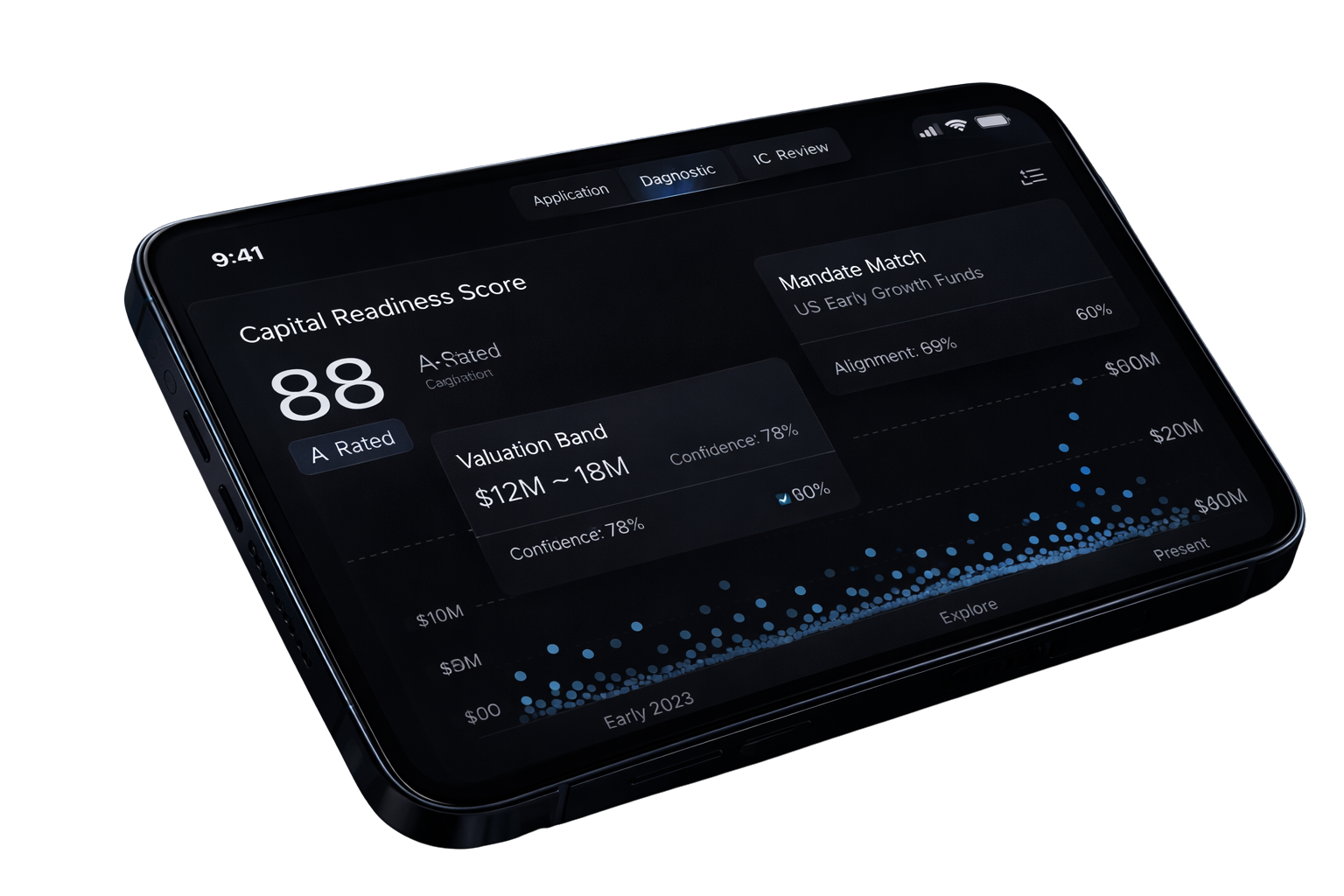
It standardises capital readiness, investor evaluation, due diligence, deal structuring, and capital deployment into a single operating system aligned to institutional investment criteria.
MoonshotNX operates as venture capital infrastructure and functions as a capital stack platform, structuring how companies prepare for funding and how investors assess and deploy capital. For a complete breakdown of how startups raise capital, how investors evaluate opportunities, and how funding rounds are structured and closed, see Startup Fundraising Explained.
Venture Capital Infrastructure in Practice
MoonshotNX operates as a venture capital platform and capital stack platform that structures how companies prepare for funding and how investors evaluate and deploy capital.
The platform functions as venture capital infrastructure, integrating capital readiness, investor evaluation, due diligence, structural rating, mandate-aligned investor targeting, and deal execution through structured SPV formation.
Unlike fragmented fundraising approaches, the system operates as a sequenced capital operating system, moving companies from preparation to completed investment through a defined and repeatable process.
MoonshotNX is built for companies operating at seed, Series A, and growth stages that require structured alignment with institutional investor expectations.
The Capital Reality
Most founders approach fundraising as outreach. Investors approach it as underwriting.
By the time investors review a company, they are not discovering it. They are evaluating it against institutional criteria across financial structure, governance, valuation, and execution risk.
MoonshotNX reverses this dynamic by ensuring companies are structurally prepared before entering investor evaluation.
Structured Capital: Debt, Non-Dilutive Funding and Capital Strategy
MoonshotNX does not treat funding as a single event.
It structures capital across both equity and non-dilutive layers, allowing founders to access and combine multiple financing options within one system.
This includes venture debt, working capital, asset-based lending, invoice finance, trade finance, secured loans, unsecured lending, and broader structured credit solutions.
These are not separate products.
They are part of a unified capital layer that sits alongside investor readiness, valuation, and fundraising execution.
What this layer does
The structured capital layer within MoonshotNX allows founders to:
– access debt and non-dilutive funding alongside equity
– extend runway without immediate dilution
– align capital to operational needs and growth timing
– structure financing based on real financial data
– evaluate ownership impact across all capital decisions
Instead of defaulting to venture capital, founders can build a capital strategy that reflects how their business actually operates.
How it works within the platform
Structured capital is embedded directly into the MoonshotNX system.
Founders:
– complete diagnostics and financial submissions
– build their capital profile
– evaluate both equity and non-dilutive options
– apply for structured financing within the platform
MoonshotNX then structures the appropriate financing solution based on the company’s profile, funding requirements, and growth trajectory.
This is not a referral process.
It is a core part of the MoonshotNX capital infrastructure.
Types of capital available
Through this layer, MoonshotNX provides access to:
– venture debt for growth-stage companies
– working capital and short-term financing
– asset-based lending against receivables, inventory, or equipment
– invoice and trade finance for cash flow management
– secured and unsecured business loans
– private credit and structured financing
Each solution is structured based on the company rather than offered as a fixed product.
How this connects to the rest of the platform
Structured capital sits within the broader MoonshotNX system:
– Investor Readiness defines whether a company can withstand capital evaluation
– Startup Valuation and Equity determines how pricing converts into ownership
– Cap Tables and Ownership model how dilution evolves over time
– Financial Planning and Runway define when capital is required
– Financing Instruments determine how capital converts into equity or debt
Structured capital connects these layers by introducing additional funding options that affect timing, dilution, and ownership outcomes.
Explore startup financing options
To understand how debt, non-dilutive funding, and structured capital work in practice, read:
Startup Financing Options: Debt, Non-Dilutive Funding and Capital Strategy and Venture Debt
This page explains:
– how startups access funding beyond equity
– how venture debt and structured capital work
– how financing decisions affect ownership and growth
– how capital is structured across multiple layers
External capital frameworks
Structured capital operates within a broader global financial system.
For additional context:
– British Business Bank provides guidance on alternative finance and growth lending
– Federal Reserve outlines business lending and credit markets
– International Finance Corporation publishes frameworks on private sector capital access
These frameworks reflect how capital is structured globally and reinforce the role of non-dilutive funding alongside equity.
How the Venture Capital Platform Operates
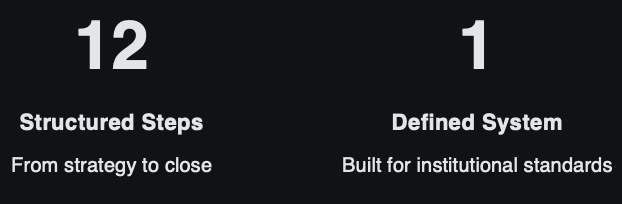
MoonshotNX structures venture capital execution through a defined operating system. The platform is organised around a twelve-step process that moves companies from preparation to completed investment rounds.
The 12-Step Venture Capital Process
The venture capital platform operates through a structured twelve-step system that prepares companies for investor evaluation and moves them through to completed funding rounds.
Each step builds institutional readiness incrementally, ensuring that by the time a company enters investor review, it meets the structural standards required for capital deployment.
Capital Strategy Definition
Every successful fundraising process begins with absolute clarity about capital strategy. Without it, founders approach investors with misaligned expectations and lose credibility before the conversation begins.
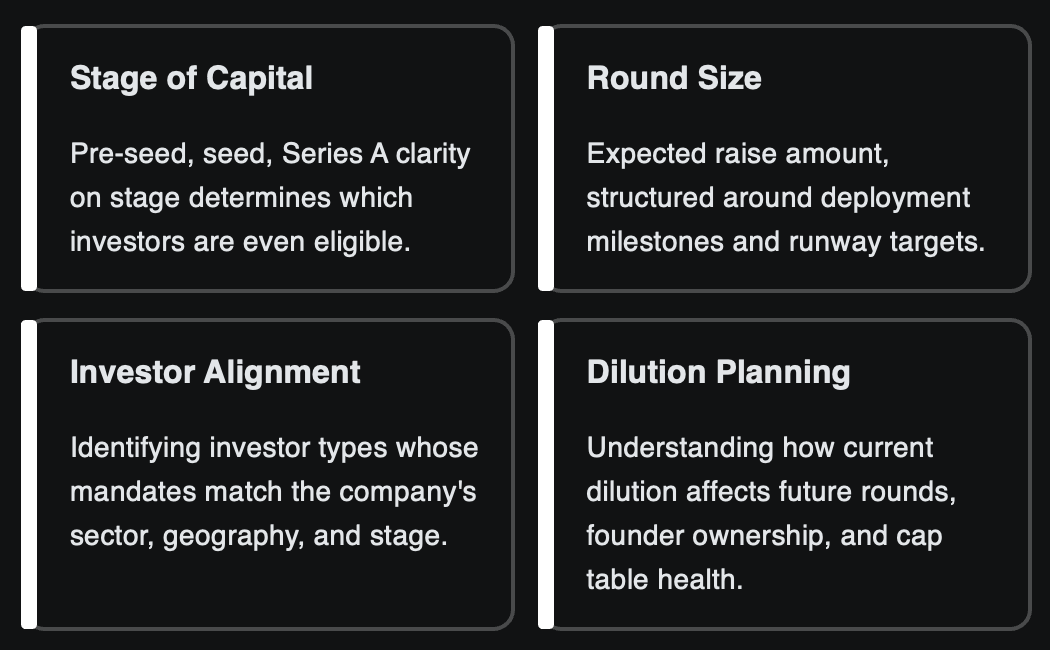
What Founders Must Determine
Before any investor outreach begins, a founder must be able to answer four foundational questions with precision and confidence.
Pitch Narrative Development
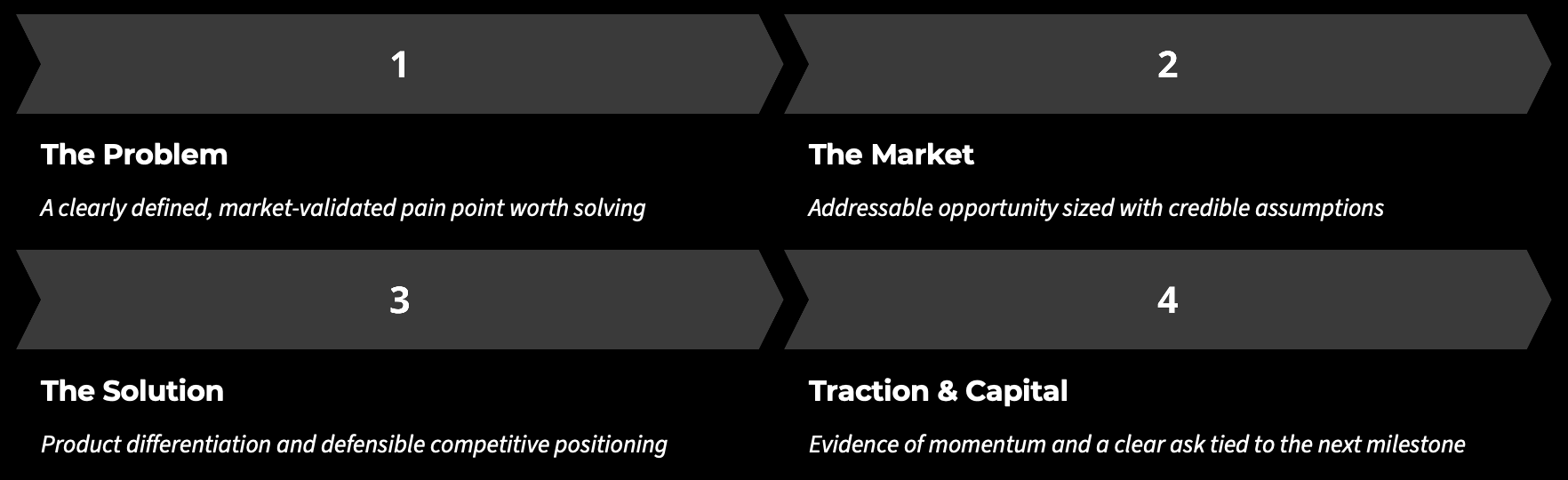
Investors evaluate opportunities through structured narratives, not vision alone. A compelling pitch is not simply a story; it is a logical argument that guides an investor from problem identification to investment conviction. Founders who fail to structure their narrative to investor expectations rarely progress beyond the first meeting.
MoonshotNX provides pitch deck frameworks and structured feedback systems specifically designed to align founder narratives with the way professional investors evaluate and score opportunities.
Financial Model Preparation
Professional investors expect startups to demonstrate financial discipline long before a term sheet is issued. A credible financial model is not about predicting the future with precision, it is about demonstrating that founders understand their unit economics, cost structure, and growth assumptions well enough to defend them under scrutiny.
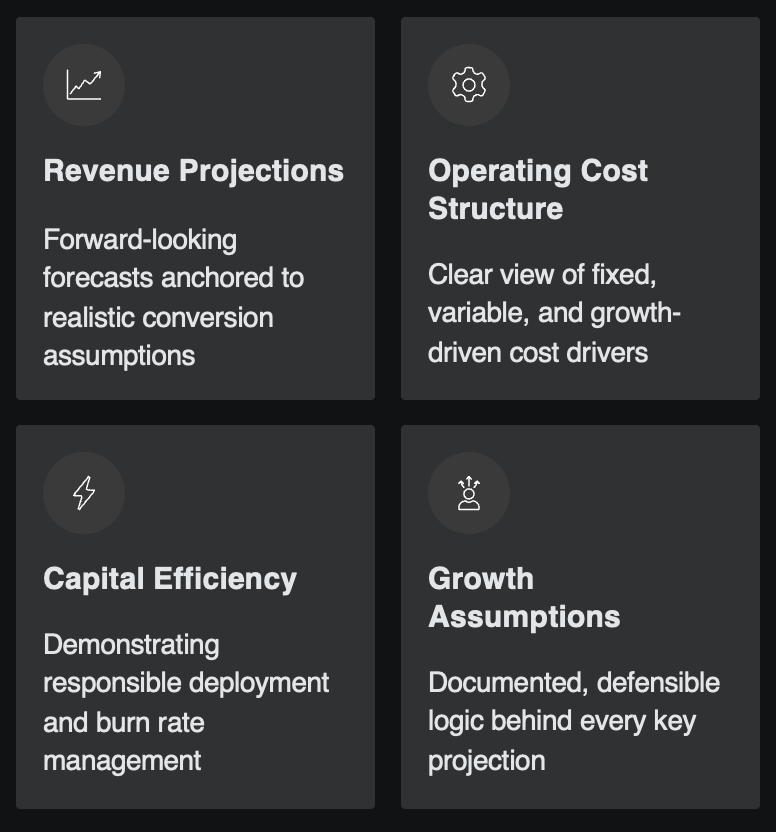
MoonshotNX provides financial modelling frameworks that prepare founders for investor due diligence, covering the four pillars that institutional investors assess during every review.
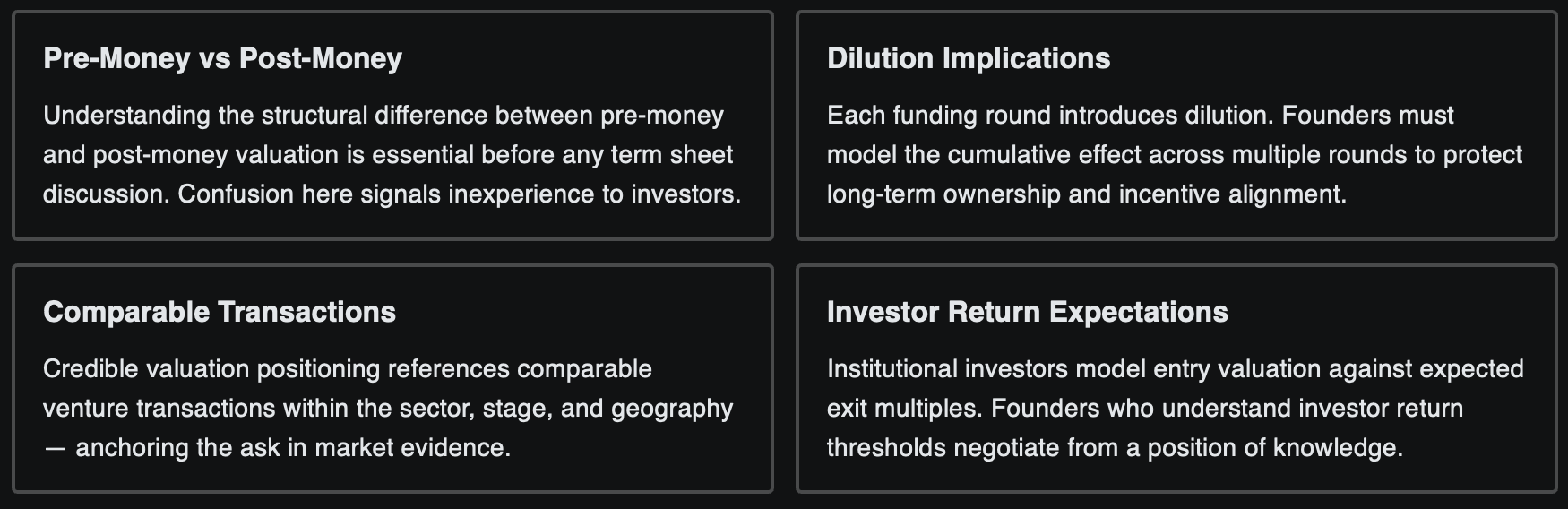
Valuation Positioning
Valuation is one of the most misunderstood and most dangerous elements of startup fundraising. Founders who enter investor conversations without a defensible valuation position routinely damage credibility, stall negotiations, or accept unfavourable terms without realising the long-term consequences.
MoonshotNX provides pitch deck frameworks and structured feedback systems specifically designed to align founder narratives with the way professional investors evaluate and score opportunities.
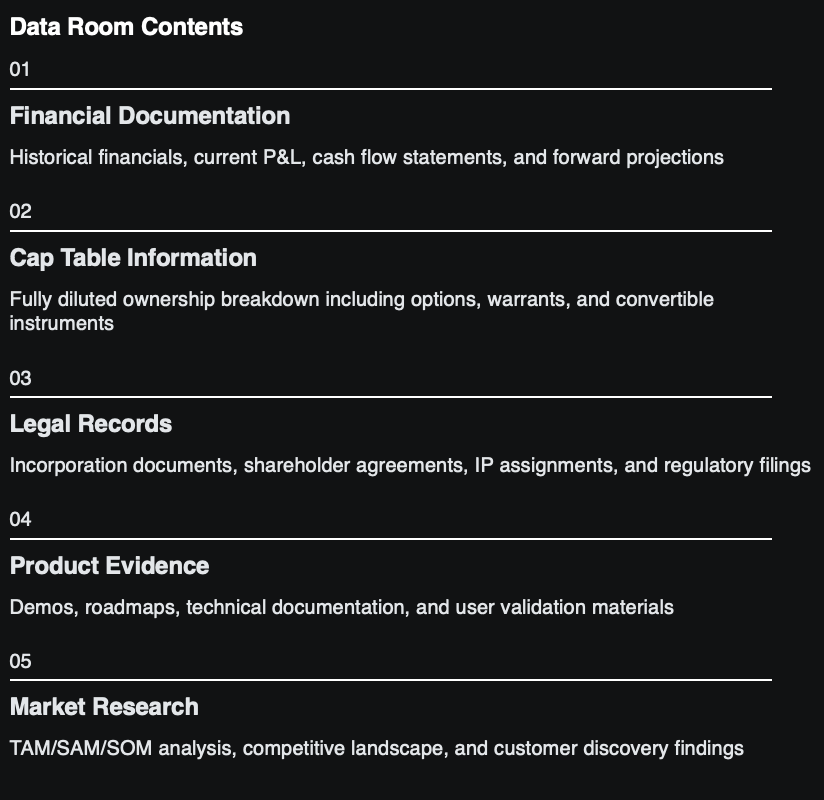
Investor Data Room Construction
Serious investors expect startups to maintain organised, accessible, and complete diligence materials from the moment interest is expressed. A disorganised data room is one of the fastest ways to signal operational immaturity to a professional investor.
MoonshotNX guides founders through building a structured investor data room that enables diligence to proceed efficiently without delays, missing documents, or back-and-forth friction.
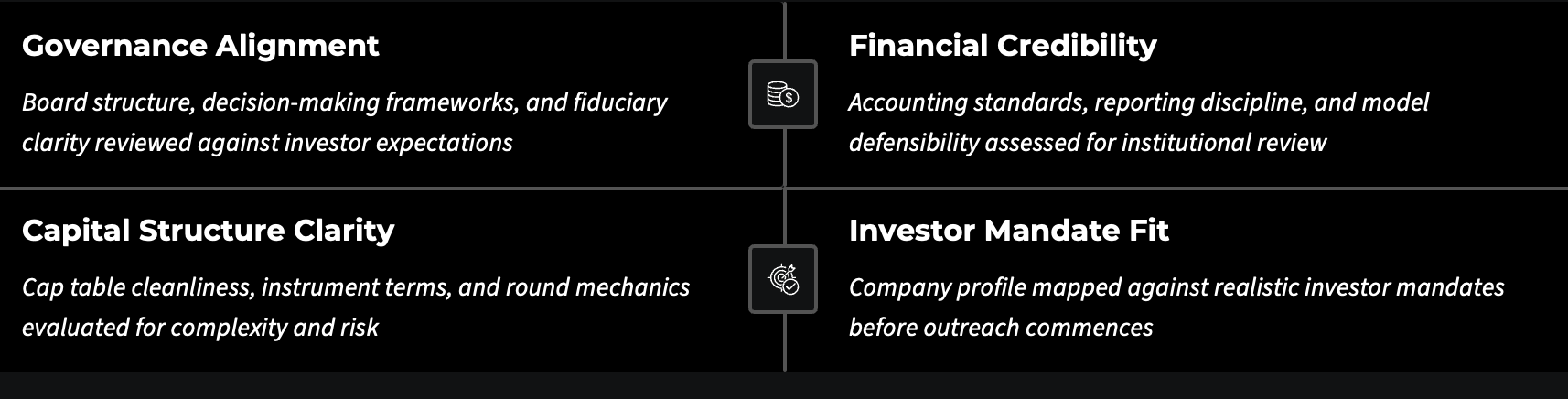
Capital Readiness Assessment
Before approaching investors, companies must be able to demonstrate readiness across four structural dimensions. Investor interest without structural readiness rarely converts to a completed round and often causes lasting reputational damage with the investors approached.
MoonshotNX applies structured capital readiness diagnostics to identify structural weaknesses before investor engagement begins, giving founders the opportunity to resolve issues on their timeline, not an investor's.
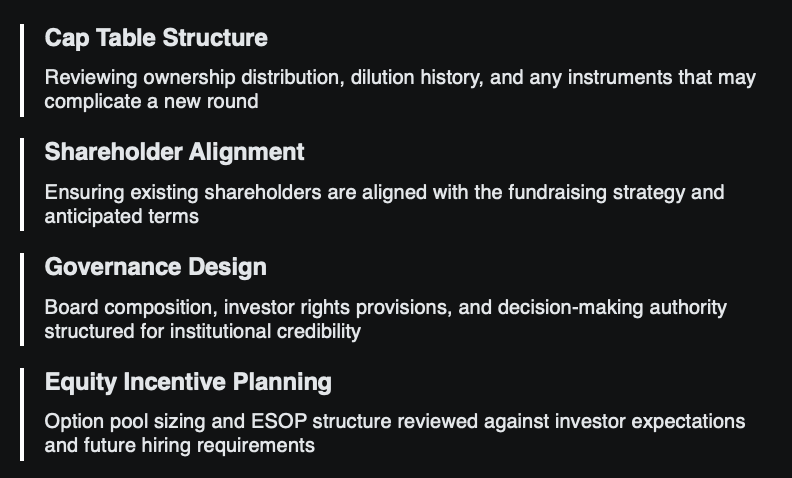
Governance and Capital Structure Review
Before institutional capital enters a company, investors conduct a thorough review of its structural integrity. Governance failures, messy cap tables, and misaligned shareholder agreements are among the most common reasons investment processes stall, often at the term sheet stage.
MoonshotNX helps founders proactively review and resolve structural issues, ensuring the company is genuinely ready to support institutional investment before any investor conversation begins in earnest.
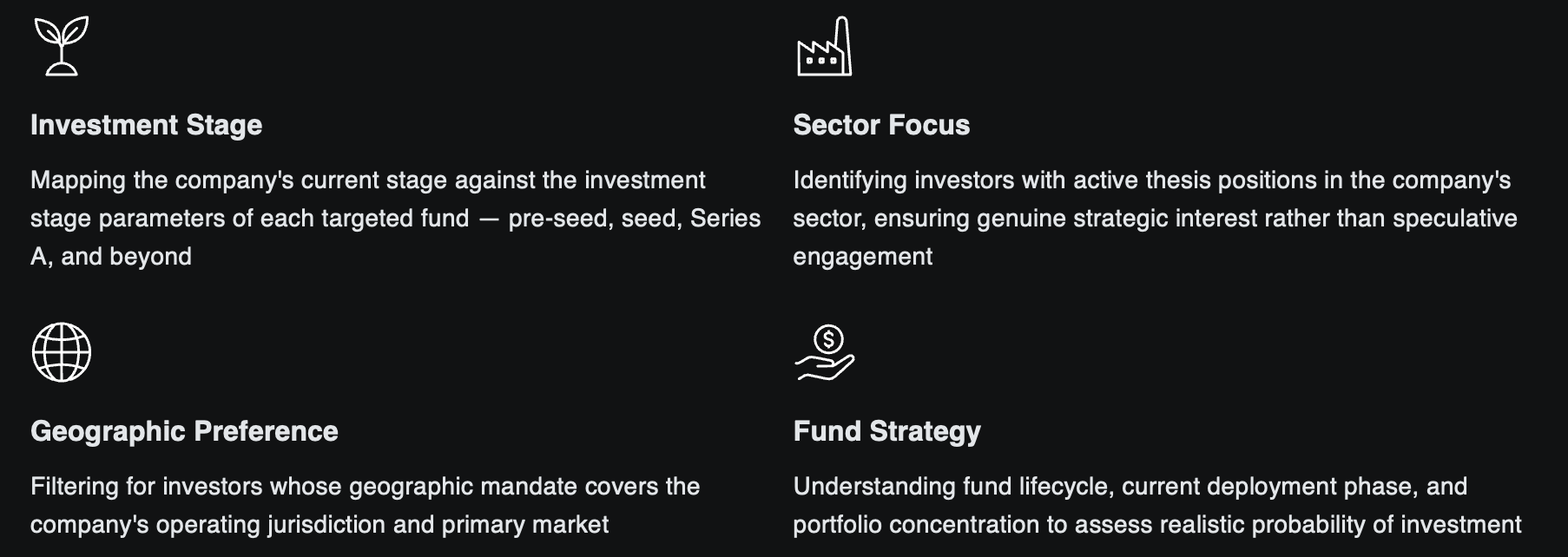
Investor Targeting and Mandate Alignment
Not every investor is suitable for every company and approaching the wrong investors is one of the most damaging mistakes a founder can make. Misaligned outreach wastes time, burns relationships, and signals to the market that the founder has not done their homework.
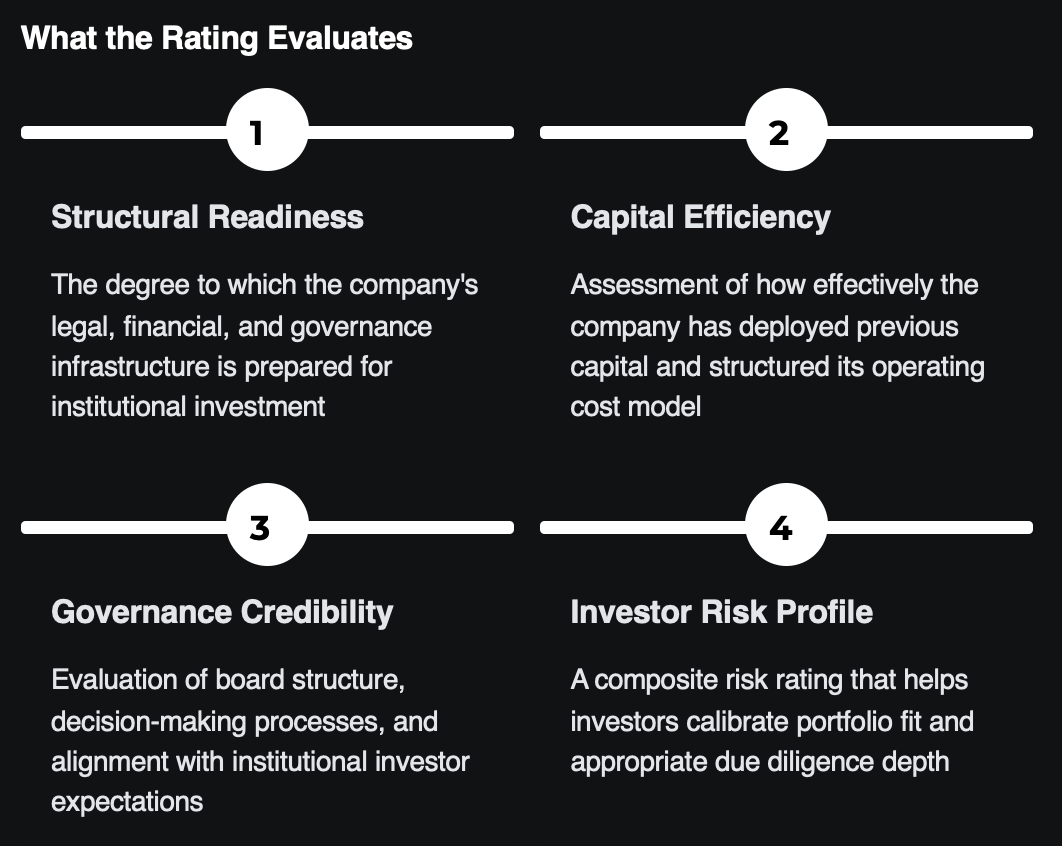
Independent Venture Rating
Qualified companies may apply for an independent venture rating through the MoonshotNX platform. These ratings provide investors with an objective, structured screening signal, reducing friction in the early stages of investor evaluation and increasing the credibility of the opportunity.
In a market saturated with unvetted deal flow, a credible independent rating is a meaningful differentiator.
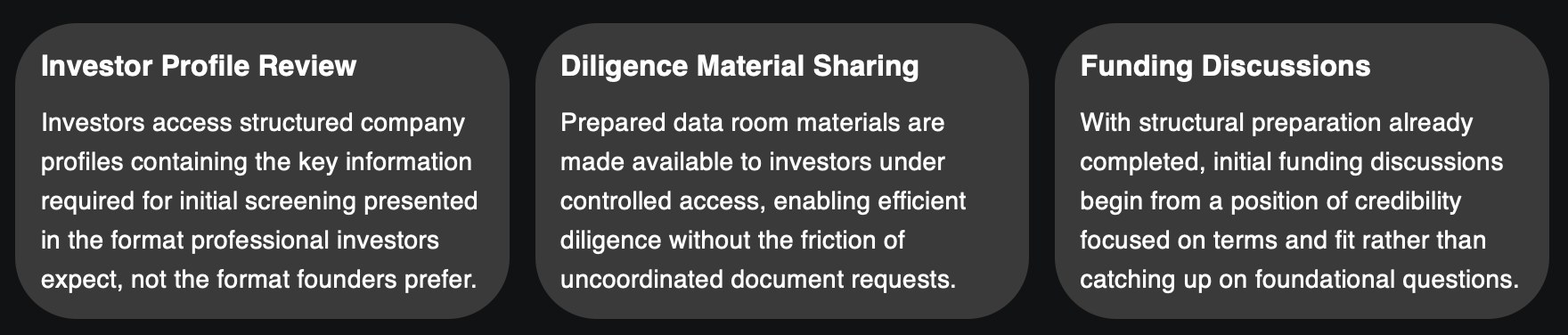
Investor Room Activation
Once a company has completed the foundational preparation steps, it may enter the MoonshotNX Investor Room the platform's active engagement environment where structurally prepared companies are matched with aligned investors. This is where preparation converts into active capital conversations.
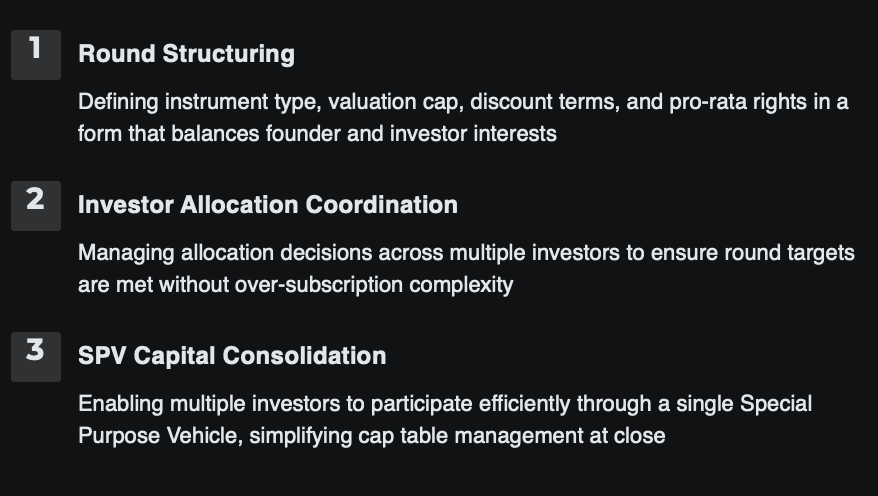
Investment Structuring
As investor interest develops and commitment signals strengthen, the funding round moves from engagement into execution. Investment structuring is the bridge between investor interest and legally binding capital commitment and it requires precision to protect all parties involved.
Poorly structured rounds create lasting problems: investor disputes, cap table complications, and governance conflicts that undermine the company long after the capital is deployed.
Funding Round Close
The final stage of the MoonshotNX Capital Stack is the completion of the investment round. This is not simply the transfer of funds it is the formal conclusion of a structured process that began with strategy and preparation, and ends with the company capitalised and ready to execute its next phase of growth.
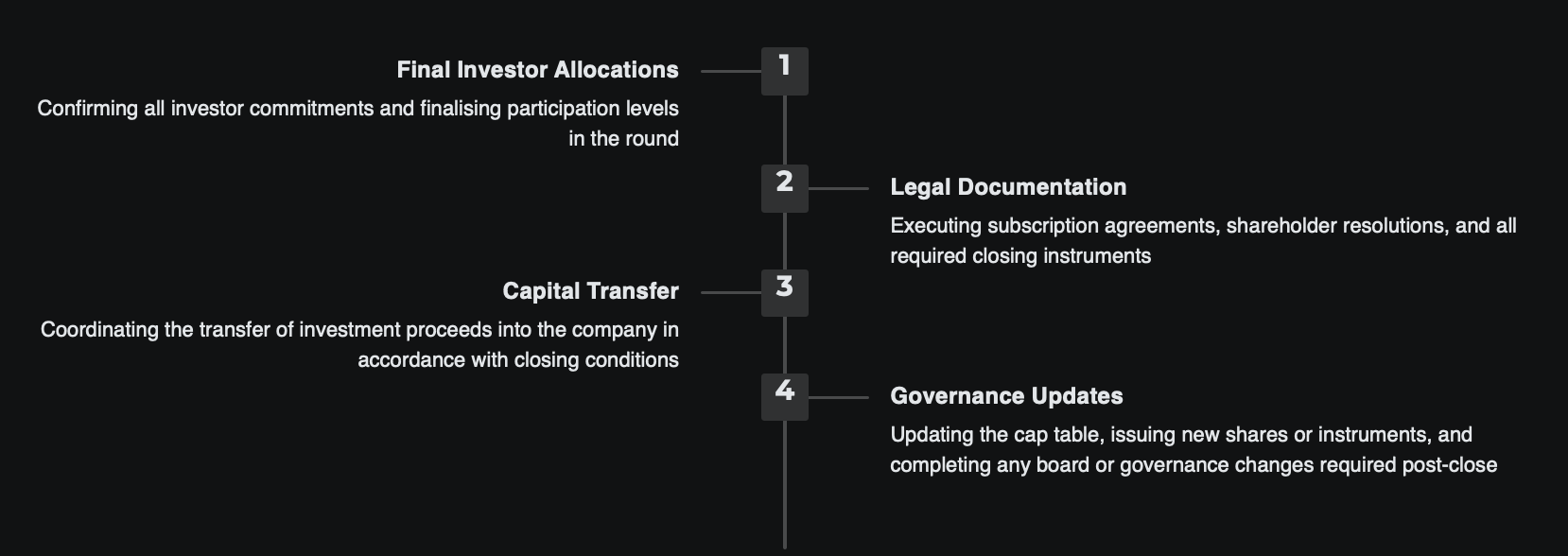
Once the round is closed, the company moves forward with the capital required to scale and the structural foundation required to raise the next round with even greater efficiency.
Venture Capital Preparation
Most fundraising failures are not visible until it is too late. By the time a founder identifies a problem, investors have already disengaged, conversations have stalled, and credibility has been lost before feedback is given.
These failures rarely sit in one place. They emerge across the structure of the company:
a financial model that cannot withstand scrutiny
a cap table that signals governance risk
a valuation that cannot be defended
an investor strategy that targets the wrong mandates
Within a venture capital platform, these issues are not discovered during investor conversations. They are identified and resolved before a company enters evaluation.
MoonshotNX operates as venture capital infrastructure that ensures companies are structurally prepared before investor review begins. By the time a company enters investor engagement, it is no longer presenting a pitch. It is being evaluated against institutional standards it already meets.
Why Startups Fail to Raise Venture Capital
Startups fail to raise venture capital when structural gaps remain unresolved before investor evaluation.
A venture capital platform maps each layer of preparation directly to how investors assess opportunities:
capital strategy → alignment with investment mandate
ownership structure → scalability across future funding rounds
valuation → defensibility under scrutiny
financial model → consistency and credibility
narrative → conversion to investment conviction
These are not theoretical concepts. They are the criteria used within venture capital infrastructure to evaluate and fund companies.
MoonshotNX functions as a capital stack platform that aligns these components into a single structured system before capital deployment.
Capital Intelligence and Platform Tools
A venture capital platform operates across both knowledge and execution layers.
MoonshotNX combines Capital Intelligence with platform tools to translate theory into structured readiness, evaluation, and execution. The knowledge layer explains how venture capital works, while the platform applies that knowledge to prepare companies for institutional investment.
Founders use the platform to test assumptions, model outcomes, and align their company with investor expectations before entering active evaluation.
Venture Capital Knowledge Framework
A venture capital platform is built on a defined set of underlying financial, structural, and evaluation concepts. These topics form the knowledge layer that supports how venture capital platforms operate in practice.
Each area below reflects a core component of the venture capital system, including how capital flows, how investors evaluate opportunities, how startups are structured, and how funding decisions are made. Together, they define the environment in which venture capital platforms function.
HUB 1:Startup Fundraising Explained : A structured breakdown of how venture capital actually works, what investors evaluate and how founders should approach raising capital.
HUB 2:Investor Readiness: A clear framework for understanding what “ready to raise” actually means and how investors assess companies before deploying capital.
HUB 3:Startup Valuation & Equity: Explains how startups are valued, how dilution works and how instruments like SAFEs and convertible notes impact ownership.
HUB 4:Cap Tables & Ownership: A detailed view of how ownership evolves over time and how funding rounds affect founder control and exit outcomes.
HUB 5:Startup Financial Planning: Covers runway, burn rate and capital strategy, helping founders understand how long they can operate and how much to raise.
HUB 6:Startup Financing Instruments & Capital Structures: A practical guide to SAFE notes, convertible notes, STACK Notes, KISS agreements, option pools and the ownership mechanics that shape startup capital structure over time.
Free Startup Tools for Founders | MoonshotNX Accelerate
MoonshotNX Accelerate provides a structured toolkit aligned to how venture capital platforms evaluate companies.
Founders can access financial modelling tools, valuation calculators, cap table simulations, investor readiness diagnostics, and pitch stress tests designed around institutional evaluation criteria.
These tools are not generic resources. They are built to reflect the real financial, structural, and diligence requirements that emerge within venture capital infrastructure.
Why Structured Fundraising Matters
Most startup fundraising efforts fail long before investors formally decline the opportunity. The rejection is simply the visible endpoint of a structural failure that began weeks or months earlier, buried in a financial model that couldn't withstand scrutiny, a cap table that raised red flags, or an investor outreach strategy that targeted the wrong funds entirely.
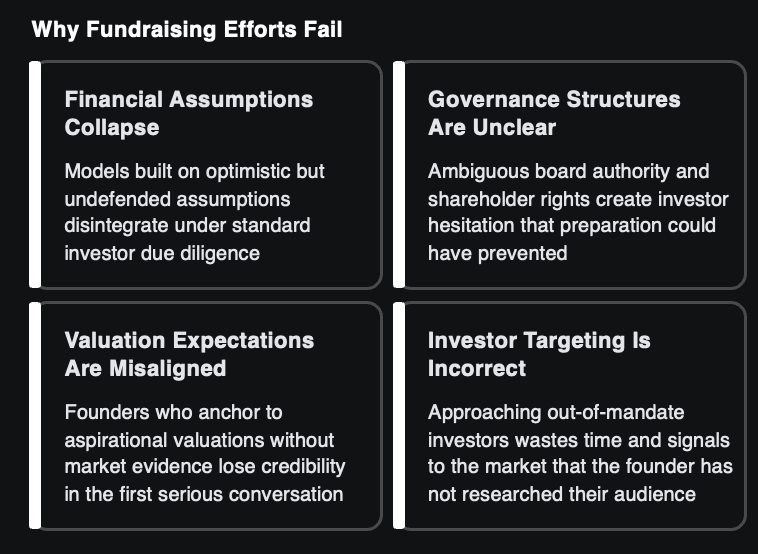
MoonshotNX exists to solve these structural problems before founders reach investors. The platform creates a systematic preparation process that addresses every failure point identified in unsuccessful fundraising attempts.
By the time a company activates investor engagement within the MoonshotNX platform, the opportunity has already been prepared to institutional standards, reviewed against the same criteria that professional investors apply during underwriting.
The MoonshotNX Difference
Investor Room — Managed Investor Relations Infrastructure
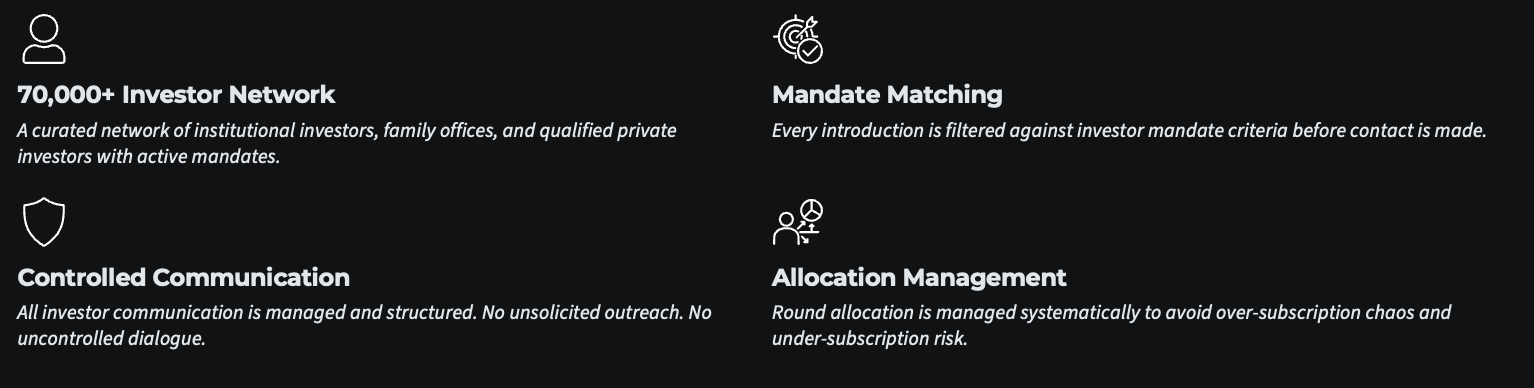
The Investor Room is a structured investor relations environment within the venture capital platform. It enables companies to engage with investors through a controlled, mandate-aligned process rather than unstructured outreach.
Within venture capital infrastructure, investor access is not based on volume or proximity. It is based on alignment. Investors are vetted, filtered by mandate, and matched to companies based on sector, stage, geography, and investment criteria.
Each introduction within the platform is structured, controlled, and aligned to investor requirements. Capital is deployed through defined processes, including SPV formation where required, ensuring consistency in execution and governance.
The global investor network is filtered before engagement begins. Investors participating in the platform have expressed interest in specific categories of opportunities, enabling efficient evaluation and reducing friction in the early stages of investor review.
Institutional Investor Access Infrastructure
MoonshotNX operates as venture capital infrastructure by managing investor access through structured evaluation, mandate alignment, and controlled engagement systems.
Direct Investor Room Entry
Some companies are already structurally prepared for institutional capital. Others are not.
The Capital Readiness Assessment determines:
whether a company meets institutional investment standards
whether structural gaps exist that will prevent conversion
whether investor engagement should begin immediately or be deferred
If readiness thresholds are met, the company may enter the Investor Room directly. If not, the platform identifies and resolves structural weaknesses before exposure to investors.
How Venture Capital Actually Closes
Within a venture capital platform, funding rounds do not fail because of lack of investor access. They fail because of structural gaps that emerge under scrutiny.
Delays are typically caused by:
missing or incomplete diligence materials
unclear or inconsistent financial logic
governance and ownership friction
misalignment between stakeholders
These issues surface during investor evaluation, not before.
The capital stack platform does not accelerate fundraising artificially. It removes the structural constraints that cause funding rounds to stall.
As a result, structured rounds close more efficiently, not because they are rushed, but because they withstand institutional scrutiny.
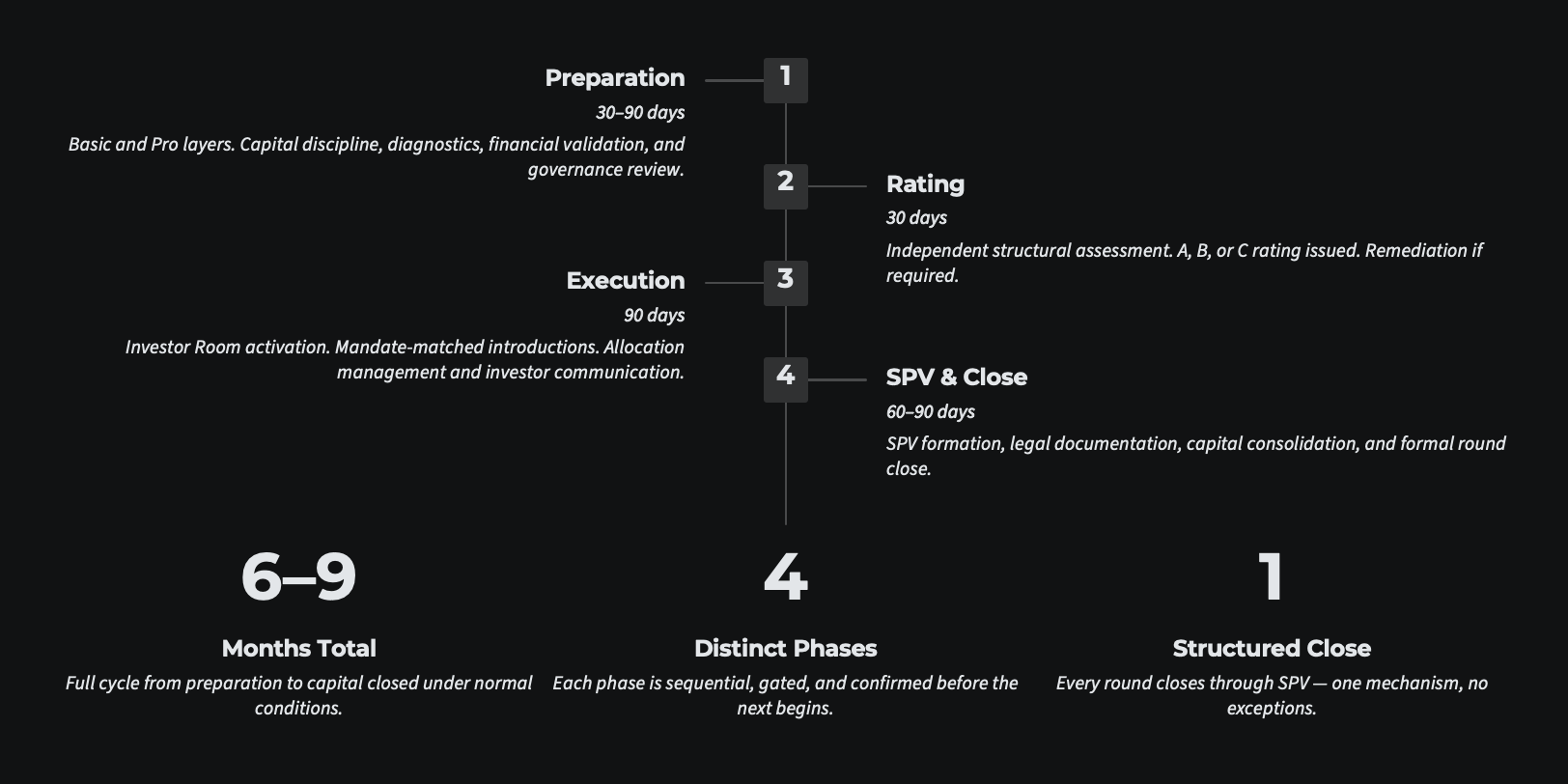
This is how venture capital actually closes. Founders who understand this before they begin are structurally better positioned than those who discover it mid-process.
M1 Capital Allocation Framework
Participation is limited to companies that meet the highest structural readiness standards and is reviewed independently by the investment committee.
M1 Fund — Lead Participation for Exceptional Companies
M1 participation is not a product and is not purchasable at any layer of the platform. It is determined based on investment merit, strategic fit, and fund mandate at the time of review.
An A rating enables eligibility for consideration. It does not create entitlement.
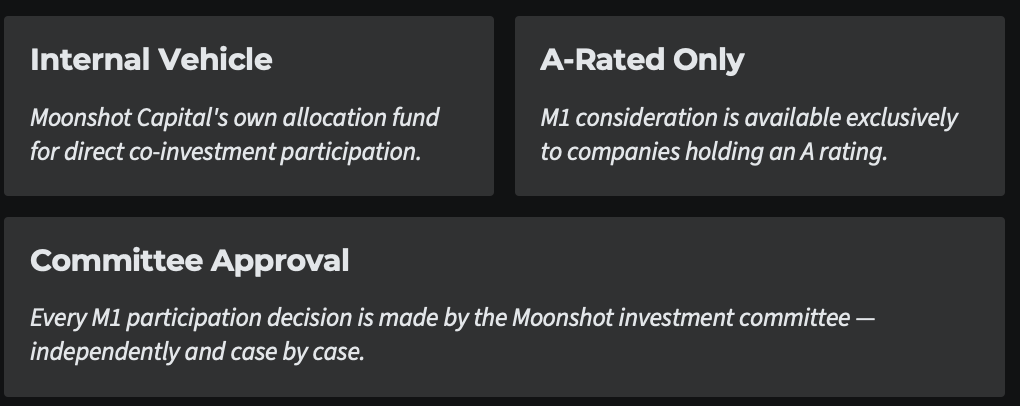
M1 participation is not a product. It is not purchasable at any layer of the Stack. It is not guaranteed by completion of any layer, including Pro or an A rating. It is a committee decision, made on the basis of investment merit, strategic fit, and fund mandate at the time of review. An A rating permits eligibility for M1 consideration. It does not create entitlement.
Infrastructure, Not Brokerage.
Moonshot charges for infrastructure. That distinction is the foundation of everything the Capital Stack represents. The fees paid at each layer purchase access to a system — to diagnostics, validation, structure, managed investor relations, and legal execution. They do not purchase outcomes. Access to investors is earned through structural readiness, not purchased through fee escalation.
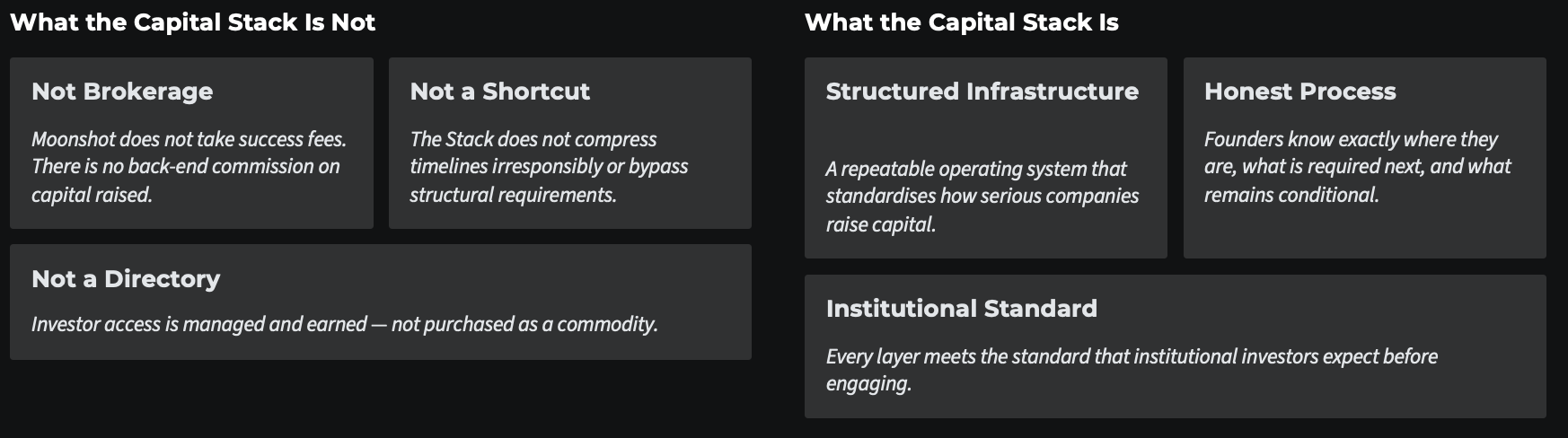
The Capital Stack exists because serious founders deserve a serious system. Not a service that promises introductions. A system that earns them.
Built for the Modern Venture Capital Market.
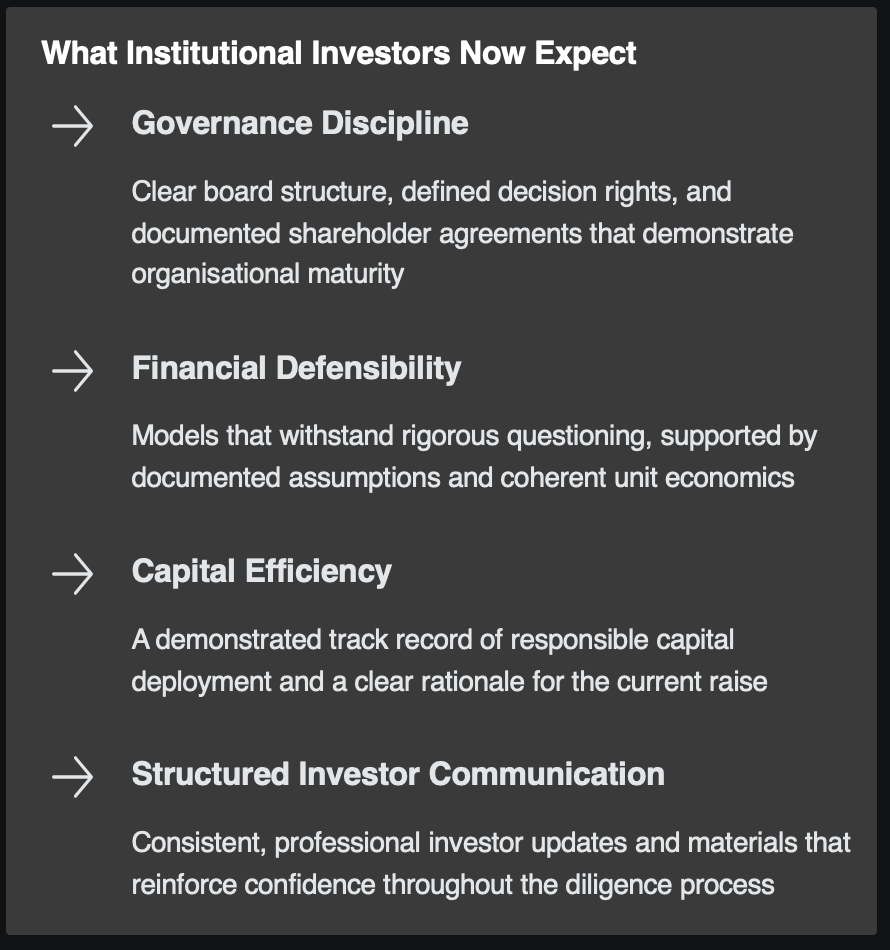
The venture capital market has changed. Institutional investors are more selective, diligence processes are more rigorous, and the cost of presenting an unprepared opportunity is higher than ever. Founders who approach investors without structural preparation are not just less likely to close, they are actively damaging their chances of raising from those investors in the future.
You do not need more investor conversations.
You need conversations that convert.
Frequently Asked Questions
What is venture capital infrastructure?
Venture capital infrastructure refers to the systems and frameworks used within a venture capital platform to prepare startups for institutional investment and enable investors to evaluate, structure, and fund companies efficiently.
How do startups prepare for venture capital funding?
Within a venture capital platform, startups prepare by achieving investor readiness across financial projections, valuation logic, governance, legal structure, and investor documentation before entering formal investor evaluation.
What is investor readiness in venture capital?
Investor readiness is the structural condition where a startup meets institutional investor expectations across financials, governance, valuation, and capital strategy within venture capital infrastructure.
How do venture capital rounds actually close?
Venture capital rounds close through a structured process within a capital stack platform, including preparation, investor alignment, term sheet negotiation, legal documentation, SPV formation where required, and final capital transfer.
What is a startup investment readiness rating?
A readiness rating is an independent assessment used within a venture capital platform to evaluate whether a startup meets institutional investment standards across financial discipline, governance, capital efficiency, and execution risk.
Why do venture capital investors require due diligence?
Within venture capital infrastructure, investors perform due diligence to evaluate risk, validate financials, assess governance, and confirm the viability of an investment before deploying capital.
What is an SPV in venture capital?
An SPV is a legal entity used within venture capital platforms to pool capital from multiple investors into a single structured investment, simplifying ownership and governance.
How do startups connect with venture capital investors?
Within a venture capital platform, startups connect with investors through structured investor relations systems based on mandate alignment, readiness, and controlled engagement processes rather than open directories.
How long does it take to raise venture capital?
Within venture capital infrastructure, raising capital typically takes six to nine months, including preparation, evaluation, due diligence, legal structuring, and final round close.
Is MoonshotNX an accelerator?
No. MoonshotNX is not an accelerator. It is a venture capital platform and capital stack platform designed to structure how companies prepare for and execute institutional funding rounds.
Does MoonshotNX provide investor introductions?
Yes, but introductions occur within a structured venture capital platform. Access is conditional on readiness and investor mandate alignment, ensuring efficient and relevant engagement.
What is the Platform Stack?
The Platform Stack is a capital stack platform that standardises venture capital preparation, readiness validation, investor targeting, evaluation, deal structuring, and funding round execution within venture capital infrastructure.