

Startup Financing Options: Debt, Non-Dilutive Funding and Capital Strategy
Startup financing options extend far beyond venture capital.
While equity funding remains one of the most common ways startups raise capital, founders can also access venture debt, non-dilutive funding, working capital facilities, revenue-based financing, asset-backed lending, invoice finance, grants, and other structured funding solutions.
Understanding startup financing options is important because the type of capital a company chooses affects dilution, ownership, runway, valuation, risk, and long-term growth potential.
Many founders focus exclusively on raising equity. However, the most effective capital strategies often combine multiple funding sources. Debt can reduce dilution. Non-dilutive funding can extend runway. Working capital facilities can support growth without requiring a new equity round. Structured financing can help companies access capital that aligns more closely with their operating model and stage of development.
This guide explains:
• startup financing options available to founders
• debt financing for startups
• non-dilutive funding and alternative capital
• venture debt and structured credit facilities
• working capital and growth financing
• how startup capital strategy affects dilution and ownership
• how founders can combine different funding sources effectively
The objective is not simply to raise capital. The objective is to choose the right type of capital at the right time. Companies that understand capital strategy are often able to grow faster, preserve ownership, reduce dilution, and create more flexibility throughout the fundraising process. See Startup Fundraising Explained.
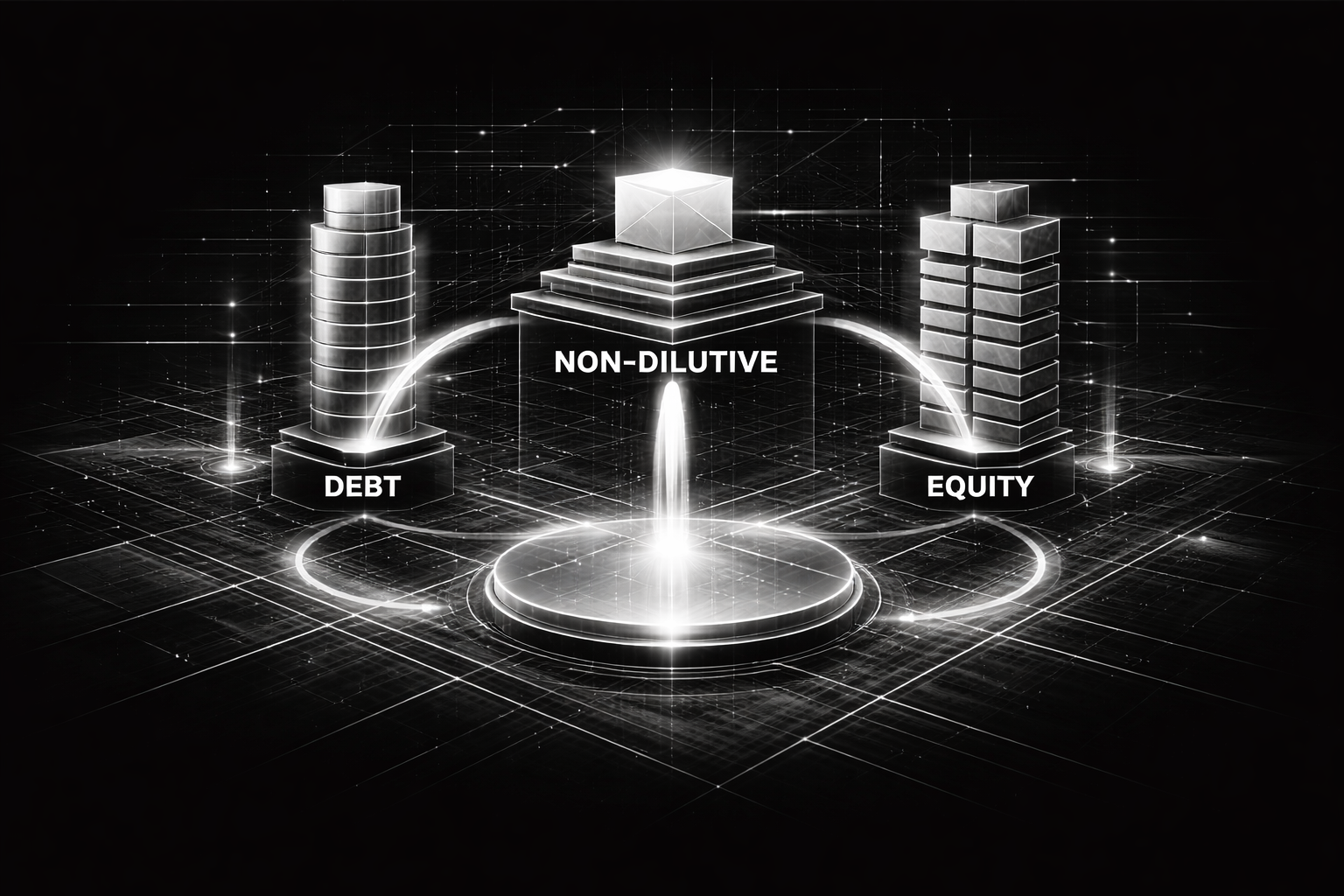
Most founders default to equity because alternative capital is less visible.
In reality, startup financing is a system of options that can be combined, structured, and sequenced based on the needs of the business.
This page explains the full range of startup financing options and how they work in practice.
Types of Startup Financing Options
Startups can access multiple forms of capital depending on their stage, traction, and financial profile.
The most common startup financing options include:
– equity funding (venture capital and angel investment)
– venture debt and structured lending
– non-dilutive funding and working capital
– asset-based lending and invoice finance
– secured and unsecured business loans
Each option has different implications for:
– ownership and dilution
– repayment and risk
– growth timing and capital efficiency
Understanding these differences is critical when building a capital strategy.
Regulated capital delivery within MoonshotNX
MoonshotNX provides structured capital solutions through its FCA authorised and regulated finance brokerage capability and its structured finance advisory division.
This means MoonshotNX does not simply connect founders to funding. It originates, structures, and negotiates financing solutions directly through the platform.
MoonshotNX provides access to over 450+ lenders across the UK, US, and EU and structures facilities across venture debt, private credit, asset-based lending, working capital, and broader commercial finance.
All facilities are tailored to the business and aligned to:
– revenue profile
– growth trajectory
– capital requirements
– existing ownership and debt structure
Founders do not leave the MoonshotNX system to access this capability. It forms part of the capital infrastructure built directly into the platform.
What is structured capital?
Structured capital refers to a range of financing solutions that sit alongside equity and are tailored to the specific needs of a business.
This includes:
– venture debt
– working capital facilities
– asset-based lending
– invoice and trade finance
– secured and unsecured business loans
– private credit and structured financing
These are not standardised products.
Each facility is structured based on the company’s financial position, growth trajectory, and capital requirements, using a network of lenders and financing partners. Visit our Venture Debt page and learn how this financing option works.
Structured capital is not a single instrument. It is a system.
How structured capital works in practice
Structured capital is built around the company, not applied to it.
A typical process includes:
– assessing financial position and growth profile
– identifying capital requirements
– structuring a facility across one or more lenders
– negotiating terms based on risk and performance
– aligning repayment with business operations
Unlike equity, where valuation determines ownership, structured capital is defined through:
– loan size
– repayment structure
– interest profile
– collateral or security
– optional equity participation
The result is a financing structure that adapts to the business rather than forcing the business into a predefined model.
Types of structured capital available
Structured capital includes multiple financing categories, each designed for different use cases.
Venture debt
Used by growth-stage companies to extend runway and delay dilution. Typically structured alongside equity funding.
Working capital
Provides short-term liquidity to support operations, inventory, or expansion.
Asset-based lending
Uses company assets such as equipment, receivables, or property as collateral to unlock capital.
Invoice finance
Allows businesses to access cash tied up in unpaid invoices, improving cash flow.
Trade finance
Funds supplier payments and inventory purchases using purchase orders or stock as security.
Secured loans
Capital provided against assets such as property or equipment.
Unsecured loans
Funding based on business performance, turnover, and credit profile without collateral.
Each of these instruments operates differently, but all form part of the same capital structure.
A unified capital products layer
MoonshotNX combines regulated finance brokerage, structured debt advisory, and multi-lender capital execution into a single capital products layer.
This allows MoonshotNX to provide:
– venture debt
– private credit
– asset-based lending
– working capital
– invoice and trade finance
– secured and unsecured commercial loans
within one system.
The result is not a referral model. It is a direct MoonshotNX capability that structures and delivers financing solutions based on the company’s needs.
Founders do not need to navigate products, lenders, or funding structures independently. MoonshotNX handles the structuring, lender negotiation, and execution as part of the broader capital process.
How much capital can startups access?
MoonshotNX provides structured financing solutions ranging from approximately $5,000 through to multi-million-dollar facilities, depending on the company’s financial profile and capital requirements.
Examples of facilities structured through this capability include:
– $3.25 million venture debt for a healthcare SaaS business bridging to Series B
– $12.4 million asset-based lending facility supporting a management buyout in logistics
– $1.35 million hire purchase refinance facility for a long-established logistics company
– facilities from $68,000 to $700,000 across asset finance, property finance, invoice finance, trade finance, secured loans, and unsecured business loans
Capital is structured according to:
– company stage
– revenue and turnover
– lender criteria
– use case
– security profile
– growth and repayment capacity
Who qualifies for structured capital?
Structured capital is typically suited to companies that have moved beyond the earliest stage.
Common characteristics include:
– revenue visibility or strong traction
– growth-stage or scaling operations
– existing equity backing or investor support
– structured financial data and reporting
In more advanced cases:
– companies with $5M+ turnover
– sponsor-backed or event-driven businesses
– companies undergoing acquisition, expansion, or restructuring
Qualification is not based on idea quality. It is based on financial structure and execution capability.
Structured capital vs equity
Equity and structured capital operate differently.
Equity:
– exchanges ownership for capital
– does not require repayment
– aligns with long-term upside
– dilutes founders
Structured capital:
– provides capital without immediate ownership change
– introduces repayment obligations
– is tied to performance and risk
– may include limited equity participation
Most companies do not choose one.
They combine both.
How structured capital affects ownership
Structured capital does not always dilute ownership immediately, but it still affects outcomes.
It changes:
– when equity is raised
– how much equity is required
– negotiation leverage in funding rounds
– exit distributions
In some cases, structured capital includes:
– warrants
– convertible elements
– equity-linked participation
This means ownership is influenced indirectly through structure rather than directly through issuance.
Structured capital and capital strategy
Capital strategy is not about raising money.
It is about sequencing capital correctly.
Structured capital introduces additional variables:
– timing of debt vs equity
– repayment obligations vs growth expectations
– dilution vs leverage trade-offs
A founder is not choosing a product.
They are building a capital system.
The role of lender networks
Structured capital is enabled through access.
A single lender cannot provide all solutions.
A network of lenders allows:
– access to multiple financing products
– competitive term negotiation
– tailored structuring
– faster approvals through established relationships
Access to over 250+ lenders across the US, UK, and EU enables capital to be matched to the business rather than forcing the business to fit a lender.
How MoonshotNX integrates structured capital
MoonshotNX integrates structured capital directly into the platform.
This is not a referral process.
It is embedded within the system used by founders to:
– prepare for funding
– structure their capital
– evaluate equity and non-dilutive options
– manage ownership outcomes
Structured capital sits alongside:
– venture capital
– valuation modelling
– capital readiness
– investor engagement
Founders do not evaluate these in isolation.
They evaluate them together.
Structured capital is not an alternative
The most important shift is conceptual.
Structured capital is not an alternative to equity.
It is a layer within the capital system.
It expands the range of decisions available to founders and changes how those decisions interact over time.
Understanding it requires moving beyond individual funding events and into the structure of capital itself.
Where structured capital fits in the startup funding system
Startup financing options do not exist in isolation.
Equity, venture debt, working capital, and structured lending all sit inside a broader capital system that determines how companies fund growth, manage dilution, and control ownership over time.
Understanding this requires looking beyond individual funding types and into how they interact.
To understand how equity funding works alongside structured capital, read Startup Fundraising Explained: How Capital Actually Works.
To see how investors evaluate companies before capital is deployed, read Investor Readiness: What It Means and How Founders Get There.
To understand how pricing translates into ownership and dilution, see Startup Valuation, Equity and Dilution Explained.
To model how ownership evolves over time, explore Cap Tables, Ownership and Exit Outcomes and use the Cap Table Outcome Calculator.
To understand how capital timing affects survival and growth, read Startup Financial Planning: Runway, Burn and Capital Strategy and use the Startup Runway Calculator.
To see how financing instruments behave and convert into ownership, read Startup Financing Instruments & Capital Structures Explained.
Structured capital expands this system. It introduces additional layers that affect how funding decisions are made, how capital is deployed, and how outcomes are ultimately distributed.
External capital frameworks and market standards
Structured capital sits within a broader financial ecosystem that includes venture capital, private credit, and commercial lending markets.
For additional context on how these markets operate:
– British Business Bank outlines how growth-stage companies access debt and alternative finance
– Federal Reserve provides guidance on business lending structures and credit markets
– International Finance Corporation publishes frameworks on private sector financing and capital access
– PitchBook tracks venture debt and private credit trends across global markets
These frameworks reinforce the role of structured capital as a core component of modern startup financing.
MoonshotNX brings these capital layers into a single system, allowing founders to evaluate, structure, and deploy capital across both equity and non-dilutive funding. Please visit the Venture Debt page for more information.
How MoonshotNX Supports Startup Fundraising Preparation
MoonshotNX helps founders prepare for fundraising through investor readiness, startup fundraising support, capital raising advisory, due diligence preparation and investor communications.
MoonshotNX operates as a human-centric Investor Relations as a Service company helping startup founders become investor-ready and navigate the path to capital.
Also in this hub:
Investor readiness is more than a pitch deck. These resources explain how investors evaluate opportunities and what founders should prepare before fundraising.
Related Startup Fundraising Guides
HUB 1: Startup Fundraising Explained – How Capital Actually Works
HUB 3: Startup Valuation, Equity And Dilution Explained
HUB 4: Cap Tables, Ownership And Exit Outcomes
HUB 5: Startup Financial Planning, Runway, Burn And Capital Strategy
HUB 6: Startup Financing Instruments And Capital Structures Explained
These resources are designed to be read together and provide a structured understanding of startup fundraising, investor readiness, capital formation, valuation, ownership and financing decisions.
FAQs
What funding options does MoonshotNX provide?
MoonshotNX provides structured capital solutions across venture debt, private credit, asset-based lending, working capital, invoice finance, trade finance, secured loans, unsecured loans, and broader commercial finance.
These products sit alongside the MoonshotNX equity and capital readiness system and allow founders to structure both dilutive and non-dilutive capital within one platform.
Is MoonshotNX a lender?
MoonshotNX provides this capability through its own regulated finance brokerage and structured capital infrastructure.
MoonshotNX originates, structures, negotiates, and executes facilities directly within the platform using its lender panel and capital network. The founder experience remains fully inside MoonshotNX.
Is MoonshotNX regulated for this activity?
Yes. MoonshotNX provides structured capital through an FCA authorised and regulated finance brokerage capability.
This allows financing to be structured, negotiated, and delivered within a regulated framework rather than as an informal referral process.
How much funding can founders access through MoonshotNX?
MoonshotNX can structure facilities starting from approximately $5,000 and extending into the multi-million-dollar range, depending on the company’s profile and funding need.
Examples include venture debt, asset-backed lending, refinance structures, working capital, and secured or unsecured commercial facilities.
What is venture debt within MoonshotNX?
Venture debt is one of the structured capital products available through MoonshotNX. It is typically used by growth-stage companies that have raised equity or have strong revenue visibility and want to extend runway or reduce dilution.
It provides capital without immediate full equity dilution, but introduces repayment obligations and, in some cases, warrants or limited equity participation.
What is private credit within MoonshotNX?
Private credit refers to structured debt capital arranged outside traditional bank channels. Within MoonshotNX, this can be used for companies requiring tailored debt solutions where standard lending products are not sufficient or where a more flexible capital structure is required.
What is asset-based lending?
Asset-based lending is financing secured against business assets such as receivables, equipment, fleets, stock, or property.
Within MoonshotNX, asset-based lending is used where companies have asset strength that can support financing more efficiently than equity alone.
What is working capital funding?
Working capital funding is structured financing used to support day-to-day business operations, supplier payments, inventory, growth periods, or temporary liquidity pressure.
Within MoonshotNX, it forms part of the broader non-dilutive capital layer and can be structured through trade finance, invoice finance, secured business lending, or related facilities.
What is invoice finance?
Invoice finance allows a business to unlock capital tied up in unpaid invoices. Instead of waiting for customers to pay on long terms, the business receives earlier access to that cash.
MoonshotNX provides invoice finance as part of its structured capital capability for companies with strong receivables and cash flow timing pressure.
What is trade finance?
Trade finance allows supplier or stock payments to be funded using confirmed purchase orders or stock as collateral.
Within MoonshotNX, trade finance is relevant for companies under growth pressure that need to fund inventory or supplier commitments without using equity.
What are secured and unsecured business loans?
Secured business loans use assets such as property or equipment as collateral for borrowing. Unsecured loans rely on turnover, creditworthiness, and trading history rather than pledged assets.
MoonshotNX provides both as part of its structured capital layer depending on the company’s financial profile and use case.
Who qualifies for structured capital through MoonshotNX?
Qualification depends on the type of facility being sought.
In general, MoonshotNX structured capital is most relevant for:
– revenue-generating companies
– fast-growing businesses
– sponsor-backed or event-driven businesses
– companies with structured financials and clear use of funds
– companies in the UK, US, or EU for the larger structured deals referenced in the materials
For larger structured debt and venture debt use cases, higher turnover and stronger financial visibility are typically expected.
How does MoonshotNX structure the right product?
MoonshotNX assesses the business need and then structures capital accordingly.
That may include:
– matching the company to the correct facility type
– selecting the right lenders from the panel
– modelling financial requirements
– negotiating terms
– structuring the capital package around business goals
The process is based on the company’s needs rather than pushing a standard product.
Does MoonshotNX only provide venture debt?
No. Venture debt is one part of the structured capital layer, but the overall MoonshotNX offering is broader.
MoonshotNX provides access to multiple forms of debt and non-dilutive finance so founders can structure the right capital mix for their company.
How does MoonshotNX compare equity and debt for founders?
MoonshotNX allows founders to evaluate equity and non-dilutive options inside the same capital system.
That means founders can assess:
– dilution vs repayment
– runway extension
– ownership outcomes
– timing of funding
– capital efficiency
instead of treating each financing decision as isolated.
Does structured capital affect ownership?
Yes, even where immediate dilution does not occur.
Debt and structured finance affect ownership indirectly by changing:
– when equity is raised
– how much equity must be issued later
– negotiation leverage
– exit outcomes
– overall capital structure
Some facilities may also include warrants or other equity-linked components.
Why does MoonshotNX emphasise capital structuring instead of fundraising?
Because founders are not only choosing how to get money into the business.
They are choosing how risk, dilution, ownership, obligations, and timing will be structured across the life of the company.
MoonshotNX therefore treats capital as a system, not as a one-off funding event.
Why is access to 450+ lenders important?
Because a single lender cannot support every business need or every capital profile.
MoonshotNX’s access to over 450 lenders across the UK, US, and EU allows capital to be structured more precisely around the company rather than forcing the company into one lender’s product set.
What does MoonshotNX actually do in the transaction?
MoonshotNX handles the structuring process.
That includes:
– evaluating the founder’s position
– identifying the correct financing structure
– negotiating with lenders
– handling the capital process through the platform
– supporting the founder through to facility outcome
MoonshotNX is not simply presenting a list of lenders. It is structuring and delivering the financing outcome.
Why does this matter for founders?
Because founders who only understand equity often make capital decisions inside too narrow a frame.
MoonshotNX expands that frame and allows founders to evaluate capital across venture debt, private credit, working capital, lending, and equity in one system.
That produces better decisions around:
– dilution
– runway
– ownership
– capital efficiency
– long-term funding strategy