

THE CAPITAL STACK PLATFORM™
How to Find Startup Investors (Real Sources, Databases and Strategies in 2026)
How do startups find investors?
Startups find investors through a combination of:
– Venture capital firms
– Angel investor networks
– Investor databases and platforms
– Warm introductions and founder networks
– Direct outreach via LinkedIn and email
Most founders underestimate how structured this process is. Investors are not randomly discovered. They are targeted based on stage, sector, and investment thesis. This guide shows exactly where to find investors and how to approach them effectively.
If you are actively raising capital, start with investor databases and targeted outreach. These are the fastest ways to identify and contact relevant investors. Finding investors is only one part of the process; see Startup Fundraising Explained to understand how targeting connects to actual capital outcomes.
Where to find startup investors:
– Venture capital firms (stage-specific funds)
– Angel investors and syndicates
– Investor databases (online platforms)
– Startup accelerators and incubators
– Founder and operator networks
– LinkedIn investor outreach
Every founder eventually reaches the moment where growth requires capital. Product development may be underway, early customers may appear, and the company may begin demonstrating traction. At that point the central strategic question emerges: how do startups find investors.
This is how investors are actually sourced in real fundraising processes, not how it is commonly described in simplified startup advice.
A typical venture capital fundraising process involves 30 to 80 investor meetings before a round closes.
Venture capital investors deployed more than $285 billion globally in 2024, according to PitchBook and Crunchbase data. More than one thousand venture capital firms operate in the United States alone, alongside thousands of angel investors and hundreds of specialised seed funds. and many more investors participate in this capital ecosystem across North America, Europe, and Asia. Venture capital investors fund thousands of startups globally across industries ranging from artificial intelligence and enterprise software to fintech, climate technology, and biotechnology. Despite the availability of capital, many founders frequently underestimate how many investor conversations are required. A typical venture capital fundraising process involves 30 to 80 investor meetings before a round closes.
The difficulty rarely arises from a lack of investors. Thousands of venture capital firms, angel investors, family offices, and corporate venture funds operate globally. The United States alone hosts the majority of the world’s venture capital investors, with venture capital firms concentrated in major startup ecosystems including Silicon Valley, New York, Boston, Austin, and Los Angeles.
The challenge lies in understanding how venture capital investors actually operate.
Most founders approach fundraising as an outreach exercise. They build a pitch deck, search online for investor emails, and begin sending messages to venture capital firms. This approach produces limited results because venture capital investment does not operate as a cold-outreach marketplace.
Venture capital investors operate within networks. Investment opportunities circulate through relationships between founders, operators, angel investors, venture capital partners, accelerators, and portfolio companies. Venture capital firms often review thousands of companies every year while funding only a small fraction of those opportunities.
Learning how to find startup investors therefore requires understanding several layers of the venture ecosystem:
• the different categories of startup investors
• the networks through which venture capital firms discover companies
• the platforms founders use to research investors
• the environments where investors and founders meet
Founders who understand these dynamics approach fundraising strategically. They identify investors aligned with their company’s stage, sector, and geography before initiating outreach. They build investor lists based on investment mandates rather than randomly contacting venture capital firms.
This article explains how founders actually discover startup investors and how venture capital firms operate within the startup ecosystem. It covers the investor landscape, the platforms founders use to research investors, the networks that drive venture deal flow, and the structural realities of how venture capital firms source new investments. Understanding these systems changes how founders approach fundraising. Instead of searching blindly for startup investors, founders begin to navigate the venture capital ecosystem intentionally.
Global Venture Capital Market
The global venture capital ecosystem has grown into one of the most influential capital markets supporting innovation and technology development. Venture capital investors fund companies building software platforms, artificial intelligence technologies, healthcare systems, climate infrastructure, financial services platforms, and many other high growth sectors.
According to data compiled from venture capital intelligence platforms including PitchBook, Crunchbase, and Dealroom, venture capital investors deploy hundreds of billions of dollars into startups each year.
Recent global venture capital activity illustrates the scale of this market.
Global Venture Capital Market Overview
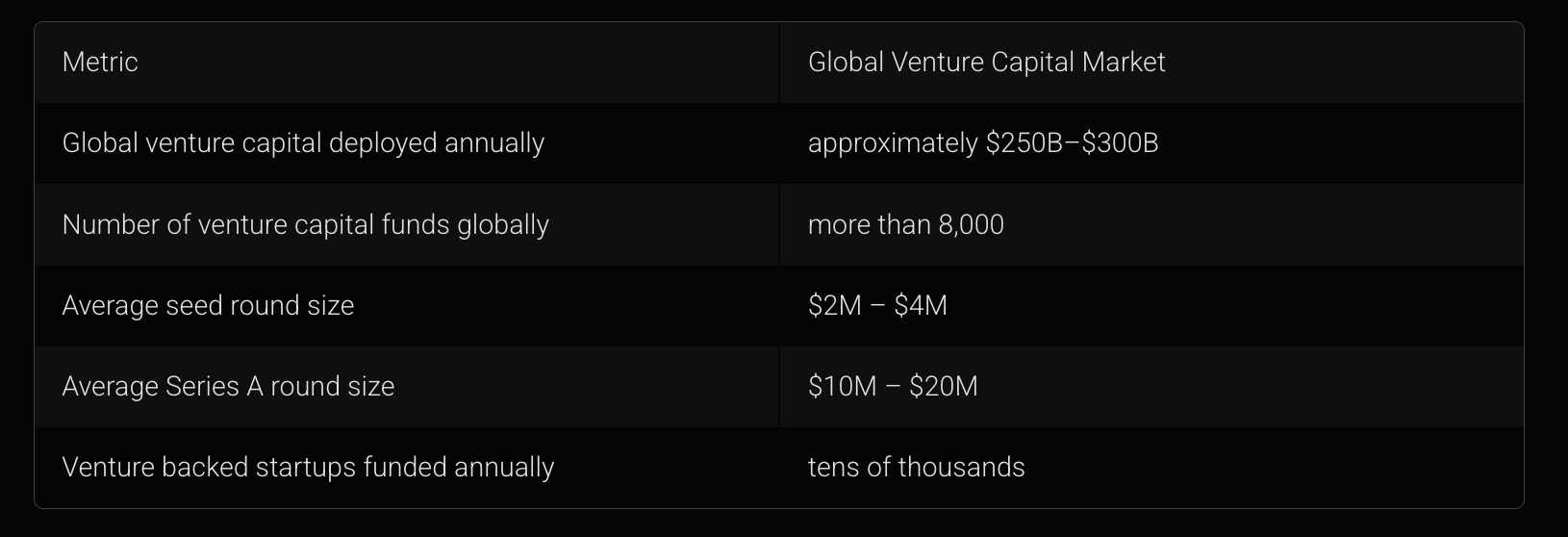
The table below summarises the scale of the global venture capital market and typical funding ranges founders encounter across seed and Series A rounds.
The Startup Investor Landscape
Startup investors participate at different stages of a company’s growth. Early-stage companies often begin with angel investors or angel networks before raising seed capital from specialised seed funds. As companies grow and demonstrate stronger traction, venture capital firms and later-stage growth investors typically participate in larger financing rounds. The investor categories below illustrate the typical stages at which different types of startup investors deploy capital and the typical investment ranges founders encounter during the venture capital lifecycle.
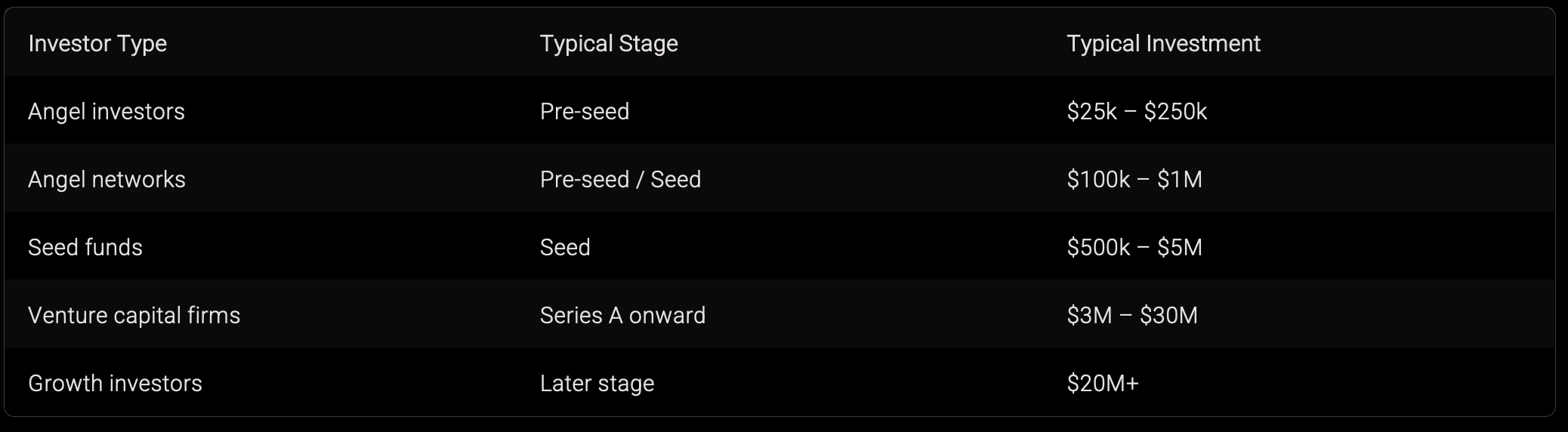
Startup investor landscape showing typical investment stages from angel investors to venture capital and growth funds.
Seed funding rounds represent the earliest stage of institutional venture capital investment. At this stage investors focus on validating product-market fit, founder capability, and market opportunity. Series A funding represents the next stage of venture capital financing. Series A investors typically evaluate companies that demonstrate clear commercial traction, measurable user growth, and evidence of scalable revenue models. These funding stages form the backbone of the startup financing lifecycle. Venture capital investors deploy capital across these stages in order to support companies as they scale from early product development toward global market expansion.
Understanding the scale of the venture capital market helps founders appreciate the broader environment in which startup investors operate. Thousands of venture capital investors evaluate startup opportunities each year, yet only a small number of companies ultimately receive venture funding. This competitive environment is one of the reasons founders invest significant effort into understanding how to find startup investors and how venture capital firms evaluate opportunities.
How Many Startup Investors Exist
Many founders assume that venture capital funding comes from a relatively small group of investors concentrated in a few technology hubs. In reality the global investor ecosystem is far larger and more diverse.
The venture capital market includes thousands of investors participating across different stages of the startup lifecycle.
Current estimates suggest the following scale.
Investor Category Estimates
The venture capital ecosystem includes several categories of investors that participate in startup funding at different stages. Venture capital firms represent only one part of the broader capital landscape. Angel investors, family offices, and corporate venture capital funds also play significant roles in financing early-stage companies. The estimates below illustrate the scale of the global investor ecosystem and the number of organisations and individuals actively deploying capital into startups.
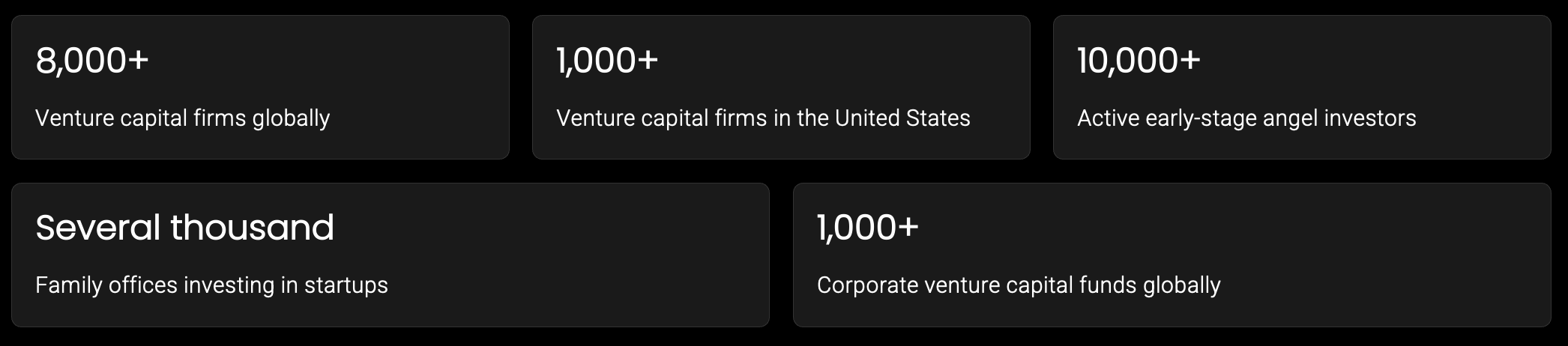
Startup investor ecosystem including venture capital firms, angel investors, family offices and corporate venture capital funds.
The United States remains the largest venture capital market in the world, hosting the greatest concentration of venture capital firms and angel investors. Major startup ecosystems exist in regions such as Silicon Valley, New York, Boston, Austin, and Los Angeles. Europe also hosts a growing venture capital landscape with strong ecosystems in London, Berlin, Paris, Stockholm, and Amsterdam. Across Asia, major venture capital markets exist in Singapore, China, India, South Korea, and Japan.
Angel investors form the earliest layer of the startup capital ecosystem. Many angel investors are former founders or early employees of successful technology companies who reinvest their capital into new startups.
Family offices represent another important investor group. Many family offices allocate capital to venture investments in order to participate in long term technology growth.
Corporate venture capital funds also play a major role in startup funding. Large technology companies, financial institutions, and industrial firms operate investment arms that fund startups aligned with strategic innovation priorities.
Together these investor groups form a global capital network that funds new companies across nearly every technology sector. For founders learning how to find startup investors, this diversity of investor types creates a wide landscape of potential funding partners. Understanding how these investors operate and where they participate within the startup lifecycle becomes a crucial step in building a successful fundraising strategy.
Understanding the Startup Investor Ecosystem.
The global startup ecosystem includes several categories of investors. Each category participates at different stages of company development and deploys capital according to different strategies.
Once founders understand the different categories of startup investors, the next step is understanding how those investors actually discover companies. Venture capital firms do not rely on a single sourcing channel. Instead they operate through a network of referrals, operator relationships, accelerators, and inbound deal flow..
Angel Investors and Early Startup Investors
Angel investors represent one of the earliest sources of startup capital. These investors deploy personal capital into early stage companies, often before venture capital firms become involved.
Angel investors frequently include experienced entrepreneurs, technology executives, and early employees of successful technology companies. Their investment decisions often rely on conviction about the founding team and the potential of the market opportunity.
Angel investors typically invest between $25,000 and $250,000 in early stage startups. Many angel investors also participate in syndicated investments alongside other angels or venture capital firms.
Angel investors play an important role in the venture capital ecosystem because they often provide the earliest external capital that allows startups to demonstrate traction before approaching institutional investors.
Angel investors also frequently introduce founders to venture capital investors once companies reach the stage where institutional funding becomes relevant.
Angel Networks
Angel networks represent organised groups of angel investors who pool capital and review startup investment opportunities collectively.
Examples of angel networks include regional investment groups, technology investor collectives, and angel syndicates. These networks often evaluate startups through structured pitch sessions where founders present their companies to multiple investors simultaneously.
Angel networks frequently invest in pre-seed and seed stage companies. Their investments help startups reach milestones that make them attractive to venture capital firms.
Seed Funds as Early Startup Investors
Seed funds represent the first layer of institutional venture capital.
These funds specialise in early stage companies that have demonstrated early product validation or user traction. Seed funds typically invest between $500,000 and $5 million depending on the stage of the company.
Seed investors often evaluate companies based on:
• product traction
• early customer growth
• founder capability
• market opportunity
Seed funds frequently participate in the first institutional funding round and often help startups prepare for later venture capital financing.
Venture Capital Firms as Institutional Startup Investors
Venture capital firms represent the largest category of institutional startup investors. These firms raise investment funds from institutional investors including pension funds, university endowments, family offices, and sovereign wealth funds.
The venture capital firm then deploys that capital into high growth companies with the expectation that a small number of successful investments will generate large returns.
Each venture capital firm operates according to an investment thesis. The thesis defines:
• the industries the fund invests in
• the stage of companies it targets
• the typical investment size
• geographic markets
Founders attempting to find investors for a startup must understand these investment mandates before contacting venture capital firms.
Corporate Venture Capital
Corporate venture capital funds operate within large corporations. These investment arms invest in startups aligned with the strategic interests of the corporation.
Corporate venture capital funds often invest in startups that complement the company’s existing products, technologies, or markets.
Examples include investment arms operated by technology companies, telecommunications companies, financial institutions, and industrial corporations.
Corporate venture capital investments often provide startups with both capital and strategic partnerships.
Family Offices
Family offices represent another source of startup capital. These organisations manage the wealth of high net worth families and increasingly participate in venture capital investments.
Family offices often invest alongside venture capital firms or participate in venture capital funds as limited partners.
Some family offices also invest directly in startups, particularly at the growth stage.
What Venture Capital Investors Look For In Startups.
Understanding what venture capital investors look for in startups is one of the most important steps in learning how These investors evaluate several structural factors including market size, product differentiation, and traction. Venture capital firms review thousands of opportunities every year, yet only a small number receive funding. Investors therefore rely on a set of consistent evaluation criteria when assessing early stage companies.
While every venture capital firm maintains its own investment thesis, most startup investors evaluate opportunities across five core dimensions: market size, product differentiation, traction, revenue growth potential, and team capability.
These factors help venture capital investors determine whether a startup has the potential to generate the scale required for venture-backed outcomes.
Market Size
Market size represents one of the most important variables in venture capital investment decisions. Venture capital firms typically invest in companies addressing large and expanding markets where the opportunity for long-term growth is substantial.
Investors often examine the total addressable market, which represents the maximum potential revenue opportunity for a product or service if it achieves widespread adoption. Large markets allow startups to grow rapidly without quickly reaching natural limits on demand.
For venture capital investors, market size determines whether a company can potentially grow into a billion-dollar business. Startups targeting small or niche markets rarely attract venture capital funding because the scale of opportunity does not align with venture capital return expectations.
Product Differentiation
Product differentiation refers to the degree to which a startup’s product or technology provides meaningful advantages over existing solutions.
Investors examine several forms of differentiation:
• proprietary technology
• network effects
• data advantages
• superior user experience
• unique distribution channels
Companies that demonstrate strong differentiation create barriers that make it difficult for competitors to replicate their products. Venture capital investors favour businesses capable of establishing defensible positions within their markets.
Traction
Traction provides evidence that a startup’s product is gaining real adoption. Venture capital investors analyse traction metrics carefully because these signals help validate product-market fit.
Common traction indicators include:
• user growth
• customer acquisition
• revenue generation
• engagement metrics
• retention rates
Even at early stages, investors prefer companies demonstrating measurable market adoption. Traction reduces uncertainty and provides investors with evidence that the product addresses a real market need.
Revenue Growth
Revenue growth represents another important signal for venture capital investors. While early stage startups may initially focus on product development and user acquisition, investors eventually expect to see revenue expansion that demonstrates a viable business model.
Investors examine:
• recurring revenue growth
• unit economics
• customer lifetime value
• acquisition costs
These metrics help investors understand whether a startup can scale economically as it grows.
Team Capability
The founding team remains one of the most critical factors in venture capital evaluation. Investors assess whether founders possess the technical expertise, leadership ability, and industry knowledge required to build and scale a company.
Experienced founders who demonstrate strong execution capability often attract investor attention even before significant traction appears. Conversely, teams that lack complementary skill sets or operational depth may struggle to convince venture capital investors of their ability to execute ambitious growth plans.
For founders learning how to find startup investors, understanding these evaluation criteria provides valuable insight into how venture capital firms assess opportunities. Companies that align their fundraising preparation with these criteria significantly increase their chances of attracting investor interest.
How Long It Takes To Raise Venture Capital.
Founders beginning the fundraising process often underestimate how long it takes to raise venture capital. Venture capital fundraising is rarely a short sequence of investor meetings. It is a structured process that includes preparation, investor discovery, relationship building, investor evaluation, and legal closing.
In today’s venture market, the full fundraising cycle frequently spans six to eighteen months from preparation to capital closing. Earlier-stage startups often experience longer timelines because investors must evaluate more uncertainty around the product, the market, and the team.
Fundraising timelines vary depending on market conditions, company traction, investor alignment, and the quality of preparation before outreach begins. While each company’s experience differs, venture capital fundraising usually unfolds across several identifiable phases.
Venture capital fundraising rarely occurs as a single transaction. Instead, founders move through a sequence of stages that include preparation, investor discovery, relationship building, investor evaluation, and legal closing. Each stage of the venture capital fundraising process has a different duration depending on investor interest, company traction, and market conditions. The timeline below illustrates the typical stages founders navigate when raising venture capital.
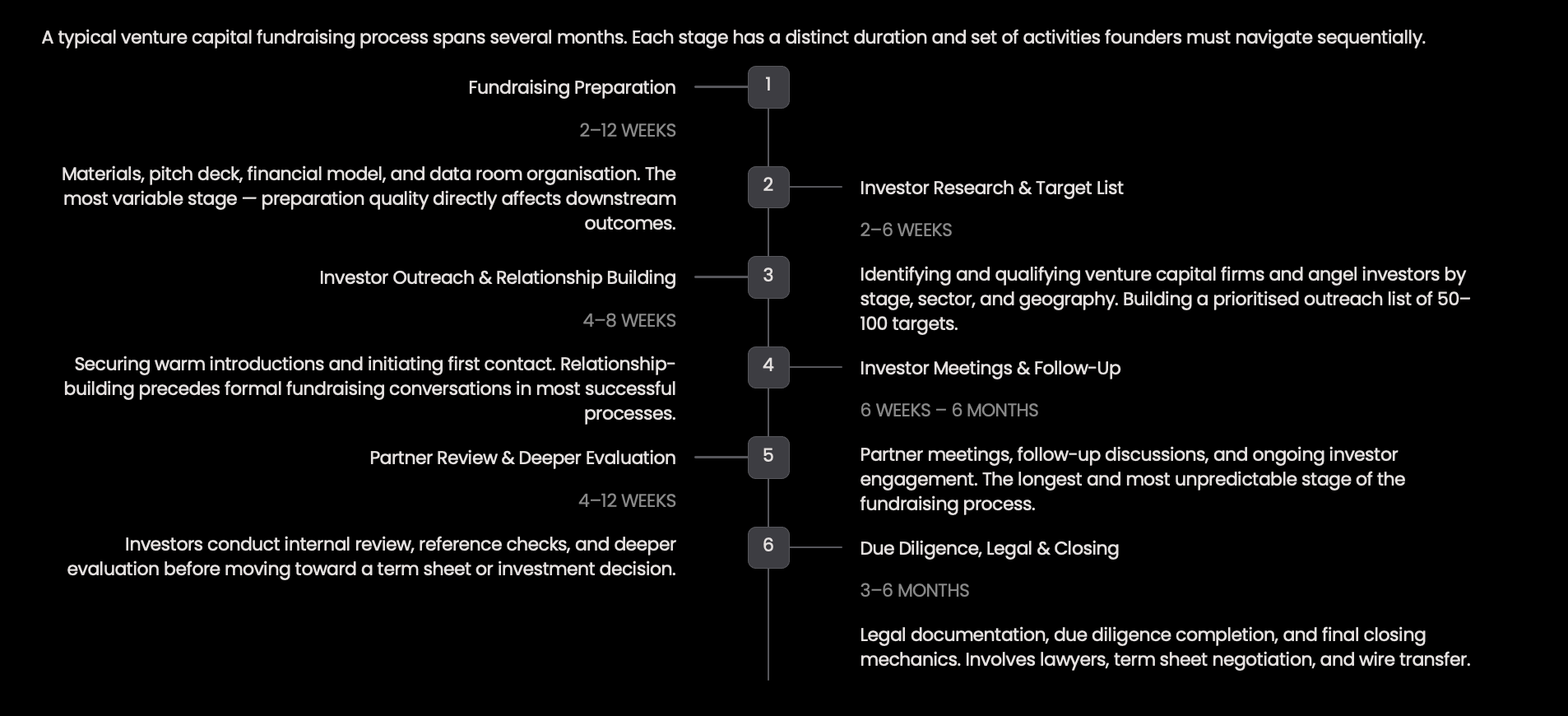
When these phases are combined, the overall timeline for raising venture capital often extends far beyond the simplified timelines commonly presented in startup blogs.
Many founders begin preparing for fundraising months before their first investor meeting. Once investor conversations begin, the process can continue for several additional months as investors evaluate the opportunity internally.
Why Venture Capital Fundraising Takes Time
The venture capital investment process involves multiple stages of evaluation inside each investment firm. Venture capital firms operate through structured internal review processes that require several levels of analysis and discussion before an investment decision is reached.
A typical investment review process may include:
• initial screening by an associate or principal
• partner discussion of the opportunity
• additional meetings with the founders
• internal investment committee evaluation
• commercial and market validation
• reference checks and financial review
• legal and structural due diligence
Each of these steps introduces additional time into the fundraising process. Even when investors express early interest, the internal review process inside a venture capital firm may take several weeks or months to complete.
The Number of Investor Conversations Required
Fundraising timelines are also influenced by the number of investor conversations required to close a round.
Venture capital firms evaluate a very large number of companies each year while investing in only a small number of them. As a result, founders typically meet many investors before securing a term sheet.
Across many fundraising processes, founders conduct 30 to 80 investor meetings before a round closes. Some companies raise capital more quickly when investor interest develops rapidly. Others require more extensive outreach across the venture capital ecosystem before finding the right investor alignment.
The number of meetings required depends on several factors including the maturity of the company, the competitiveness of the market opportunity, and the degree of investor interest in the sector.
Preparation Is the Factor Founders Control Most
While founders cannot control investor decision timelines, they can control preparation.
Preparation plays one of the most important roles in determining how long fundraising takes. Companies that approach investors with incomplete materials, unclear financial models, or poorly organised documentation often experience longer fundraising cycles.
The companies that move through fundraising more efficiently typically complete significant preparation before beginning outreach.
Preparation often includes:
• developing a clear fundraising narrative
• preparing a well-structured pitch deck
• building a detailed financial model
• organising a comprehensive startup data room
• preparing legal and corporate documentation
• building a targeted investor list
• securing warm introductions where possible
Strong preparation does not guarantee faster fundraising, but it significantly increases the probability that investor conversations progress efficiently.
Market Conditions Influence Fundraising Timelines
Venture capital activity changes over time as economic conditions shift. During periods of strong venture investment, capital flows more quickly and investors actively search for new opportunities.
During periods of greater caution, investors conduct more detailed evaluation before committing capital. This often results in longer diligence cycles and more extended fundraising timelines.
In recent years venture capital firms have become more selective as they prioritise disciplined capital deployment and stronger evidence of traction before investing.
Startup Traction and Investor Alignment
The strength of a company’s traction also influences fundraising speed. Startups demonstrating clear customer adoption, strong revenue growth, or compelling product engagement frequently attract investor attention more quickly.
Alignment between the startup and the investor also matters. Venture capital firms invest according to defined mandates that specify the sectors, stages, and geographies they focus on. When founders approach investors whose mandates closely match the company’s opportunity, investor evaluation often proceeds more efficiently.
Planning for the Real Fundraising Timeline
Understanding the realistic timeline for venture capital fundraising allows founders to plan their capital strategy more effectively. Companies that begin preparation early and structure their fundraising process carefully often move through investor conversations with greater confidence.
For founders learning how to find startup investors, recognising the true timeline of venture capital fundraising encourages disciplined preparation, thoughtful investor targeting, and a structured outreach strategy.
In practice, raising venture capital is rarely a rapid event. It is a process that rewards preparation, alignment, and persistence across a complex investor landscape.
The Startup Fundraising Timeline Explained.
The process of raising venture capital unfolds across several distinct stages. Each stage involves different investor groups, different funding amounts, and different expectations regarding traction and company maturity.
Understanding this timeline helps founders prepare the right materials, approach the right startup investors, and structure fundraising conversations appropriately.
The startup funding lifecycle typically progresses through four major stages: pre-seed funding, seed funding, Series A funding, and growth stage capital. Startup funding progresses through several distinct stages. Each funding stage introduces different types of investors and different capital requirements as the company grows. Early-stage startups often begin with angel investors and seed funds, while later stages attract venture capital firms and growth investors focused on scaling operations and expanding market reach.
Each stage of the venture capital lifecycle introduces new expectations from startup investors.
Pre-Seed Funding
Pre-seed funding represents the earliest stage of startup financing. At this stage founders often raise capital from angel investors or small early-stage funds. Companies raising pre-seed capital typically focus on building an initial product, validating the core concept, and demonstrating early market interest.
Pre-seed investors primarily evaluate founder capability, the clarity of the problem being solved, and the potential size of the market opportunity.
Seed Funding
Seed funding usually represents the first institutional funding round. Companies raising seed capital typically demonstrate early product adoption, early revenue signals, or meaningful user growth.
Seed investors evaluate several signals during this stage, including:
• early traction
• product-market fit indicators
• founder execution capability
• early customer adoption
Seed rounds provide the capital necessary for startups to refine their product and begin building scalable growth channels.
Series A Funding
Series A funding represents the stage where venture capital firms begin financing companies that demonstrate clear growth potential.
Startups raising Series A capital usually present stronger commercial signals such as:
• repeatable customer acquisition
• measurable revenue growth
• scalable product architecture
• evidence of market demand
Series A investors evaluate whether the company can scale into a large and durable business.
Growth Stage Funding
Companies that successfully pass through the Series A stage often raise larger rounds from venture capital funds and growth investors.
Growth rounds provide capital for expanding operations, entering new markets, hiring leadership teams, and accelerating product development.
At this stage investors evaluate more complex metrics such as revenue expansion, market share, customer retention, and operational efficiency. Understanding this fundraising timeline allows founders to align their fundraising strategy with the expectations of startup investors at each stage of company development. Founders who approach venture capital fundraising with a clear understanding of these stages typically build stronger investor relationships and execute fundraising processes more effectively.
Where Founders Actually Find Startup Investors.
The Process Founders Use To Find Startup Investors
Finding startup investors usually follows a structured process rather than a single introduction or cold email. Founders begin by identifying the funding stage they are raising, then research investors whose mandate matches their sector, geography, and maturity. From there, they build a focused target list, secure warm introductions where possible, and begin a coordinated outreach process. The sequence below shows the practical steps founders use to identify and approach startup investors more effectively.
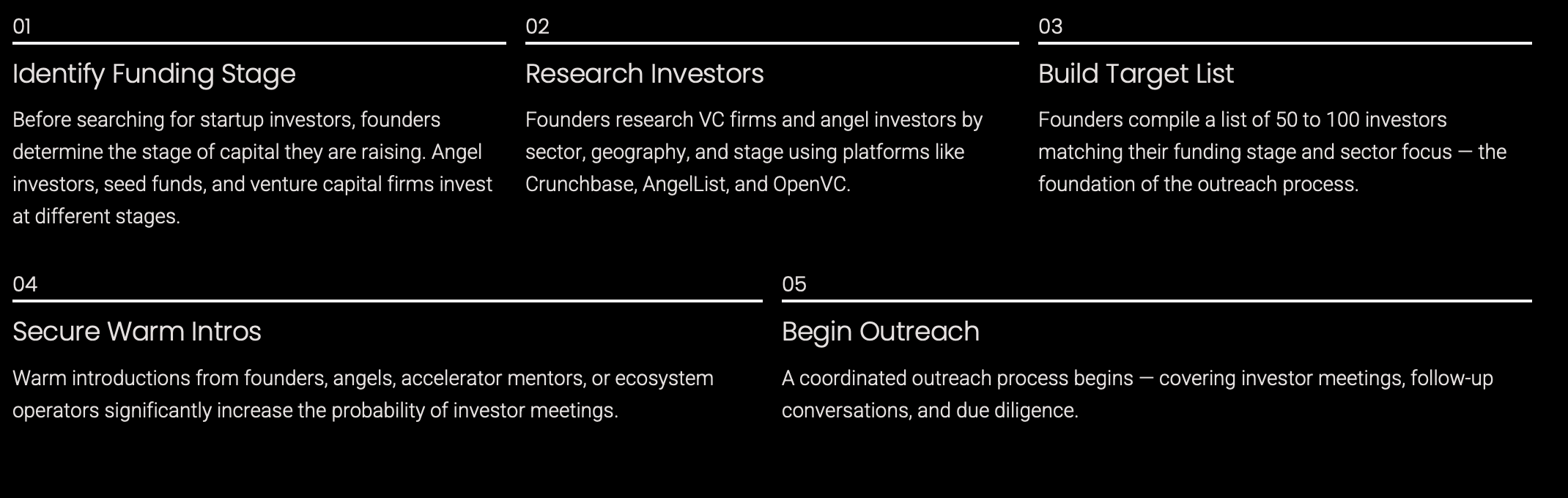
Founders frequently assume that investor discovery begins with sending messages to venture capital firms. In reality, the process usually begins with research.
Several platforms and networks allow founders to identify venture capital investors and analyse their investment activity.
Understanding where founders discover startup investors allows entrepreneurs to build structured investor lists rather than randomly contacting venture capital firms.
How Venture Capital Firms Actually Source Deals
Many founders believe venture capital firms primarily discover startups through inbound applications or cold outreach. In practice venture capital firms rely heavily on networks to source investment opportunities.
The most common deal sourcing channels include:
Founder referrals
Portfolio company introductions
Angel investor networks
Accelerator programmes
Industry operators
Venture capital partners maintain extensive relationships with entrepreneurs, engineers, product leaders, and investors within the startup ecosystem. These relationships create information networks that surface promising companies.
Founders who understand how venture capital investors source deals position themselves within these networks. Building relationships with founders, operators, and angel investors often increases visibility among venture capital firms. Understanding these dynamics changes how founders approach the process of finding startup investors. Instead of relying solely on cold outreach, founders focus on participating in the networks where venture capital investors discover opportunities.
How Founders Build a Venture Capital Investor Target List
Once founders understand where startup investors operate and how venture capital firms source deals, the next step becomes constructing a structured investor targeting strategy. Many founders searching for startup investors begin by contacting investors randomly, sending outreach messages to venture capital firms without understanding whether those investors are aligned with the company’s stage or sector.
A structured investor targeting process dramatically improves fundraising efficiency. Founders who build well researched investor lists before beginning outreach often experience far higher response rates from venture capital investors.
The process of building an investor target list involves identifying investors whose investment mandates align with the company’s stage, sector, geography, and capital requirements.
Most venture capital investors specialise in particular categories of startups. For example, some venture capital firms focus on enterprise software companies while others specialise in fintech, healthcare, biotechnology, climate technology, or consumer internet companies. Similarly, many investors focus on specific funding stages such as seed, Series A, or growth stage investments.
Understanding these investment parameters allows founders to focus their outreach on startup investors who are actually capable of investing in their company.
Step 1 — Identify the Funding Stage
The first step in building an investor target list is determining the funding stage of the company.
Startup investors participate in different stages of company growth. Some investors focus on the earliest phases of company development while others invest in later stage companies that have already achieved substantial revenue growth.
Funding stages generally follow a progression:
Startup investors expect companies to demonstrate different levels of traction depending on the funding stage. Angel investors often fund companies based on the founding team and the market opportunity, while venture capital investors typically evaluate metrics such as product adoption, revenue growth, and market scalability.
Founders who align their fundraising stage with the expectations of startup investors dramatically increase the probability of investor engagement.
Step 2 — Identify Sector Alignment
Once the funding stage is established, founders must identify venture capital investors who specialise in their industry.
Most venture capital firms build expertise within specific sectors. This allows investors to evaluate companies more effectively because they understand the competitive landscape, customer acquisition dynamics, and market opportunity within those sectors.
Examples of common venture capital focus areas include:
Artificial intelligence
Enterprise software
Fintech
Healthcare technology
Biotechnology
Climate technology
Consumer marketplaces
Infrastructure software
When founders attempt to find investors for a startup, identifying sector focused investors becomes essential. Investors who have already funded companies within a particular industry often maintain strong networks within that ecosystem and possess deeper understanding of the technology or business model.
For example, a venture capital firm specialising in fintech investments will likely maintain relationships with financial institutions, payment networks, and fintech operators. These connections allow the investor to support portfolio companies within that sector.
Sector alignment therefore increases the probability that startup investors will recognise the value of a company’s product and market strategy.
Step 3 — Analyse Investor Portfolios
The next step in building an investor target list involves studying the portfolios of venture capital firms.
Investor portfolios reveal the types of companies that venture capital firms prefer to fund. By analysing past investments founders can determine whether their company fits within the investor’s existing strategy.
For example, if a venture capital firm has invested in multiple enterprise software companies within a particular category, it may continue exploring similar opportunities. Portfolio analysis therefore provides clues about investor preferences.
Several investor research platforms allow founders to analyse venture capital portfolios. These platforms display the companies a venture capital firm has previously funded as well as the stage at which the investment occurred.
Studying these portfolios allows founders to build a highly targeted list of startup investors whose investment thesis aligns with their company.
Step 4 — Prioritise Investor Outreach
Once founders have compiled a list of potential startup investors, the next step involves prioritising outreach.
Investors should be organised based on their alignment with the company’s funding stage, sector, and geographic market. Founders often group investors into tiers based on how closely they match these criteria.
A structured investor list might include categories such as:
Tier 1 — Highly aligned venture capital investors
Tier 2 — Moderately aligned investors
Tier 3 — Investors with partial alignment
This structure allows founders to begin outreach with investors most likely to engage with the company.
Building a Venture Capital Fundraising Pipeline.
Investor targeting becomes significantly more effective when founders build a structured fundraising pipeline.
Rather than contacting investors sporadically, founders create a system for managing investor conversations, tracking outreach, and scheduling follow up meetings.
A venture capital fundraising pipeline typically includes several stages:
Initial investor research
Warm introduction requests
Introductory investor meetings
Follow up discussions
Investor due diligence
Term sheet negotiation
Each stage represents a step in the process of converting startup investor interest into an investment.
Maintaining a structured pipeline allows founders to monitor the progress of investor conversations and identify which investors remain engaged with the company.
Angel Investors
In many companies the first external capital comes from angel investors. These individuals invest personal capital into early stage startups long before institutional funds appear. These investors deploy personal capital into early stage companies.
Angel investors often include:
• experienced startup founders
• early employees of successful technology companies
• technology executives
• high net worth individuals interested in venture investing
Angel investors frequently invest before venture capital firms become involved. They help startups demonstrate early traction and prepare for institutional funding.
Angel investors also function as connectors. Many venture capital firms rely on angel networks to discover promising startups.
Seed Funds
Seed funds specialise in financing early stage companies once early product validation appears.
These funds often deploy investments between $500,000 and $5 million depending on the maturity of the company.
Seed investors typically evaluate:
• early user growth
• product adoption
• founder capability
• market opportunity
Seed funds frequently participate in the first institutional funding round.
Venture Capital Firms
Venture capital firms represent the primary institutional investors in high growth startups.
These firms raise capital from institutional investors such as:
• pension funds
• university endowments
• sovereign wealth funds
• family offices
Venture capital firms then deploy that capital into startups with the expectation of generating exceptional returns.
Major venture capital firms include organisations such as Sequoia Capital, Andreessen Horowitz, Accel, and New Enterprise Associates, all of which have backed globally recognised technology companies.
Each venture capital firm operates according to a clearly defined investment thesis. Founders searching for startup investors must therefore understand each investor’s mandate.
Corporate Venture Capital
Corporate venture capital funds operate within large corporations.
These funds invest in startups aligned with strategic innovation goals.
Examples include investment arms operated by:
• technology companies
• financial institutions
• telecommunications companies
• industrial conglomerates
Corporate venture capital can provide both funding and strategic partnerships.
Venture capital investors deploy hundreds of billions of dollars into startups each year, funding companies across software, artificial intelligence, climate technology, fintech, and biotechnology.
How Venture Capital Investors Evaluate Investor Outreach.
Understanding how venture capital investors evaluate inbound opportunities can also improve a founder’s approach to outreach.
Venture capital firms receive a large volume of startup introductions every week. Investors therefore rely on rapid evaluation frameworks to determine whether a company warrants further discussion.
When venture capital investors review a startup opportunity they often examine several factors:
Market size
Product differentiation
Founder capability
Early traction
Scalability potential
Founders who communicate these elements clearly during initial outreach increase the likelihood that venture capital investors will request further meetings.
Investor outreach therefore benefits from clarity and precision. Founders should be able to explain the core problem their company solves, the size of the market opportunity, and the progress the company has already achieved.
How Warm Introductions Influence Venture Capital Decisions
Within the venture capital ecosystem, warm introductions play a significant role in investor discovery.
A warm introduction occurs when a trusted intermediary introduces a founder to a venture capital investor. This intermediary may be another founder, an angel investor, an operator within the industry, or an advisor connected to the venture capital firm.
Warm introductions carry credibility because the intermediary is effectively vouching for the founder and the company. Venture capital investors often prioritise introductions that originate from individuals within their network.
Cold outreach can still lead to investment conversations, particularly when founders demonstrate strong traction. However, introductions from trusted sources frequently accelerate the process of securing meetings with venture capital investors.
Strategic Positioning Within the Venture Capital Ecosystem
The process of finding startup investors therefore involves more than identifying venture capital firms. Founders must also position themselves within the networks that drive venture capital deal flow.
Participating in founder communities, building relationships with angel investors, attending startup events, and engaging with industry operators all contribute to investor visibility.
These networks increase the probability that venture capital investors will encounter a company through trusted channels rather than through unsolicited outreach.
Founders who build relationships within the startup ecosystem gradually expand the number of pathways through which investors can discover their company.
Why Investor Discovery Is Only the Beginning
Finding startup investors represents only the first stage of venture capital fundraising.
Once founders identify appropriate investors, the process transitions into a deeper evaluation phase where venture capital firms analyse the company’s potential.
Investors examine market opportunity, competitive advantage, team capability, and the scalability of the business model. They often request access to financial models, product demonstrations, customer data, and company documentation.
This evaluation process ultimately determines whether venture capital investors choose to fund the company.
Understanding how to find startup investors therefore represents the starting point of a much larger process that culminates in the successful closing of a venture capital round.
Why Most Founders Fail to Find the Right Startup Investors
Understanding how to find startup investors requires more than identifying venture capital firms and building investor lists. Many founders research startup investors extensively yet still struggle to raise venture capital. The difficulty often arises from structural mistakes that occur before investor conversations even begin.
Venture capital investors evaluate thousands of opportunities every year while funding only a small percentage of companies. Because of this imbalance between supply and demand, founders who approach startup investors without a structured strategy frequently encounter rejection or silence.
Examining the most common mistakes founders make when attempting to find investors for a startup helps clarify why fundraising often fails.
Misaligned Investor Targeting
One of the most frequent mistakes founders make when searching for startup investors is contacting investors whose mandates do not align with the company.
Every venture capital firm operates according to an investment thesis. The thesis defines the sectors the fund invests in, the stage of companies it targets, the geographic markets it focuses on, and the size of the investments it deploys.
For example, a venture capital firm specialising in enterprise software investments at the Series A stage is unlikely to invest in a pre-seed consumer marketplace startup. Similarly, a growth-stage investor that writes $30 million checks rarely participates in seed rounds.
When founders search for startup investors without understanding these mandates, they often send outreach messages to investors who cannot invest in their company regardless of its quality.
Investor targeting therefore represents the foundation of successful fundraising. Founders must research startup investors carefully and ensure that the investors they approach are aligned with their stage, sector, and geographic market.
Insufficient Investor Research
Another common fundraising problem arises from limited investor research.
Many founders identify venture capital investors through online databases but do not examine those investors in detail before initiating outreach. As a result, founders often approach investors without understanding the investor’s portfolio, thesis, or historical investment behaviour.
Thorough research improves the quality of investor conversations. When founders demonstrate familiarity with a venture capital firm’s portfolio and explain how their company fits within the investor’s strategy, investors recognise that the founder has approached them deliberately rather than randomly.
Investor research platforms such as Crunchbase, OpenVC, and PitchBook allow founders to analyse venture capital portfolios and study historical investments. These tools reveal the types of companies investors prefer to fund.
Founders who perform detailed investor research are more likely to identify startup investors who genuinely recognise the opportunity presented by their company.
Fragmented Investor Outreach
Investor outreach often becomes fragmented when founders attempt to contact startup investors without a clear process.
Founders sometimes send sporadic messages to investors whenever they discover a new venture capital firm. Over time this approach creates a scattered pattern of outreach that makes it difficult to manage investor relationships or track conversations.
A structured outreach strategy significantly improves fundraising outcomes. When founders organise investor conversations into a coordinated campaign, they create momentum in the fundraising process.
Many successful fundraising campaigns involve contacting investors within a concentrated time window rather than gradually approaching investors over several months. Concentrated outreach increases the likelihood that investors will perceive competitive interest from other venture capital firms.
Maintaining a structured investor pipeline also allows founders to track the status of conversations and prioritise follow-up meetings with interested investors.
Weak Market Positioning
Even when founders successfully identify startup investors and initiate conversations, fundraising often stalls because investors cannot clearly understand the company’s market positioning.
Venture capital investors evaluate companies primarily based on their potential to capture large markets. If a startup cannot articulate the scale of its opportunity, investors may hesitate to continue discussions.
Clear market positioning requires founders to demonstrate:
• the size of the addressable market
• the problem the company solves
• the uniqueness of the product
• the growth potential of the business model
When founders communicate these elements effectively, venture capital investors can quickly assess the potential impact of the company.
Lack of Investor Readiness
Another reason founders struggle to find startup investors involves insufficient preparation for investor scrutiny.
Venture capital investors evaluate startups through detailed due diligence processes. Investors often request documentation that includes financial models, customer data, product demonstrations, intellectual property records, and legal information.
Startups that approach venture capital investors without preparing these materials often encounter delays in the fundraising process.
Investor readiness therefore plays a significant role in fundraising success. Companies that prepare financial projections, product demonstrations, and data rooms before approaching startup investors appear more credible to venture capital firms.
Preparation also accelerates the due diligence process once investor interest emerges.
Limited Network Visibility
Because venture capital firms rely heavily on networks to source deals, founders who operate outside these networks may struggle to gain visibility among investors.
Many venture capital investors discover new companies through founder referrals, portfolio company introductions, or accelerator programmes. Founders who participate in startup communities, industry events, and accelerator programmes often gain greater exposure to venture capital investors.
Visibility within these networks increases the probability that investors will encounter the company through trusted channels.
Building relationships within the startup ecosystem therefore becomes an important part of the process of finding startup investors.
How Structured Fundraising Improves Investor Discovery.
The challenges described above reveal an important insight about venture capital fundraising. The process of finding startup investors becomes significantly easier when founders approach fundraising systematically.
Structured fundraising begins with preparation. Founders clarify their company’s funding stage, identify the sectors in which they operate, and research venture capital investors whose mandates align with the company. Next, founders build detailed investor lists based on these criteria. These lists include venture capital firms, angel investors, and other startup investors whose portfolios suggest interest in the company’s market.
Finally, founders organise outreach into a coordinated campaign that includes introductions, meetings, and follow-up discussions.
This structured approach transforms fundraising from a chaotic process into a deliberate strategy.
When founders understand the venture capital ecosystem, conduct thorough investor research, and manage investor outreach strategically, the process of finding startup investors becomes far more effective.
The Transition From Investor Discovery to Fundraising
Identifying startup investors represents only the beginning of venture capital fundraising. Once founders identify appropriate investors and initiate conversations, the process enters a deeper phase where venture capital firms evaluate the company’s potential.
During this phase investors analyse the company’s market opportunity, growth potential, competitive advantages, and financial projections. Investors may request meetings with the founding team, review product demonstrations, and examine customer adoption metrics. Successful fundraising therefore requires both investor discovery and investor readiness. Founders must identify the right venture capital investors while also preparing their company to withstand investor scrutiny.
Understanding how to find startup investors provides the foundation for this process. The next stage involves transforming investor interest into committed capital through structured fundraising execution.
How Venture Capital Relationships Develop Before Funding
Understanding how to find startup investors involves more than identifying venture capital firms and sending outreach emails. Venture capital investing operates through long-term relationship building. Investors frequently observe startups for months before deciding whether to invest.
This dynamic surprises many founders. The popular perception of venture capital fundraising often focuses on the moment when a founder begins actively raising capital. In reality, the process of building investor relationships often begins long before a funding round formally opens.
Venture capital investors track companies over extended periods in order to evaluate how the company evolves. During this observation period investors watch how founders execute their strategy, how the product develops, and how customers respond to the solution. Because of this behaviour within the venture capital ecosystem, founders who begin building investor relationships early create a significant advantage when they later begin fundraising.
Why Venture Capital Investors Track Startups Over Time
Venture capital firms make investment decisions that often involve holding companies for seven to ten years. Because of this long time horizon, investors evaluate founders carefully before committing capital. Investors look for evidence of execution over time. They want to observe how founders make decisions, how the company responds to challenges, and whether the product continues improving as the team gathers market feedback.
Tracking startups over time allows investors to evaluate several important dimensions of company development:
Founder capability
Product evolution
Customer adoption
Revenue growth
Market expansion
These observations help venture capital investors determine whether the company demonstrates the characteristics required for long-term growth.
For founders searching for startup investors, understanding this dynamic changes how investor relationships should be approached.
The Importance of Early Investor Conversations
Many founders begin contacting startup investors only after deciding to raise capital. While this approach can still produce successful fundraising outcomes, it often means that investors encounter the company for the first time when a funding decision is required.
When investors encounter a company for the first time during an active fundraising process, they have limited time to understand the business. This compressed timeline can make it more difficult for investors to develop conviction about the opportunity. Founders who begin building relationships with venture capital investors earlier create a more favourable environment for future fundraising discussions.
Early conversations allow investors to become familiar with the company before the fundraising process begins. Investors gain visibility into the founder’s thinking, the market opportunity, and the progress the company makes over time. When the company eventually begins raising capital, those investors already possess context about the opportunity.
How Founders Introduce Their Startup to Venture Capital Investors
Introducing a startup to venture capital investors typically begins with a concise explanation of the company’s mission, product, and market opportunity.
Investors often refer to this explanation as the company’s narrative. The narrative helps investors understand why the company exists and what problem it aims to solve.
Founders who approach venture capital investors effectively usually communicate several key elements during early conversations:
The problem being addressed
The size of the market opportunity
The product solution
The progress the company has achieved
The long term vision of the business
These elements help venture capital investors quickly assess whether the company aligns with their investment focus. Clarity during early conversations also increases the probability that investors will remember the company and follow its progress.
Why Consistent Updates Strengthen Investor Relationships
Once founders establish contact with startup investors, maintaining regular communication becomes important.
Many founders send periodic updates to investors describing the progress the company has achieved. These updates often include information such as:
Product development milestones
Customer growth
Revenue expansion
Partnerships or strategic initiatives
Key hires within the company
Consistent updates help investors observe how the company evolves over time. Investors can track whether the company continues progressing toward its goals.
Updates also demonstrate that the founding team operates with transparency and discipline. Venture capital investors value founders who communicate clearly about the development of their company. Over time these updates help investors build familiarity with the business.
Investor Meetings Before Fundraising Begins
In many cases founders meet venture capital investors several times before a funding round formally opens.
These meetings often focus on exploring the market opportunity, discussing the company’s strategy, and understanding the founder’s vision for the business. Investors may ask questions about customer acquisition, product development, and competitive positioning. Because the company is not actively raising capital during these early discussions, the meetings can focus on learning rather than negotiation.
This environment often leads to more productive conversations. Investors gain a deeper understanding of the company while founders gain insight into how investors evaluate opportunities. Over time these conversations help both sides determine whether collaboration would make sense in the future.
Why Venture Capital Investors Appreciate Relationship Driven Founders
Venture capital investing relies heavily on trust between investors and founders. Investors commit capital for long periods and frequently work closely with founders throughout the development of the company.
Because of this relationship dynamic, investors often prefer founders who take time to build relationships before requesting capital.
Relationship driven founders demonstrate patience and long term thinking. Investors recognise that these founders view venture capital relationships as partnerships rather than purely transactional interactions. When investors already trust the founder’s judgement and leadership, the decision to invest becomes easier.
The Role of Founder Reputation in Investor Discovery
Within the venture capital ecosystem, reputation spreads quickly. Founders who consistently execute well and communicate effectively often become known within investor networks. Reputation influences how venture capital investors respond to new opportunities. When investors hear about a company led by a founder with a strong reputation, they are more likely to investigate the opportunity.
Reputation develops through several channels within the startup ecosystem:
Referrals from other founders
Recommendations from angel investors
Connections through accelerator programmes
Introductions from industry operators
Each of these channels increases the probability that venture capital investors will hear about the company. Building a reputation within the ecosystem therefore becomes an important component of the process of finding startup investors.
Timing the Transition Into Fundraising
At some point founders decide to transition from relationship building into active fundraising.
This transition usually occurs when the company has reached specific milestones that demonstrate progress to investors. These milestones often include product adoption, revenue growth, or customer traction.
When founders have already established relationships with venture capital investors, this transition becomes smoother. Investors who have followed the company’s development already possess context about the opportunity.
Instead of evaluating the company from scratch, these investors can focus on whether the company has achieved the progress required to justify investment. This dynamic often accelerates the fundraising process.
How Founder Preparation Influences Investor Confidence
Investor relationships ultimately converge with preparation. Venture capital investors expect founders to present clear evidence that the company can scale.
Preparation often includes building a financial model that demonstrates how the company plans to grow. Investors also review product demonstrations, customer feedback, and market research. These materials allow investors to evaluate whether the company possesses the potential to capture a large market.
Founders who combine strong relationships with careful preparation often attract greater investor interest during fundraising.
The Role of Structured Platforms in Investor Discovery
As the startup ecosystem continues expanding, founders increasingly rely on platforms that help them navigate investor discovery.
These platforms provide founders with structured ways to identify startup investors, analyse venture capital portfolios, and organise investor outreach. By consolidating investor information in one place, platforms reduce the time founders spend searching for investors.
Platforms also create environments where investors can discover startups through curated introductions or structured data rooms.
The evolution of these platforms reflects the growing complexity of venture capital fundraising. As more startups seek venture capital, founders benefit from tools that simplify the process of finding startup investors.
The Reality Of Finding Startup Investors
The venture capital ecosystem reviews thousands of companies every year. A typical venture capital firm evaluates more than 3,000 startups annually while investing in fewer than twenty.
This means fewer than one percent of companies that approach venture capital firms ultimately receive investment.
The scarcity of venture capital funding explains why investor discovery requires structured preparation. Founders who understand how venture capital investors operate, how investor networks function, and how venture capital firms source deals dramatically increase their probability of securing investor meetings.
Understanding how to find startup investors therefore begins with understanding the structure of the venture capital ecosystem itself.
How Structured Fundraising Improves Investor Discovery.
FAQ
Frequently Asked Questions About Finding Startup Investors
How do startups find investors?
Startups find investors through a combination of venture capital firms, angel investors, startup accelerators, investor databases, and founder networks. Most founders begin by researching investors who actively fund companies in their sector and stage. Platforms such as Crunchbase, AngelList, OpenVC, and Dealroom allow founders to identify investors and analyse their past investments.
Founders then build a targeted investor list and begin outreach through warm introductions, direct investor emails, or introductions from other founders and operators.
Where do founders actually find venture capital investors?
Founders most often discover venture capital investors through investor databases, startup accelerators, founder communities, and referrals from other entrepreneurs. Venture capital firms frequently source deals through introductions from other founders, angel investors, and portfolio companies.
Investor research platforms such as Crunchbase, AngelList, OpenVC, PitchBook, and Dealroom help founders identify active venture capital firms and analyse their investment patterns.
How many startup investors exist globally?
The venture capital ecosystem includes more than 1,000 active venture capital firms in the United States alone. Globally, the number of venture capital firms is significantly larger as capital markets expand across Europe, Asia, and emerging startup hubs.
In addition to venture capital firms, the startup ecosystem includes tens of thousands of angel investors and thousands of family offices that participate in startup funding.
How many investors should founders approach during fundraising?
Most fundraising processes involve outreach to between 50 and 100 investors. Venture capital firms review thousands of companies every year but invest in only a small number. Because of this competitive dynamic, founders typically engage a large pool of potential investors in order to secure sufficient meetings and maintain fundraising momentum.
What do venture capital investors look for in startups?
Venture capital investors evaluate several core factors when analysing startup opportunities. These include the size of the market opportunity, product differentiation, evidence of customer traction, revenue growth potential, and the capability of the founding team.
Investors also analyse business model scalability, customer acquisition economics, and the long-term potential for the company to become a large market leader.
How long does it take to raise venture capital?
Fundraising timelines vary depending on the stage of the company and market conditions. A typical venture capital fundraising process can take several months from the first investor meeting to final investment.
Many fundraising processes involve between 30 and 80 investor meetings before a round closes, particularly in competitive funding environments.
What is the difference between angel investors and venture capital firms?
Angel investors invest their own personal capital into startups, usually at very early stages such as pre-seed or seed. Venture capital firms manage funds raised from institutional investors and deploy larger investments across high growth startups.
Angel investors often help startups reach early traction, while venture capital firms typically invest once companies demonstrate stronger growth potential.
How do founders approach venture capital investors?
Founders typically approach venture capital investors through warm introductions from other founders, angel investors, or accelerator mentors. Warm introductions significantly increase the probability of securing investor meetings.
Some founders also contact investors directly using structured outreach strategies built from carefully researched investor lists.
What happens during venture capital due diligence?
During due diligence venture capital firms review detailed information about the company. This typically includes financial statements, customer contracts, intellectual property documentation, legal records, cap table structure, and revenue data.
Investors use due diligence to confirm the accuracy of information presented during fundraising discussions and to evaluate long-term investment risk.
How do founders build an investor target list?
Founders build investor lists by identifying venture capital firms and angel investors aligned with their stage, geography, and sector. A structured investor list typically includes investor name, investment stage, sector focus, location, typical cheque size, and recent investments.
This list becomes the foundation of a coordinated investor outreach strategy.
Where do early stage startups find angel investors?
Early stage startups often find angel investors through founder communities, angel networks, startup accelerators, and investor platforms. Angel investors frequently participate in early fundraising rounds where companies are still validating their product and market opportunity.
Founder introductions and operator networks also play an important role in connecting startups with angel investors.
What are the best platforms to find startup investors?
Several platforms help founders identify active investors. Commonly used platforms include Crunchbase, AngelList, OpenVC, PitchBook, Dealroom, and NFX Signal.
These platforms allow founders to research venture capital firms, analyse funding rounds, and build targeted investor lists.
Do venture capital investors accept cold emails from founders?
Some venture capital firms accept direct outreach from founders, but warm introductions significantly increase the probability of receiving a response. Venture capital firms receive a large volume of inbound startup pitches, so referrals from trusted founders, operators, or angel investors often carry more credibility.
How competitive is venture capital funding?
Venture capital funding is highly competitive. Venture capital firms evaluate thousands of startups each year while investing in only a small number of companies. This means the percentage of startups that ultimately receive venture capital funding remains relatively small.
This competitive dynamic explains why founders must approach fundraising strategically.
When should a startup begin contacting investors?
Startups usually begin contacting investors once they have validated their product concept and can demonstrate early traction signals. These signals may include early customer adoption, product usage growth, or revenue development.
Investor conversations typically begin once founders can demonstrate a credible growth opportunity.
What is the role of startup accelerators in finding investors?
Startup accelerators play a major role in connecting founders with investors. Many accelerators operate structured programmes that culminate in investor demo days where founders present their companies to venture capital firms and angel investors.
Accelerators also provide mentorship and access to founder networks that facilitate investor introductions.
Do founders need introductions to meet venture capital investors?
Warm introductions significantly increase the likelihood of securing investor meetings. Venture capital firms often rely on trusted founder networks when evaluating new companies. However, some founders still succeed through direct outreach when their company demonstrates strong traction or operates in a compelling market.
How do venture capital firms discover startups?
Venture capital firms discover startups through multiple channels including founder referrals, angel investor networks, accelerator programmes, operator communities, and inbound pitch flow. Many firms rely heavily on referrals from trusted founders and portfolio companies.
These networks form the foundation of venture capital deal flow.
What happens after an investor agrees to invest?
Once an investor decides to participate in a funding round, the process moves into legal documentation and closing. This stage includes term sheet agreements, investor allocation decisions, legal documentation, and capital transfer.
The closing process finalises the funding round and formally brings investors onto the company’s cap table.
Why do many startups struggle to find investors?
Many startups struggle to find investors because venture capital firms focus on a narrow set of opportunities with large market potential. Investors evaluate market size, product differentiation, traction, and team capability before committing capital.
Founders who align their fundraising strategy with investor expectations significantly improve their chances of securing funding.
A Practical Next Step for Founders Raising Capital
Understanding how startup investors operate is only the first step in the fundraising process. In practice, founders often need structured systems to organise investor outreach, prepare investor materials, and coordinate capital participation during a funding round.
Modern fundraising increasingly relies on specialised platforms that help founders manage the complexity of investor engagement and capital formation. These platforms combine investor discovery, outreach organisation, and capital execution tools that simplify the process of raising venture capital.
One example is MoonshotNX, a fundraising infrastructure platform designed to help founders prepare for and execute venture capital fundraising more systematically. The platform provides founders with structured tools for organising investor materials, building investor target lists, and managing investor conversations throughout the fundraising process.
Unlike traditional fundraising intermediaries, MoonshotNX does not charge founders fees for raising capital. Instead, the platform focuses on improving capital readiness and connecting founders with relevant investors based on their funding stage, sector, and traction.
MoonshotNX also enables the creation of special purpose vehicles (SPVs) that allow groups of investors to participate collectively in startup funding rounds. SPVs simplify cap table management by aggregating multiple investors into a single investment entity while allowing founders to accept capital from a broader group of angels and smaller funds.
For founders navigating the venture capital ecosystem, platforms such as MoonshotNX can provide a structured environment for preparing investor materials, organising investor outreach, and coordinating funding rounds more efficiently.