

THE CAPITAL STACK PLATFORM™
Venture Capital Pricing Explained: How Startup Valuation Works Across Funding Stages
Venture capital pricing reflects how investors evaluate startups across different funding stages. Valuation is shaped by risk, growth potential, market dynamics, and the company’s ability to scale from early traction to institutional growth.
For a complete explanation of startup valuation, including equity, dilution, and ownership impact, see the full guide here
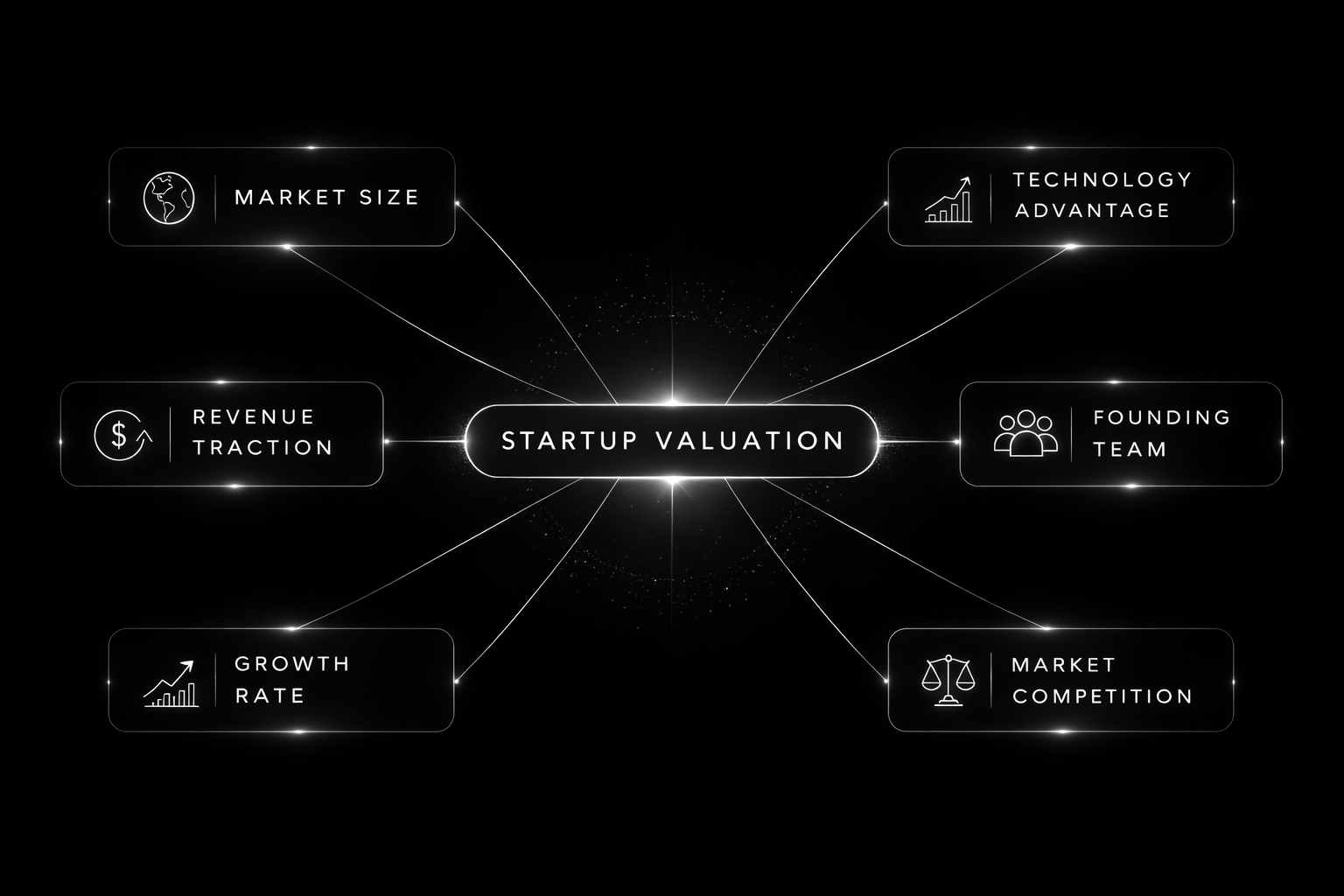
Startup Valuation Framework: The key factors venture capital investors evaluate when determining startup valuation during seed and Series A funding rounds.
How venture capital pricing works across funding stages.
The concept of startup valuation sits at the centre of every venture capital investment. When founders raise funding, the discussion quickly turns to the price of the company and the ownership investors receive in exchange for capital. Yet despite its importance, the mechanics of how startups are valued are often misunderstood.
Unlike mature companies, startups rarely possess long operating histories or stable revenue streams. Traditional corporate valuation methods rely heavily on financial performance and predictable cash flow. Venture capital investors evaluate opportunities in a very different environment. Early stage companies are priced based on future potential rather than historical performance.
This difference explains why venture capital valuation can appear opaque to founders encountering the process for the first time. Investors analyse markets, growth potential, and the ability of a founding team to build a scalable company. Valuation therefore becomes a reflection of both opportunity and risk. To understand how valuation fits into the broader funding process, see Startup Fundraising Explained.
Understanding how startups are valued is essential for founders entering the startup fundraising process. Valuation determines how much equity founders exchange for capital, how future funding rounds unfold, and how ownership evolves as the company grows. A poorly structured valuation early in the life of a company can create challenges in later funding rounds.
This article explains the mechanics behind startup valuation. It explores how venture capital firms assess opportunity, how pricing changes across funding stages, and how founders can think about valuation when raising capital.
For founders preparing to engage investors, understanding venture capital valuation provides a foundation for navigating funding discussions with clarity and confidence.
How Venture Capital Valuations Work
To understand how vc valuations work, founders must recognise the economic model that drives venture capital investment. Venture capital funds operate under a portfolio strategy in which a small number of companies generate the majority of returns.
Because many early stage companies fail, investors look for opportunities capable of producing very large outcomes. This reality shapes the structure of venture capital valuation. Investors price companies not only on their current performance but on their potential to become large market leaders.
Risk plays a central role in this process. Early stage companies carry significant uncertainty. Markets may evolve, technologies may change, and customer adoption may develop more slowly than expected. Investors therefore incorporate risk into the pricing of early stage opportunities.
Growth expectations represent another important element of how vc valuations work. Venture capital investors evaluate whether a company has the potential to expand rapidly within a large market. Companies capable of reaching substantial scale may justify higher valuations because their potential returns are greater.
The interaction between risk and growth potential creates the distinctive structure of venture capital valuation. Early stage companies may receive valuations that appear disconnected from traditional financial metrics. Instead, investors evaluate whether the company could achieve the scale required to produce venture level returns.
Understanding this framework allows founders to interpret investor feedback more effectively. When investors discuss market size, competitive advantage, and growth trajectory, they are assessing whether the opportunity supports the valuation required for venture capital investment.
What Startup Valuation Actually Means
Startup valuation refers to the estimated economic value of a company at the point of investment. It determines how much ownership investors receive in exchange for capital and defines how equity is distributed between founders and investors.
Two key concepts underpin valuation:
Pre-money valuation: the value of the company before new capital is invested.
Post-money valuation: the value of the company after investment capital is added.
Understanding the relationship between valuation and ownership is critical for evaluating investor offers and modelling dilution across funding rounds.
Startup Valuation Methods Used by Venture Capital Investors
Several analytical approaches influence startup valuation methods used by venture capital investors. Although early stage companies lack the financial history required for traditional valuation techniques, investors still rely on structured frameworks to analyse opportunities.
One commonly used approach involves comparing the company to similar businesses that have recently raised capital. This method, often referred to as comparable analysis, examines how other startups in the same sector have been priced by investors. These comparisons provide a reference point for venture capital valuation methods.
Revenue multiples also influence pricing once companies begin generating income. Investors may examine how public technology companies or later stage startups are valued relative to revenue. Although early stage companies often lack stable revenue streams, these benchmarks help investors estimate potential future value.
Another framework frequently used within startup valuation methods is known as the venture capital method. This approach begins with an estimate of the company's potential value at a future exit event such as an acquisition or public offering. Investors then work backwards to determine the valuation required today to generate a target return.
Financial modelling also contributes to venture capital valuation methods. Investors examine how capital will be deployed, how quickly the company expects to grow, and how future funding rounds may influence ownership.
Each of these frameworks provides a lens through which investors evaluate opportunity. None of them produces a precise valuation on its own. Instead, venture capital investors combine several analytical perspectives to form a judgement about the appropriate price of the company.
For founders approaching investors through the startup fundraising process, understanding these methods helps explain how venture capital firms interpret the information presented during fundraising discussions.
How Seed Stage Startup Valuation Works
The seed round valuation represents one of the earliest pricing decisions in the life of a venture backed company. At this stage the company often possesses limited operating history, which means investors must rely heavily on qualitative factors when assessing the opportunity.
During seed startup valuation, investors examine the strength of the founding team, the size of the target market, and the early evidence that customers value the product. Traction may appear in the form of early users, pilot programmes, or initial revenue. Although these signals may still be developing, they provide investors with insight into the potential direction of the company.
Risk remains particularly high during the seed stage. Products may still be evolving, markets may not yet be fully validated, and the company's operating structure is often still developing. Because of this uncertainty, investors incorporate risk premiums when determining seed round valuation.
Typical seed rounds also involve smaller amounts of capital than later stage investments. Investors provide funding that allows the company to refine the product, expand the team, and demonstrate early market adoption. The objective of the seed round is to reach milestones that justify a larger investment during the next funding stage.
Seed stage pricing also influences the long term ownership structure of the company. Founders must balance the need for capital with the desire to retain sufficient ownership for future rounds. Understanding the dynamics of seed startup valuation allows founders to approach early stage investment discussions with a clearer perspective on how pricing decisions influence the trajectory of the company.
How Series A Startup Valuations Are Determined
The transition from seed funding to institutional growth capital introduces a different dynamic in series a valuation discussions. At the Series A stage, investors expect a company to demonstrate stronger evidence that the business can scale within a meaningful market.
During series a startup valuation, investors examine how effectively the company has used the capital raised during earlier funding rounds. Evidence of product market fit, expanding customer adoption, and repeatable sales processes often plays a central role in determining the valuation.
Revenue becomes increasingly relevant at this stage. While early stage investors may fund companies based largely on vision and market opportunity, Series A investors often analyse the company's revenue trajectory and growth rate. Revenue multiples derived from comparable companies begin to influence the structure of venture capital valuation.
Investors also consider the operational maturity of the business. The development of leadership teams, the strength of the company's technology platform, and the scalability of the operating model all contribute to the evaluation of series a startup valuation.
Market dynamics influence pricing as well. If several venture capital firms express interest in the same company, competitive dynamics may drive valuations higher. Conversely, companies raising capital in more challenging market conditions may encounter more conservative pricing from investors.
Understanding how series a valuation works helps founders anticipate the expectations associated with this stage of funding. The transition from early experimentation to scalable growth becomes the central theme of Series A investor discussions. Visit the startup valuation hub.
Startup Dilution Across Venture Capital Funding Rounds
Startup dilution occurs as companies raise multiple rounds of venture capital. Each funding round introduces new investors who receive equity in exchange for capital, gradually reducing the percentage ownership held by founders and earlier investors. Although dilution reduces individual ownership percentages, it also enables companies to raise the capital required to grow rapidly. The diagram below illustrates how startup dilution typically evolves across seed, Series A, and Series B funding rounds.
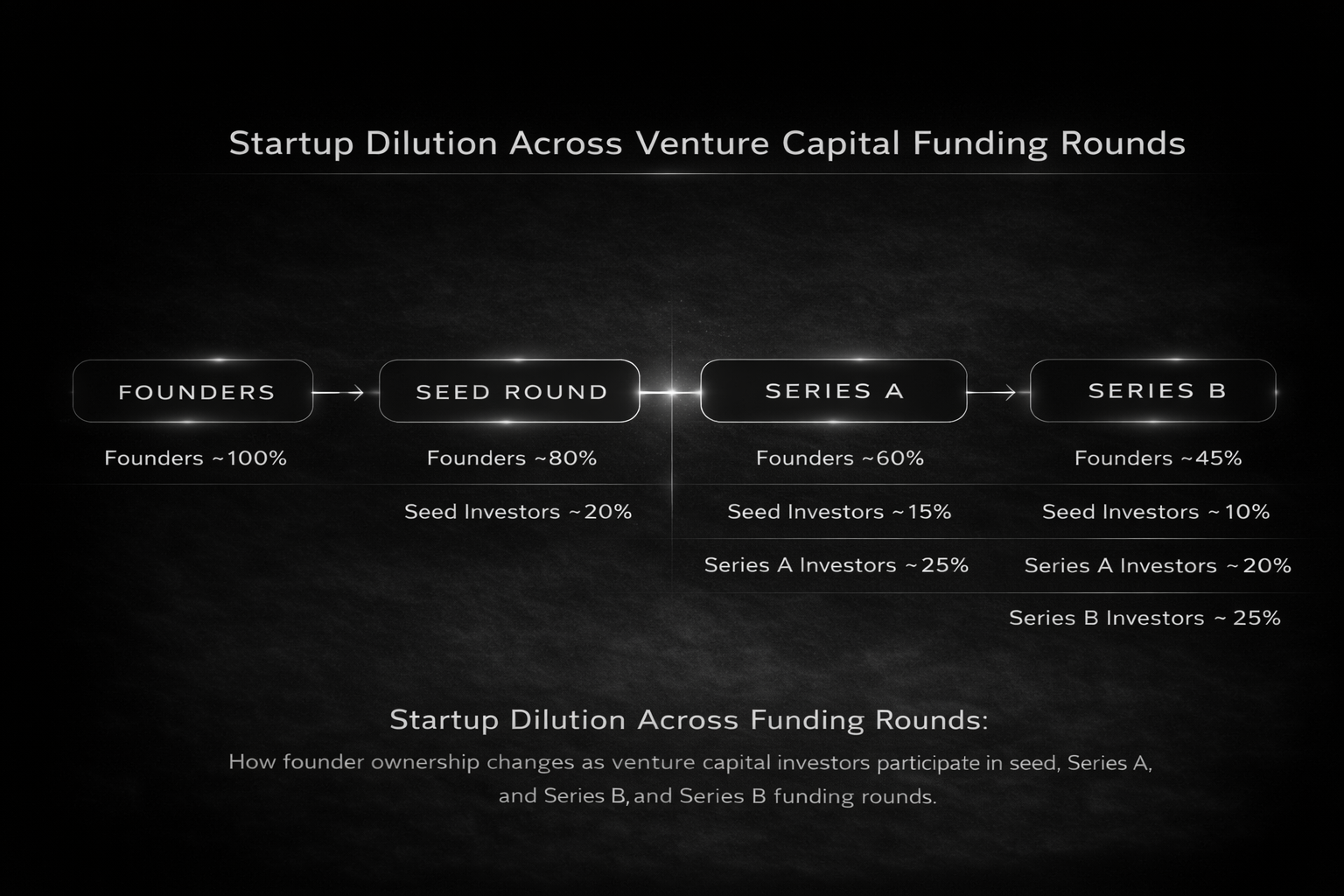
Startup Dilution Across Funding Rounds: How founder ownership changes as venture capital investors participate in seed, Series A, and Series B funding rounds.
Startup Valuation and Founder Dilution
One of the most important implications of startup valuation involves the impact on founder ownership. When investors provide capital to a company, they receive shares in return. This exchange creates dilution for existing shareholders.
Understanding startup dilution requires examining how equity is distributed across funding rounds. Each time a company raises capital, new shares are issued to investors. As a result, the percentage ownership held by founders and early shareholders decreases.
The concept of founder dilution venture capital reflects the trade off between capital and ownership. Founders accept dilution because the capital provided by investors allows the company to grow faster and pursue larger opportunities.
The structure of dilution also depends on the size of each funding round and the valuation at which capital is raised. Higher valuations allow founders to raise capital while giving away a smaller percentage of the company. Lower valuations often result in greater dilution for the founding team.
Cap tables illustrate how ownership evolves across the life of the company. Early seed investors may own a small portion of the company, while later stage investors acquire larger stakes as the company grows and raises additional rounds.
For founders navigating the startup fundraising strategy described in the previous pillar, understanding dilution dynamics provides a clearer perspective on how ownership evolves over time. The objective is not to avoid dilution entirely but to ensure that the capital raised enables the company to reach milestones that increase the long term value of the business.
How Venture Capital Investors Negotiate Startup Valuations
Although analytical frameworks influence pricing, the final outcome of startup valuation negotiation often emerges through interaction between founders and investors. Negotiation reflects both the perceived strength of the opportunity and the competitive dynamics among investors.
During venture capital valuation negotiation, the lead investor typically proposes an initial valuation based on their assessment of the company. This proposal reflects the investor's evaluation of market size, growth potential, and the risks associated with the opportunity.
If several investors express interest in the company, the negotiation dynamic may shift in favour of the founders. Competing investors may offer more favourable terms in order to secure a position in the funding round. In these situations the startup valuation negotiation process becomes influenced by demand for the opportunity.
Conversely, when investor interest is limited, the balance of negotiation may favour investors. Venture capital firms may propose more conservative valuations that reflect the perceived risk of the company.
Lead investors play an especially important role in this process. Once a lead investor commits to a valuation and establishes the structure of the round, other investors often participate on similar terms. For this reason founders frequently focus their fundraising efforts on securing a credible lead investor who can anchor the round.
Understanding the dynamics of venture capital valuation negotiation helps founders approach discussions with a clearer sense of how investor behaviour influences pricing.
Why Venture Capital Pricing Works Differently From Traditional Valuation
The pricing model used in venture capital differs significantly from the methods applied to mature companies. Traditional valuation techniques rely heavily on historical financial performance. Startups often lack this history, which means investors must evaluate opportunities using a different framework.
The concept of venture capital pricing reflects the unique economics of venture investing. Venture capital funds invest in companies that have the potential to grow very quickly and dominate large markets. Because only a small number of investments generate the majority of returns, investors focus on opportunities capable of producing substantial outcomes.
This portfolio logic shapes the startup pricing model used by venture capital firms. Investors accept that many companies within their portfolio may fail. The goal is to identify companies capable of producing very large returns that offset losses elsewhere in the portfolio.
Power law dynamics play a central role in this approach. A small number of successful companies often generate the majority of returns within a venture capital fund. Investors therefore evaluate opportunities through the lens of potential scale rather than short term profitability.
Understanding venture capital pricing helps founders interpret investor feedback more accurately. When investors focus on market size, growth potential, and competitive advantage, they are assessing whether the opportunity fits the venture capital return model.
This perspective explains why startups operating in large markets with the potential for rapid expansion often attract higher valuations than businesses pursuing smaller opportunities.
How Founders Should Approach Startup Valuation
The discussion around startup valuation strategy often begins with a simple question. What valuation should a founder pursue when raising capital? Although the answer varies depending on the company and the market environment, several principles help founders approach the conversation constructively.
The first principle involves understanding that valuation represents a negotiation between opportunity and risk. Investors examine the potential size of the market, the growth trajectory of the business, and the capability of the founding team. Founders must therefore position the company within a narrative that clearly explains the scale of the opportunity.
A thoughtful founder valuation strategy also considers the long term consequences of pricing decisions. Accepting a valuation that is unrealistically high may create challenges during future funding rounds if the company does not grow quickly enough to justify that valuation. Conversely, raising capital at a valuation that is too low may result in unnecessary dilution for founders.
Balancing these considerations requires founders to evaluate the relationship between capital and ownership. The objective of startup valuation strategy is not simply to achieve the highest possible price but to create a structure that allows the company to raise capital repeatedly as it grows.
Another important element involves alignment with investors. Venture capital investors seek opportunities that allow them to generate substantial returns relative to the size of their investment. Founders who understand how investors evaluate opportunities can position the company in a way that supports productive valuation discussions.
Ultimately the goal of founder valuation strategy is to create a partnership between founders and investors that supports long term growth. When both sides share a clear understanding of the company's potential and the milestones required to reach that potential, valuation becomes a constructive component of the broader funding relationship.
The Factors That Influence Startup Valuation
The price assigned to a startup rarely emerges from a single formula. Instead, startup valuation factors combine quantitative and qualitative elements that shape investor perception of the opportunity.
Market size represents one of the most influential elements. Venture capital investors seek companies capable of addressing very large markets because these opportunities offer the potential for significant returns. When evaluating what affects startup valuation, investors frequently begin by examining the total addressable market for the company's product.
Traction also plays an important role. Evidence that customers are adopting the product provides investors with confidence that the company is solving a meaningful problem. Revenue growth, user adoption, and customer retention all contribute to the evaluation of startup valuation factors.
Growth rate provides another signal to investors. Companies demonstrating rapid expansion often attract stronger investor interest and may command higher valuations as a result. Growth indicates that the company's product resonates with customers and that the market opportunity may be substantial.
The founding team also influences pricing. Investors examine the experience, expertise, and leadership capability of the founders. A strong team capable of navigating complex markets may justify a higher valuation than a company lacking operational depth.
Finally, competitive dynamics influence what affects startup valuation. When several investors pursue the same opportunity, the resulting competition may drive valuations upward. Conversely, limited investor interest may result in more conservative pricing.
Understanding these startup valuation factors allows founders to frame their company in a way that addresses the questions investors typically ask during funding discussions.
Common Startup Valuation Mistakes Founders Make
Despite the increasing availability of venture capital knowledge, founders often encounter challenges when navigating startup valuation mistakes during fundraising.
One common issue involves focusing exclusively on achieving the highest possible valuation. While strong pricing may appear attractive in the short term, excessively high valuations can create difficulties in later funding rounds. If a company fails to grow quickly enough to justify the initial valuation, subsequent investors may hesitate to invest.
Another frequent founder valuation mistake involves misunderstanding dilution. Founders sometimes view dilution purely as a loss of ownership rather than as a mechanism that enables the company to access capital for growth. When used strategically, dilution allows founders to build larger businesses that ultimately create greater value for all shareholders.
Inadequate preparation can also contribute to startup valuation mistakes. Investors expect founders to understand how their company compares with other businesses in the same sector. Without this context, founders may struggle to justify the valuation they propose.
Timing also influences valuation outcomes. Companies that approach investors before achieving sufficient traction may encounter lower valuations because investors perceive greater risk. Waiting until the company demonstrates meaningful progress can improve the conditions under which capital is raised.
Recognising these founder valuation mistakes allows entrepreneurs to approach fundraising with a clearer understanding of how pricing decisions influence the long term trajectory of the company.
Tools and Frameworks Used to Analyse Startup Valuation
As venture capital markets have matured, a variety of analytical tools have emerged to support startup valuation tools used by investors and founders.
One commonly used framework involves comparable analysis. This approach examines the valuation of similar companies that have recently raised capital or completed acquisitions. By comparing businesses operating in the same sector, investors can develop benchmarks that inform venture capital valuation models.
Financial modelling also contributes to valuation analysis. Detailed models allow investors to examine how revenue, operating costs, and market expansion may evolve over time. These models provide insight into how the company could grow and what level of valuation might be justified in future funding rounds.
Another important framework is the venture capital method described earlier in this article. By estimating the potential value of the company at a future exit event, investors can work backwards to determine the valuation required today to generate the target return.
Data platforms and market intelligence tools increasingly support these processes. Investors use databases of venture transactions, industry reports, and financial benchmarks to analyse how companies are priced across different sectors.
These startup valuation tools do not produce a single definitive answer. Instead they provide perspectives that help investors interpret the opportunity. When combined with qualitative judgement about the company and its market, these tools form the foundation of modern venture capital valuation models.
Frequently Asked Questions About Startup Valuation
How are startups valued
Startup valuation reflects the estimated economic value of a company at the time investors provide capital. Venture capital investors evaluate factors such as market size, growth potential, product differentiation, and the capability of the founding team when determining how startups are valued.
What is a good startup valuation
A good valuation depends on the stage of the company, the size of the market opportunity, and the level of investor interest. Founders typically aim for a valuation that balances access to capital with sustainable ownership as the company grows.
How do seed valuations work
Seed round valuation often relies on qualitative factors such as the strength of the founding team, early product traction, and the potential size of the market. Because financial history is limited at this stage, investors rely heavily on judgement about the future potential of the business.
How much equity do investors take
The amount of equity investors receive depends on the valuation of the company and the amount of capital invested. Early stage venture capital investments often involve investors acquiring a minority ownership stake in exchange for providing capital that supports the company's growth.
Venture capital pricing evolves as companies progress from early-stage experimentation to institutional growth. Each funding stage introduces different expectations around performance, scalability, and risk.
Valuation is not static. It is continuously shaped by market conditions, investor perception, and company execution.
To understand how valuation connects to fundraising, investor readiness, and capital strategy, read the complete guide here.
Capital Framework
Capital is not raised through narrative alone. It moves through structure, sequencing and disciplined execution. Capital Framework sets out the principles and structural progression required before institutional capital will engage.
Beyond Analysis
Capital Intelligence provides the structural research layer behind the applied capital sequencing within MoonshotNX. Founders who require structured assessment can engage the Capital Readiness Audit or review the Funding & SPV framework for deployment pathways.
Archive Structure
Capital Intelligence is maintained as a structured methodology archive. Articles are updated periodically to reflect regulatory shifts, capital deployment trends, and evolving institutional standards.
Each entry is designed to stand independently while contributing to a coherent analytical framework.