

THE CAPITAL STACK PLATFORM™
Startup Fundraising Strategy: How to Plan and Structure Your Raise
A startup fundraising strategy defines how a founder plans, structures, and executes a funding round. It determines how much capital to raise, when to raise it, how to position the company to investors, and how to manage dilution and investor expectations.
For a complete explanation of how startup fundraising works, including process and investor evaluation, see the full guide here.
How to plan a startup fundraising strategy
A structured fundraising strategy includes:
Defining how much capital to raise
Aligning valuation expectations with market conditions
Identifying the right investors to target
Timing the fundraising process correctly
Structuring the round to support future growth
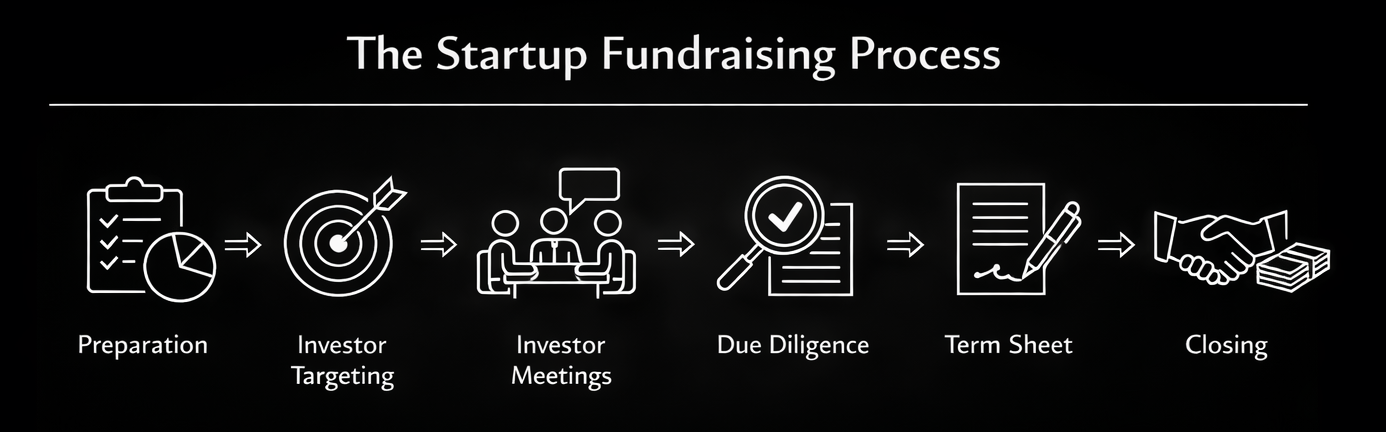
Startup Fundraising Process: The six stages of venture capital fundraising from preparation and investor targeting through investor meetings, due diligence, term sheet negotiation, and closing a venture capital funding round.
The startup fundraising process sits at the centre of the modern technology economy. Venture capital funds billions of dollars of innovation every year, yet the mechanics behind venture capital fundraising remain opaque to most founders.
Early stage companies rarely fail because capital is unavailable. They struggle because the process of raising capital is misunderstood. Founders often imagine that funding emerges from a compelling pitch or a persuasive meeting with a venture capitalist. In reality, the journey through how startups raise venture capital follows a structured sequence of preparation, investor engagement, negotiation, and closing.
This structure reflects how venture capital firms operate internally. Investors do not simply evaluate an idea and write a cheque. Each investment decision passes through layers of analysis, partner discussion, diligence, and capital allocation within the fund. Understanding this system allows founders to approach venture capital fundraising with the correct expectations and preparation.
A company that approaches the startup fundraising process as a structured campaign dramatically increases the probability of success. Preparation creates credibility. Structured outreach builds momentum among investors. Clear positioning within the venture capital funding process allows investors to understand both the opportunity and the risks associated with funding the company.
This article explains how the process actually works. It examines the operational structure of venture capital fundraising, the stages through which companies progress, and the preparation required before engaging investors.
For founders approaching institutional capital for the first time, understanding the architecture of venture capital fundraising can transform a confusing process into an organised capital strategy.
Strategy only works when aligned to the full capital system; see Startup Fundraising Explained.
How fundraising strategy shapes the capital process
The startup fundraising process operates less like a single event and more like a campaign that unfolds over several months. Investors rarely commit capital during a first conversation. Instead, venture capital funding emerges from a sequence of interactions that allow investors to evaluate the company, test the founder's assumptions, and understand the potential scale of the opportunity.
Within the venture capital fundraising process, companies move through stages that combine preparation, outreach, investor evaluation, and negotiation. Each stage serves a specific purpose within the broader investment decision cycle.
At the beginning of the process, founders assemble the materials required to present the opportunity to investors. This preparation phase establishes the narrative of the company, the structure of the market opportunity, and the capital required to reach the next stage of growth.
Once preparation is complete, founders begin engaging with investors. This stage involves identifying firms whose investment strategy aligns with the company's sector and stage. A carefully constructed investor list becomes the foundation of the venture capital fundraising campaign.
During the engagement phase, founders conduct meetings with investors, present their company, and respond to questions about the market, product, and growth trajectory. These conversations allow investors to evaluate whether the opportunity fits the mandate of their fund.
If investors see potential, the company moves into a deeper evaluation phase in which venture capital firms conduct diligence on the opportunity. The diligence process examines financial models, product performance, market dynamics, and the structure of the founding team.
Only after this analysis does the process move toward negotiation of terms and ultimately the closing of the funding round. For many founders, the most surprising aspect of how startups raise venture capital is the length and structure of this process. What appears externally as a simple funding announcement represents months of preparation and investor interaction behind the scenes.
Understanding the full sequence of the startup fundraising process helps founders organise their time, prepare the necessary materials, and approach investors with the credibility required for institutional funding.
How Startups Raise Venture Capital
The mechanism through which companies secure venture funding follows a structure that reflects the design of venture capital funds themselves. Understanding how startups raise venture capital requires understanding how venture capital firms deploy capital and evaluate opportunities.
Venture capital funds operate by investing in a portfolio of companies that have the potential to generate very large outcomes. Because many early stage companies fail, investors concentrate capital in opportunities that demonstrate the potential for rapid growth and large market impact.
Within this framework, venture capital fundraising takes place through discrete funding rounds. Each round provides capital that enables the company to reach the next stage of development while increasing the valuation of the business.
A typical venture trajectory begins with a seed round that finances product development and early market entry. Once the company demonstrates traction, it may pursue a Series A round that funds expansion of the team, product scaling, and customer acquisition. Later rounds may finance international growth or the development of new products.
Each funding round reflects a milestone within the venture capital funding process. Investors expect companies to demonstrate progress between rounds. Revenue growth, customer adoption, and product development milestones signal that the company is progressing toward a scalable business.
This milestone based model shapes the dynamics of venture capital fundraising. Investors examine the evidence available at each stage to determine whether the company has reached the threshold required for institutional investment.
Understanding this structure allows founders to frame their opportunity in a way that aligns with investor expectations. The most successful founders position their company within the context of venture capital milestones, demonstrating how the capital raised will enable the company to reach the next stage of growth.
Preparing Your Startup for Venture Capital Fundraising
Preparation determines the outcome of most venture capital fundraising campaigns. Investors encounter thousands of opportunities every year. The companies that secure funding are those that present a clear opportunity supported by credible evidence.
The process of venture capital fundraising preparation begins with the construction of a compelling narrative about the company. This narrative explains the problem the company solves, the size of the market opportunity, and the reason the founding team is uniquely positioned to build the business.
A clear narrative allows investors to quickly understand the scale of the opportunity. Venture capital firms look for companies capable of reaching very large markets. Founders who can clearly articulate the relationship between their product and a large market opportunity establish credibility with investors early in the process.
The next component of prepare startup for investors involves the creation of a structured financial model. The financial model demonstrates how capital will be deployed, how the business expects to grow, and the milestones the company intends to reach before the next funding round.
Financial models allow investors to understand the relationship between capital and growth. Venture capital firms evaluate whether the proposed use of funds aligns with the company's strategic objectives.
A third element of venture capital fundraising preparation involves organising the data room. Investors expect companies to provide access to key documents that support the claims presented in the pitch. These documents often include financial statements, market research, product documentation, customer contracts, and legal records.
A well organised data room signals operational maturity. It allows investors to evaluate the company efficiently during the diligence process.
The final element of preparation involves aligning the narrative, financial model, and operational evidence into a coherent investment story. Investors must understand not only what the company does but why it represents a compelling opportunity for venture capital investment.
Founders who complete this preparation before beginning the startup fundraising process enter investor conversations with a significant advantage. Their opportunity is clearly articulated, their evidence is organised, and their strategy aligns with the expectations of venture capital investors.
Structuring a Startup Fundraising Strategy
A successful startup fundraising strategy begins long before the first investor meeting. Founders who approach fundraising with a defined strategy are able to manage investor conversations, control the pace of the process, and shape the structure of the funding round.
The first strategic decision involves determining the size of the funding round. The round must provide enough capital to allow the company to reach the next meaningful milestone while maintaining a sustainable ownership structure for the founding team. Determining the correct amount of capital requires careful analysis of hiring plans, product development timelines, and customer acquisition costs.
Within venture capital fundraising strategy, investors often evaluate the relationship between the amount of capital requested and the progress the company expects to achieve before the next funding round. A company raising a seed round might use capital to complete product development, build its first commercial team, and demonstrate early customer traction. A company raising a Series A round may focus on scaling sales, expanding internationally, or building operational infrastructure.
The second component of startup fundraising strategy involves identifying the type of investor required to lead the round. Venture capital rounds typically require a lead investor who commits a substantial portion of the capital and establishes the valuation for the round. Other investors then participate alongside the lead investor by contributing smaller allocations.
Lead investors play a central role in the venture capital funding process. They conduct detailed diligence, negotiate the terms of the investment, and often take a board seat within the company. Because of this responsibility, founders must carefully consider which investors they approach as potential leads.
Another element of structuring a venture capital fundraising strategy involves the allocation of the round among investors. Venture rounds frequently include a combination of institutional venture capital firms, angel investors, and strategic partners. Each group contributes different types of expertise and networks to the company.
A well structured funding round creates alignment between founders and investors. It provides the capital required for growth while maintaining a cap table that supports future rounds of investment. By approaching fundraising with a deliberate strategy, founders ensure that the capital raised strengthens the long term trajectory of the company.
Launching a Venture Capital Fundraising Campaign
Once preparation is complete and the round structure is defined, founders move into the phase of actively approaching venture capital investors. This phase transforms preparation into a structured startup investor outreach campaign designed to create momentum among investors.
Momentum plays a critical role in venture capital fundraising. Investors often interpret the level of interest from other investors as a signal of opportunity. A well organised fundraising campaign therefore attempts to concentrate investor meetings within a relatively short time frame. This concentration allows interest to build across the investor community.
The first step in launching the campaign involves securing introductions to investors. Venture capital firms often prefer to receive opportunities through trusted networks such as founders, operators, or other investors. Warm introductions provide context for the opportunity and increase the likelihood that the investor will review the company.
After introductions are secured, founders begin scheduling meetings with investors. Early meetings serve as opportunities to refine the presentation of the company and to gather feedback about the opportunity. Investors often provide valuable insights about the market, the product, and the company's positioning within the competitive landscape.
As the campaign progresses, founders continue expanding their startup investor outreach to additional venture firms. Maintaining a steady flow of meetings ensures that the company remains visible within the investor community.
Communication during this stage requires careful management. Founders must provide investors with sufficient information to evaluate the opportunity while maintaining a clear narrative about the company's progress and market potential.
Successful venture capital fundraising campaigns often involve dozens of investor conversations. Each conversation builds familiarity with the company and increases the probability that an investor will decide to pursue the opportunity further.
How Venture Capital Investor Meetings Work
The structure of venture capital meetings follows a pattern that reflects how venture firms evaluate investment opportunities. Understanding this pattern helps founders prepare for the different types of discussions that occur throughout the fundraising campaign.
The first meeting typically serves as an introduction between the founding team and the investor. During this conversation founders present the company's vision, the market opportunity, and the progress achieved to date. Investors use this meeting to determine whether the opportunity fits within their investment thesis.
If the investor remains interested after the initial meeting, the process moves into a deeper discussion phase. These conversations often involve additional partners from the venture firm. The focus shifts toward examining the business model, customer traction, and the long term potential of the market.
During subsequent startup investor meetings, investors frequently request additional information that helps them understand the opportunity in greater depth. This may include access to financial models, product demonstrations, or conversations with customers.
As interest grows, the opportunity may be presented to the broader partnership within the venture firm. Many venture capital firms make investment decisions collectively. Partners review the opportunity, discuss the risks and potential returns, and determine whether the company aligns with the fund's investment strategy.
For founders, the progression of venture capital meetings provides insight into how seriously an investor is evaluating the opportunity. Moving from an introductory meeting to a partner discussion signals that the firm is actively considering the investment.
Preparing for each stage of investor interaction allows founders to present their company with clarity and confidence. Understanding how meetings unfold also helps founders manage expectations throughout the fundraising process.
What Happens During Venture Capital Due Diligence
When a venture capital firm decides to explore an investment in depth, the process enters the stage known as venture capital due diligence. During this stage investors examine the company carefully to confirm the assumptions underlying the investment opportunity.
The purpose of startup investor diligence is to reduce uncertainty. Venture capital investors accept high levels of risk, yet they seek to understand the major variables that could influence the success of the company.
Financial diligence represents one component of this evaluation. Investors analyse the company's financial model, revenue projections, and operating costs. They examine how capital will be deployed and assess whether the proposed plan for growth appears realistic.
Product evaluation forms another aspect of venture capital due diligence. Investors often review the underlying technology, product architecture, and the roadmap for future development. In some cases venture firms may engage external experts to assess the product or the technical approach adopted by the company.
Market analysis also plays a central role in the diligence process. Investors study the competitive landscape, the potential size of the market, and the barriers that might protect the company from competitors.
Legal diligence represents the final component of the review. Venture firms examine the company's corporate structure, intellectual property ownership, and contractual obligations. These checks ensure that the company is structured appropriately for investment.
The diligence phase provides investors with the information required to determine whether the opportunity justifies the risk of investment. For founders, preparation during earlier stages of the startup fundraising process often determines how efficiently this stage unfolds. Companies that organise their financial information, legal documents, and operational records in advance enable investors to complete diligence more quickly and confidently.
How Venture Capital Term Sheets Work
When a venture capital firm decides to proceed with an investment, the conversation moves into the negotiation phase. This phase begins with the presentation of a venture capital term sheet, a document that outlines the core economic and governance terms of the investment.
The startup term sheet process establishes the relationship between founders and investors for the duration of the investment. Although term sheets vary across firms and jurisdictions, most include a set of standard components that determine how ownership, control, and future financing events will operate.
One of the most visible elements of the venture capital term sheet is the valuation of the company. The valuation determines the percentage of ownership that investors receive in exchange for the capital invested. Founders and investors negotiate valuation based on the company's stage of development, the size of the market opportunity, and the competitive dynamics surrounding the investment round.
Another central component of the startup term sheet process involves the allocation of equity within the funding round. The lead investor often receives the largest portion of the round and plays a central role in structuring the investment. Other investors may participate alongside the lead investor with smaller allocations.
Governance provisions also appear within the venture capital term sheet. These provisions define how decisions are made within the company once investors join the cap table. Investors may request board representation, information rights, and protective provisions that allow them to participate in key strategic decisions.
The term sheet stage represents a critical moment within the venture capital funding process. Although the document itself is typically non binding, it sets the framework for the legal agreements that follow. Founders therefore benefit from understanding the implications of each term and how it influences the long term ownership and governance structure of the company.
Once founders and investors agree on the terms of the investment, the process moves forward to the legal documentation required to complete the funding round.
Closing a Venture Capital Funding Round
After the term sheet has been agreed, the closing venture capital round stage begins. During this phase lawyers representing the company and the investors draft the legal agreements that formalise the investment.
The startup funding closing process typically includes several core documents. These may include a share purchase agreement, an amended shareholders agreement, and updated company constitutional documents. Together these agreements establish the rights and obligations of all shareholders after the investment.
Legal documentation also formalises the governance arrangements agreed in the term sheet. Board composition, voting rights, and investor protections are recorded in the final agreements.
Another important aspect of closing venture capital round involves updating the company's capital structure. The cap table reflects the ownership of the company after the investment and records the distribution of shares among founders, employees, and investors.
Once all legal documentation is completed, the final step of the startup funding closing process occurs when investors transfer capital into the company's bank account. This moment marks the official completion of the funding round.
For founders, closing the funding round represents both the end of the venture capital fundraising campaign and the beginning of a new phase of company growth. With capital secured, the company moves forward with executing the strategy that was presented to investors during the fundraising process.
The Four Stages of Venture Capital Fundraising
The venture capital fundraising stages follow a pattern that reflects both founder preparation and investor decision making. Although each funding round unfolds differently, most companies progress through four core stages within the startup fundraising stages.
The first stage is preparation. During this phase the company assembles the materials required to communicate the opportunity to investors. Preparation includes constructing a coherent narrative about the market opportunity, building a financial model that explains how capital will be deployed, and organising the documents required for investor diligence.
The second stage involves investor targeting. Founders identify venture capital firms whose investment thesis aligns with the company's sector, stage, and growth trajectory. Targeting allows founders to concentrate their efforts on investors who actively fund companies with similar characteristics.
The third stage is investor engagement. At this stage founders begin meeting with investors, presenting the company, and answering questions about the opportunity. Engagement allows investors to evaluate the founder's vision, assess the product, and analyse the potential market size.
The final stage involves closing the funding round. Once an investor decides to lead the round, the process moves into negotiation of valuation, allocation of equity, and legal documentation. After these steps are completed, the capital is transferred to the company and the round officially closes.
Understanding these venture capital fundraising stages allows founders to approach the process with clarity. Each stage requires different preparation, different communication strategies, and different expectations about investor behaviour.
Why Many Startup Fundraising Processes Fail
Despite the availability of venture capital globally, many companies struggle to complete the startup fundraising process. Failure often stems from misunderstandings about how venture capital investors evaluate opportunities and how the fundraising campaign should be structured.
One common challenge involves weak preparation. Investors evaluate hundreds of companies every year. Founders who begin venture capital fundraising without a clear narrative, organised data room, or credible financial model often struggle to sustain investor interest.
Another issue arises from poor investor targeting. The venture capital ecosystem includes firms that specialise in specific sectors, stages, and geographies. When founders approach investors whose mandate does not align with the company's profile, conversations rarely progress beyond an initial meeting.
Fragmented outreach also undermines many startup fundraising efforts. Founders who approach investors sporadically over long periods of time often lose the momentum required to generate competitive interest. Venture capital fundraising benefits from concentrated outreach that allows investors to see that other investors are actively evaluating the opportunity.
A further challenge involves misalignment between the company's stage and the expectations of institutional investors. Venture capital firms often expect clear evidence of traction before committing capital. Companies that approach venture investors before demonstrating sufficient market validation may struggle to secure funding.
Understanding these challenges allows founders to approach the venture capital funding process with greater clarity. Preparation, targeting, and disciplined execution significantly improve the likelihood of a successful fundraising outcome.
How Fundraising Platforms Improve Venture Capital Execution
The increasing complexity of venture capital fundraising has led to the emergence of specialised startup fundraising platforms designed to help founders manage the process more effectively.
These platforms organise many of the operational elements of venture capital fundraising. They provide structured environments where founders can assemble data rooms, track investor engagement, and manage the communication required during a fundraising campaign.
Within a venture capital fundraising tools environment, founders can present their company in a format that aligns with investor expectations. Structured investor materials, organised documentation, and transparent communication channels simplify the evaluation process for investors.
Some platforms also support the formation of investment vehicles such as Special Purpose Vehicles. These structures allow groups of investors to participate collectively in funding rounds while simplifying the administrative process for founders.
For founders navigating the startup fundraising process, structured platforms provide a framework that helps coordinate the many moving parts of the fundraising campaign. Investor communication, document management, and capital allocation can be managed within a single environment.
Platforms such as MoonshotNX illustrate how digital infrastructure can streamline venture capital fundraising. By organising the preparation, evaluation, and execution stages of fundraising, structured platforms reduce friction between founders and investors.
As the venture ecosystem continues to evolve, technology platforms increasingly support the operational side of the venture capital funding process, enabling founders to focus on building companies while maintaining disciplined capital strategy.
Frequently Asked Questions About Startup Fundraising
How long does it take to raise venture capital
The duration of the startup fundraising process varies depending on the stage of the company and market conditions. Early stage rounds may take several months to complete, while larger growth rounds can take longer due to more extensive diligence and negotiation.
How many investors should founders approach
Founders often speak with many investors during venture capital fundraising campaigns. The number depends on the stage of the company and the size of the round. Concentrated outreach within a defined time frame typically improves the efficiency of the process.
What do venture capital investors expect from startups
Investors evaluating opportunities within the venture capital funding process typically examine market size, product differentiation, customer traction, and the capability of the founding team. Evidence that the company can scale rapidly within a large market significantly influences investment decisions.
What documents do investors require before investing
During venture capital due diligence, investors often review financial models, product documentation, legal records, customer contracts, and other operational materials. Organising these documents in advance supports a smoother evaluation process.
To understand how this strategy is executed within the full startup fundraising process, read the complete guide here.
Capital Framework
Capital is not raised through narrative alone. It moves through structure, sequencing and disciplined execution. Capital Framework sets out the principles and structural progression required before institutional capital will engage.
Beyond Analysis
Capital Intelligence provides the structural research layer behind the applied capital sequencing within MoonshotNX. Founders who require structured assessment can engage the Capital Readiness Audit or review the Funding & SPV framework for deployment pathways.
Archive Structure
Capital Intelligence is maintained as a structured methodology archive. Articles are updated periodically to reflect regulatory shifts, capital deployment trends, and evolving institutional standards.
Each entry is designed to stand independently while contributing to a coherent analytical framework.