

THE CAPITAL STACK PLATFORM™
Investor Startup Evaluation Framework
Venture capital firms evaluate startups using a structured framework that considers market opportunity, founder capability, product differentiation, traction, and risk. While every venture capital firm has its own internal investment process, most investment decisions rely on a small number of core evaluation dimensions. These dimensions help investors determine whether a startup has the potential to produce venture-scale returns.
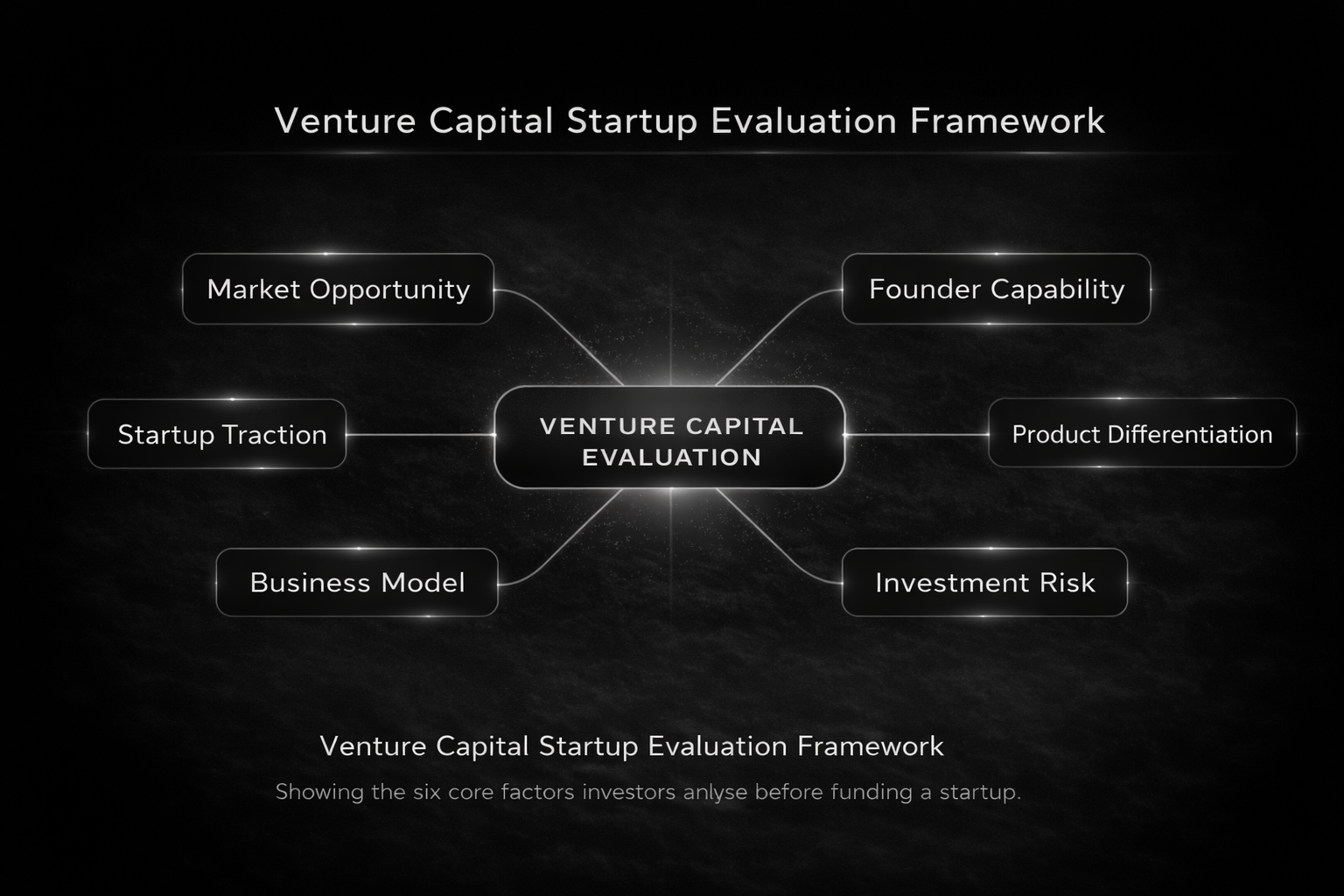
Venture Capital Startup Evaluation Framework showing the six core factors investors analyse before funding a startup.
How Venture Capital Investors Evaluate Startups
Every year, thousands of founders attempt to raise venture capital funding. Only a small number of these companies successfully secure investment from institutional venture capital firms. The reason is simple: venture capital investors follow a structured evaluation process that determines whether a startup has the potential to produce venture-scale returns.
Understanding what investors look for in startups requires understanding how venture capital firms make investment decisions. Venture capital investing operates within a portfolio model in which investors expect most companies to fail while a small number of companies generate extremely large outcomes. Because of this return structure, venture capital investors evaluate startup opportunities using criteria that focus on scale, growth potential, and competitive advantage.
When founders search online for guidance about venture capital evaluation, they often encounter simplified advice that emphasises pitch decks or storytelling. In reality, the evaluation process used by venture capital firms is far more analytical. Investors examine markets, analyse traction data, assess founder capability, and evaluate the structural defensibility of the company’s product or technology.
This article explains how venture capital investors evaluate startups and how those evaluation frameworks influence investment decisions. The goal is to make the investor decision process visible so founders can better understand how venture capital firms analyse opportunities before committing capital.
How Venture Capital Investors Evaluate Startups
When venture capital investors analyse a startup, they typically focus on a small number of core evaluation dimensions. These dimensions form the foundation of venture capital evaluation criteria across most institutional investment firms.
Although individual venture capital funds may prioritise certain factors differently depending on their investment strategy, the underlying evaluation framework is remarkably consistent across the venture capital industry.
Investors generally analyse startups across six core areas:
Market opportunity
Founder capability
Product differentiation
Startup traction
Business model structure
Investment risk
These dimensions represent the structural elements that determine whether a startup has the potential to produce venture-scale outcomes.
Market Opportunity
The first factor investors examine is the size and growth potential of the market in which the startup operates. Venture capital firms invest in companies that can grow into extremely large businesses, which means the underlying market must be large enough to support significant expansion.
Investors typically analyse market opportunity using several indicators, including total addressable market, market growth rate, and competitive landscape. A startup operating in a small or stagnant market is unlikely to generate the scale required to produce the returns venture capital investors expect.
Founder Capability
The founding team plays a central role in startup investor evaluation. Venture capital investors often emphasise the importance of founder capability because early stage companies face significant uncertainty and operational complexity.
Investors evaluate founders based on factors such as domain expertise, execution ability, leadership capability, and adaptability. In many early stage investments, the quality of the founding team can carry more weight than early product traction.
Product Differentiation
Another critical dimension of venture capital evaluation is the uniqueness and defensibility of the startup’s product or technology. Investors analyse whether the company has developed a product that offers a meaningful advantage over existing alternatives.
Product differentiation may arise from proprietary technology, unique data assets, network effects, or strong brand positioning. Companies that lack defensible differentiation often face intense competition, which can reduce long-term growth potential.
Startup Traction
Traction provides evidence that a startup’s product is gaining market adoption. Venture capital investors evaluate traction using metrics such as user growth, revenue growth, customer acquisition efficiency, and retention rates.
Strong traction signals that the company has discovered a viable market opportunity and is beginning to scale its operations.
Business Model Structure
Investors also analyse how the company generates revenue and whether the business model can support scalable growth. Subscription models, marketplace dynamics, and platform economics can influence the attractiveness of a startup’s business model.
A business model that scales efficiently as the company grows increases the likelihood that the startup can achieve venture-scale outcomes.
Investment Risk
Finally, venture capital investors analyse the risk profile of the opportunity. Risk factors may include market uncertainty, technological feasibility, regulatory challenges, and operational execution risks.
Understanding these factors allows investors to determine whether the potential return justifies the level of uncertainty associated with the investment.
How Venture Capital Investors Evaluate Startup Opportunities
Venture capital firms do not make investment decisions in a single step. Most opportunities move through a defined internal process that starts with deal sourcing and initial screening, then progresses through partner review, due diligence, investment committee discussion, and a final investment decision. The diagram below shows how venture capital firms typically evaluate startup opportunities before deciding whether to invest.
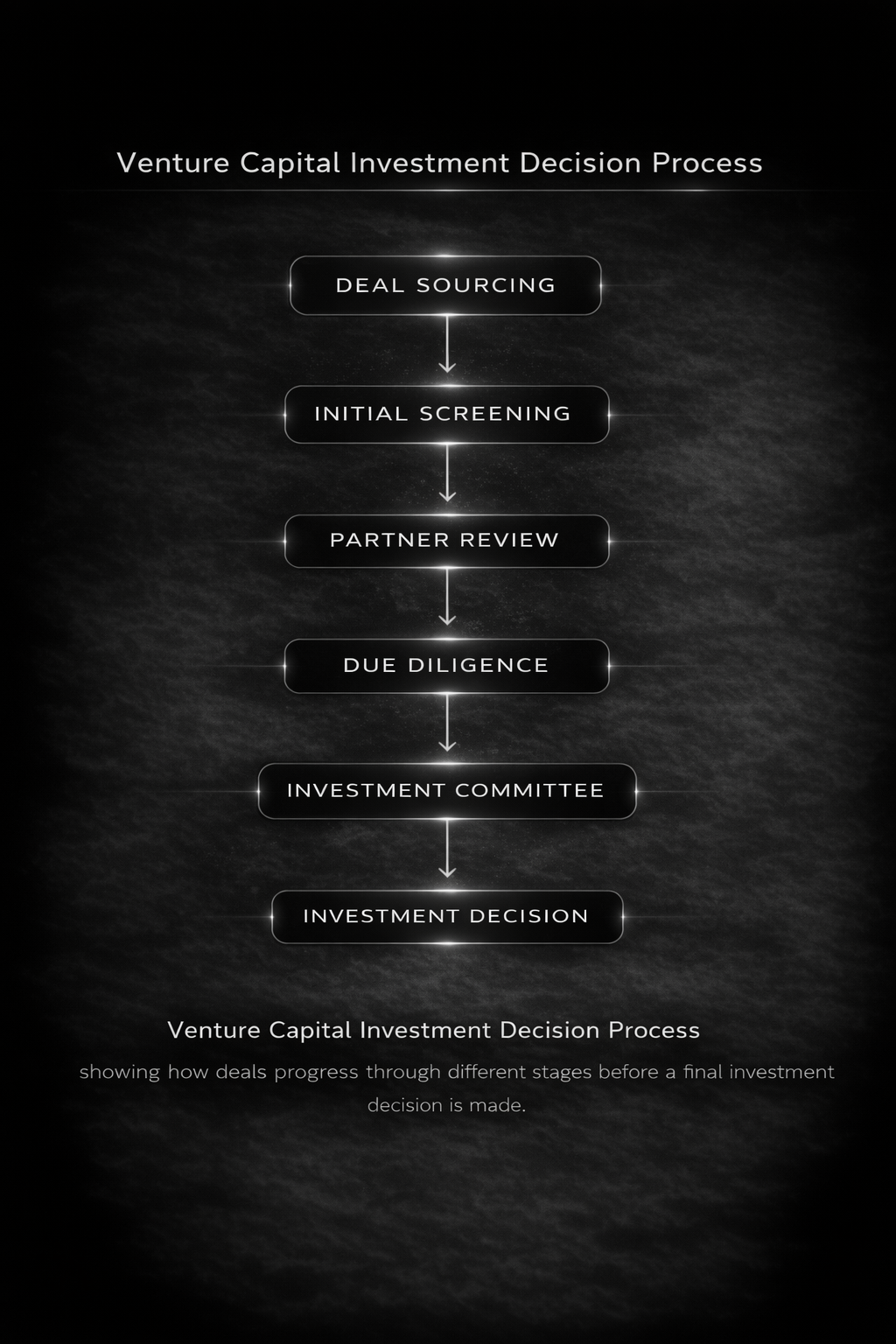
Venture Capital Investment Decision Process: How startup opportunities move from sourcing and screening through due diligence and final investment approval.
The evaluation process used by venture capital firms typically follows a structured internal workflow that allows investors to analyse opportunities efficiently. Understanding how venture capital investors evaluate startups requires examining the internal processes that venture capital firms use to review potential investments.
Most venture capital firms review hundreds or even thousands of startup opportunities each year. Because of this high deal volume, investors rely on a multi-stage screening process to identify the most promising opportunities.
Deal Sourcing
The evaluation process begins with deal sourcing. Venture capital firms discover startup opportunities through founder outreach, professional networks, accelerators, and industry referrals.
Once a startup enters a venture capital firm’s deal pipeline, the opportunity typically undergoes an initial screening process.
Initial Screening
During the screening stage, investors quickly evaluate whether the opportunity aligns with the firm’s investment strategy. Factors such as industry focus, stage of development, geographic location, and market size influence whether the opportunity proceeds to deeper evaluation.
Startups that meet the firm’s basic investment criteria may advance to internal discussions among the investment team.
Partner Discussion
If an opportunity appears promising, the deal is often discussed during internal partner meetings. At this stage, investors analyse the startup’s market opportunity, founding team, product differentiation, and early traction.
These discussions help determine whether the firm should allocate additional time and resources to evaluating the opportunity.
Due Diligence Preparation
When a venture capital firm decides to pursue an opportunity further, the startup may enter a due diligence process in which investors gather detailed information about the company’s operations, financial performance, and product capabilities.
The due diligence process allows investors to validate the assumptions made during the earlier stages of evaluation.
Investment Committee Review
Many venture capital firms make final investment decisions through an internal investment committee. The committee reviews the deal, evaluates the risks and potential returns, and decides whether the firm will proceed with the investment.
This structured process helps venture capital firms maintain consistency in how investment decisions are made.
How Venture Capital Investors Analyse Market Opportunities
One of the most important factors in venture capital evaluation is the size and structure of the market a startup intends to serve. Venture capital investors seek opportunities that can grow into extremely large companies. Because of this, the first question many investors ask when analysing a startup opportunity is whether the underlying market can support the scale required for venture returns.
When conducting venture capital market analysis, investors typically examine three dimensions: total market size, market growth rate, and the competitive structure of the industry.
Total Addressable Market
The total addressable market represents the maximum potential demand for a product or service if the company were able to capture the entire market. Venture capital investors frequently refer to this as the TAM.
A large startup market size venture capital opportunity increases the probability that the company can grow into a substantial business. If the addressable market is small, even a successful company may struggle to produce the level of returns venture capital investors expect.
Market Growth
Market growth rate also influences how investors interpret the opportunity. A rapidly expanding market allows startups to capture customers more easily because demand is increasing over time.
In contrast, companies operating in stagnant or declining markets may face significant resistance when attempting to expand. Even strong products can struggle to gain traction if the broader market environment is not supportive.
Competitive Landscape
The structure of the competitive environment also influences venture capital market analysis. Investors analyse whether the market is fragmented, dominated by incumbents, or experiencing disruption from emerging technologies.
Markets that allow new entrants to challenge established players often attract strong venture capital interest. Conversely, markets dominated by entrenched incumbents with significant barriers to entry may discourage investment unless the startup demonstrates a clear competitive advantage.
By analysing these factors together, investors form an initial view of whether the opportunity has the scale required to justify venture capital investment.
How Venture Capital Investors Evaluate Startup Traction
Traction represents the observable evidence that a startup’s product or service is gaining adoption within its target market. For venture capital investors, traction serves as one of the most reliable indicators that a company has identified a real customer need and is beginning to scale its operations.
When evaluating startup traction investors typically focus on a combination of growth signals that demonstrate demand for the product.
User Growth
User adoption provides one of the earliest indicators that a product is resonating with customers. Investors often examine how quickly the user base is expanding and whether growth is accelerating over time.
Rapid user growth suggests that the product is solving a meaningful problem within the market. In some cases, investors may prioritise user growth even when revenue has not yet materialised, particularly for technology platforms that intend to monetise their user base later.
Revenue Growth
Revenue represents another critical signal within venture capital traction metrics. Investors analyse how consistently revenue is increasing and whether the company has established repeatable sales processes.
Companies demonstrating strong revenue growth may attract more investor interest because revenue confirms that customers are willing to pay for the product.
Customer Retention
Retention metrics reveal whether customers continue using the product after their initial adoption. High retention rates indicate that customers derive ongoing value from the product, which strengthens the company’s long-term growth prospects.
For venture capital investors, the combination of user growth, revenue expansion, and strong retention often signals that the startup is approaching product market fit.
How Venture Capital Investors Evaluate Founding Teams
While markets and products influence investment decisions, many venture capital investors believe that the founding team ultimately determines whether a startup succeeds. Because early stage companies operate in environments of high uncertainty, investors often place significant weight on startup founding team evaluation.
The evaluation of founders typically focuses on several dimensions: domain expertise, execution capability, leadership qualities, and resilience.
Domain Expertise
Founders who possess deep knowledge of the industry they are addressing often attract stronger investor confidence. Domain expertise enables founders to understand customer problems more deeply and identify opportunities that others may overlook.
Execution Capability
Investors frequently emphasise the ability of founders to execute effectively. Execution capability includes the ability to build products quickly, attract talented team members, and navigate operational challenges as the company grows.
Within venture capital founder assessment, investors may evaluate how founders have handled previous projects or companies. Past achievements can provide signals about how the team may perform in the future.
Leadership and Team Building
As startups grow, founders must transition from building products to leading organisations. Investors analyse whether founders can attract skilled employees, build strong teams, and create organisational structures capable of supporting rapid growth.
Adaptability
Startups frequently encounter unexpected challenges. Markets evolve, technologies shift, and competitive dynamics change. Investors therefore value founders who demonstrate adaptability and the willingness to revise strategies when necessary.
These qualities together shape the venture capital founder assessment process that determines whether investors believe the founding team can execute the company’s vision.
How Venture Capital Investors Evaluate Product Differentiation
In addition to market opportunity and founder capability, venture capital investors carefully analyse whether a startup’s product offers meaningful differentiation relative to existing alternatives. A company that lacks clear differentiation may struggle to maintain long-term competitive advantage.
During venture capital product evaluation, investors typically focus on three dimensions: technological advantage, defensibility, and scalability.
Technological Advantage
Some startups create differentiation through proprietary technology. Advanced algorithms, specialised hardware, or unique engineering solutions may provide advantages that competitors cannot easily replicate.
When evaluating technological advantage, investors often examine the complexity of the technology and the resources required to reproduce it.
Defensibility
Defensibility refers to the mechanisms that protect a company’s position within the market. Network effects, intellectual property, data advantages, and strong brand positioning can all contribute to defensibility.
Companies with strong defensibility are more likely to maintain their market position as competitors emerge.
Scalability
Finally, investors analyse whether the product can scale efficiently as demand increases. Software platforms and digital marketplaces often scale more easily than products that require extensive physical infrastructure.
For this reason, scalable technology platforms frequently attract strong venture capital interest.
By analysing startup product differentiation, investors determine whether the company possesses a sustainable competitive advantage capable of supporting long-term growth.
How Venture Capital Investors Evaluate Startup Opportunities
Venture capital firms do not make investment decisions in a single step. Most opportunities move through a defined internal process that starts with deal sourcing and initial screening, then progresses through partner review, due diligence, investment committee discussion, and a final investment decision. The diagram below shows how venture capital firms typically evaluate startup opportunities before deciding whether to invest.
Venture Capital Investment Decision Process: How startup opportunities move from sourcing and screening through due diligence and final investment approval.
The evaluation process used by venture capital firms typically follows a structured internal workflow that allows investors to analyse opportunities efficiently. Understanding how venture capital investors evaluate startups requires examining the internal processes that venture capital firms use to review potential investments.
Most venture capital firms review hundreds or even thousands of startup opportunities each year. Because of this high deal volume, investors rely on a multi-stage screening process to identify the most promising opportunities.
Deal Sourcing
The evaluation process begins with deal sourcing. Venture capital firms discover startup opportunities through founder outreach, professional networks, accelerators, and industry referrals.
Once a startup enters a venture capital firm’s deal pipeline, the opportunity typically undergoes an initial screening process.
Initial Screening
During the screening stage, investors quickly evaluate whether the opportunity aligns with the firm’s investment strategy. Factors such as industry focus, stage of development, geographic location, and market size influence whether the opportunity proceeds to deeper evaluation.
Startups that meet the firm’s basic investment criteria may advance to internal discussions among the investment team.
Partner Discussion
If an opportunity appears promising, the deal is often discussed during internal partner meetings. At this stage, investors analyse the startup’s market opportunity, founding team, product differentiation, and early traction.
These discussions help determine whether the firm should allocate additional time and resources to evaluating the opportunity.
Due Diligence Preparation
When a venture capital firm decides to pursue an opportunity further, the startup may enter a due diligence process in which investors gather detailed information about the company’s operations, financial performance, and product capabilities.
The due diligence process allows investors to validate the assumptions made during the earlier stages of evaluation.
Investment Committee Review
Many venture capital firms make final investment decisions through an internal investment committee. The committee reviews the deal, evaluates the risks and potential returns, and decides whether the firm will proceed with the investment.
This structured process helps venture capital firms maintain consistency in how investment decisions are made.
How Venture Capital Investors Analyse Market Opportunities
One of the most important factors in venture capital evaluation is the size and structure of the market a startup intends to serve. Venture capital investors seek opportunities that can grow into extremely large companies. Because of this, the first question many investors ask when analysing a startup opportunity is whether the underlying market can support the scale required for venture returns.
When conducting venture capital market analysis, investors typically examine three dimensions: total market size, market growth rate, and the competitive structure of the industry.
Total Addressable Market
The total addressable market represents the maximum potential demand for a product or service if the company were able to capture the entire market. Venture capital investors frequently refer to this as the TAM.
A large startup market size venture capital opportunity increases the probability that the company can grow into a substantial business. If the addressable market is small, even a successful company may struggle to produce the level of returns venture capital investors expect.
Market Growth
Market growth rate also influences how investors interpret the opportunity. A rapidly expanding market allows startups to capture customers more easily because demand is increasing over time.
In contrast, companies operating in stagnant or declining markets may face significant resistance when attempting to expand. Even strong products can struggle to gain traction if the broader market environment is not supportive.
Competitive Landscape
The structure of the competitive environment also influences venture capital market analysis. Investors analyse whether the market is fragmented, dominated by incumbents, or experiencing disruption from emerging technologies.
Markets that allow new entrants to challenge established players often attract strong venture capital interest. Conversely, markets dominated by entrenched incumbents with significant barriers to entry may discourage investment unless the startup demonstrates a clear competitive advantage.
By analysing these factors together, investors form an initial view of whether the opportunity has the scale required to justify venture capital investment.
How Venture Capital Investors Evaluate Startup Traction
Traction represents the observable evidence that a startup’s product or service is gaining adoption within its target market. For venture capital investors, traction serves as one of the most reliable indicators that a company has identified a real customer need and is beginning to scale its operations.
When evaluating startup traction investors typically focus on a combination of growth signals that demonstrate demand for the product.
User Growth
User adoption provides one of the earliest indicators that a product is resonating with customers. Investors often examine how quickly the user base is expanding and whether growth is accelerating over time.
Rapid user growth suggests that the product is solving a meaningful problem within the market. In some cases, investors may prioritise user growth even when revenue has not yet materialised, particularly for technology platforms that intend to monetise their user base later.
Revenue Growth
Revenue represents another critical signal within venture capital traction metrics. Investors analyse how consistently revenue is increasing and whether the company has established repeatable sales processes.
Companies demonstrating strong revenue growth may attract more investor interest because revenue confirms that customers are willing to pay for the product.
Customer Retention
Retention metrics reveal whether customers continue using the product after their initial adoption. High retention rates indicate that customers derive ongoing value from the product, which strengthens the company’s long-term growth prospects.
For venture capital investors, the combination of user growth, revenue expansion, and strong retention often signals that the startup is approaching product market fit.
How Venture Capital Investors Evaluate Founding Teams
While markets and products influence investment decisions, many venture capital investors believe that the founding team ultimately determines whether a startup succeeds. Because early stage companies operate in environments of high uncertainty, investors often place significant weight on startup founding team evaluation.
The evaluation of founders typically focuses on several dimensions: domain expertise, execution capability, leadership qualities, and resilience.
Domain Expertise
Founders who possess deep knowledge of the industry they are addressing often attract stronger investor confidence. Domain expertise enables founders to understand customer problems more deeply and identify opportunities that others may overlook.
Execution Capability
Investors frequently emphasise the ability of founders to execute effectively. Execution capability includes the ability to build products quickly, attract talented team members, and navigate operational challenges as the company grows.
Within venture capital founder assessment, investors may evaluate how founders have handled previous projects or companies. Past achievements can provide signals about how the team may perform in the future.
Leadership and Team Building
As startups grow, founders must transition from building products to leading organisations. Investors analyse whether founders can attract skilled employees, build strong teams, and create organisational structures capable of supporting rapid growth.
Adaptability
Startups frequently encounter unexpected challenges. Markets evolve, technologies shift, and competitive dynamics change. Investors therefore value founders who demonstrate adaptability and the willingness to revise strategies when necessary.
These qualities together shape the venture capital founder assessment process that determines whether investors believe the founding team can execute the company’s vision.
How Venture Capital Investors Evaluate Product Differentiation
In addition to market opportunity and founder capability, venture capital investors carefully analyse whether a startup’s product offers meaningful differentiation relative to existing alternatives. A company that lacks clear differentiation may struggle to maintain long-term competitive advantage.
During venture capital product evaluation, investors typically focus on three dimensions: technological advantage, defensibility, and scalability.
Technological Advantage
Some startups create differentiation through proprietary technology. Advanced algorithms, specialised hardware, or unique engineering solutions may provide advantages that competitors cannot easily replicate.
When evaluating technological advantage, investors often examine the complexity of the technology and the resources required to reproduce it.
Defensibility
Defensibility refers to the mechanisms that protect a company’s position within the market. Network effects, intellectual property, data advantages, and strong brand positioning can all contribute to defensibility.
Companies with strong defensibility are more likely to maintain their market position as competitors emerge.
Scalability
Finally, investors analyse whether the product can scale efficiently as demand increases. Software platforms and digital marketplaces often scale more easily than products that require extensive physical infrastructure.
For this reason, scalable technology platforms frequently attract strong venture capital interest.
By analysing startup product differentiation, investors determine whether the company possesses a sustainable competitive advantage capable of supporting long-term growth.
How Venture Capital Firms Make Investment Decisions
The evaluation of a startup opportunity eventually leads to a formal investment decision inside the venture capital firm. Although venture capital firms vary in size and structure, most follow a broadly similar internal process when deciding whether to invest in a company.
Because venture capital firms review a large number of opportunities each year, decision making must be structured. Investment teams typically move opportunities through a series of internal discussions that allow partners to evaluate the company from multiple perspectives before committing capital.
Once a startup has passed the initial screening stage, the opportunity is often discussed in internal partner meetings. During these meetings, members of the investment team review the company’s market opportunity, traction, product differentiation, and the capability of the founding team. These discussions help determine whether the firm should continue evaluating the opportunity or move on to other potential investments.
If the investment team develops conviction around the opportunity, the firm may begin to consider whether it wants to lead the investment round. In venture capital funding rounds, one firm typically acts as the lead investor. The lead investor negotiates the valuation, establishes the structure of the investment, and coordinates participation from other investors.
Because this role carries significant responsibility, venture capital firms carefully consider whether they want to lead a particular investment. The decision often reflects the firm’s level of conviction in the company and its alignment with the firm’s broader investment strategy.
Many venture capital firms formalise the final decision through an investment committee. The committee reviews the opportunity in detail and evaluates the potential risk and return profile of the investment. If the committee approves the opportunity, the firm proceeds to negotiate final terms with the founders and prepare the legal documentation required to complete the investment.
What Happens During Venture Capital Due Diligence
When a venture capital firm decides to pursue an investment seriously, the opportunity enters the due diligence phase. Due diligence is the stage during which investors verify the assumptions they have formed about the company during earlier discussions.
The purpose of due diligence is to ensure that the company’s claims about its product, market position, and financial performance are supported by evidence. Investors analyse the company’s operations, financial data, legal structure, and product capabilities to confirm that the opportunity aligns with the expectations developed during the evaluation process.
Financial diligence focuses on understanding the company’s revenue model, cost structure, and financial projections. Investors review financial models to assess whether the company’s growth assumptions are realistic and whether the business model can support sustainable expansion.
Product diligence examines the company’s technology or product offering. Investors may analyse the architecture of the product, the development roadmap, and the technical advantages that differentiate the company from competitors. In some cases, venture capital firms consult external technical experts to evaluate the feasibility of complex technologies.
Legal diligence focuses on the company’s corporate structure and contractual relationships. Investors review incorporation documents, intellectual property ownership, employment agreements, and customer contracts to ensure that no legal issues could disrupt the company’s future operations.
Through this process, investors aim to reduce uncertainty and confirm that the opportunity matches the expectations established during earlier stages of evaluation.
What Investors Verify Before Funding a Startup
In addition to broader due diligence, investors often follow a structured checklist before committing capital. This checklist helps ensure that the company’s financial, legal, and operational foundations are sound.
One of the first elements investors examine is the company’s capital structure. The capitalisation table reveals how ownership is distributed among founders, employees, and existing investors. Investors analyse the cap table to understand how previous funding rounds were structured and how future rounds may affect ownership.
The financial model is another critical component of investor review. A well-constructed financial model explains how the company plans to generate revenue, manage operating costs, and reach future growth milestones. Investors examine these projections carefully to determine whether the assumptions behind them are realistic.
Legal documentation also receives close attention. Investors review incorporation records, shareholder agreements, intellectual property assignments, and major commercial contracts. These documents confirm that the company owns its assets and that its legal structure supports future growth.
Operational metrics provide another important source of insight. Investors often examine data related to customer acquisition, product engagement, and revenue performance. These metrics help investors understand how the company performs on a day-to-day basis and whether the business model is gaining traction.
By verifying these elements before funding a startup, investors reduce the uncertainty associated with early stage investments.
How Venture Capital Investors Assess Startup Risk
Venture capital investing always involves uncertainty. However, investors still analyse the risks associated with each opportunity before committing capital. The objective is not to eliminate risk entirely but to understand the different types of uncertainty involved and determine whether the potential return justifies the investment.
Market risk represents one of the most important considerations. Investors evaluate whether the market opportunity is large enough to support the company’s growth and whether demand for the product is likely to expand over time. Companies operating in rapidly growing markets often attract stronger investor interest because growth creates more opportunities for expansion.
Execution risk relates to the ability of the founding team to build the company successfully. Even strong ideas can fail if the team struggles to execute. Investors therefore evaluate the experience of the founders, their ability to recruit talented employees, and their capacity to navigate the operational challenges associated with scaling a startup.
Technology risk arises when the company’s product depends on technical breakthroughs that may take time to develop. Investors analyse whether the technology is feasible and whether the company can realistically deliver the product it promises.
Capital risk reflects the possibility that the company may require additional funding sooner than expected. Investors examine financial projections to determine whether the company has sufficient resources to reach key milestones before raising another round of capital.
By analysing these different categories of risk, venture capital investors form a clearer picture of the uncertainty surrounding the investment and decide whether the potential reward justifies that uncertainty.
Startup Risk Assessment Matrix
Venture capital investors analyse several categories of risk before committing capital to a startup. These risks include the size and growth of the market, the ability of the founders to execute, the feasibility of the technology, and the company’s future capital requirements. The diagram below illustrates how venture capital investors typically classify startup investment risk across four core dimensions.
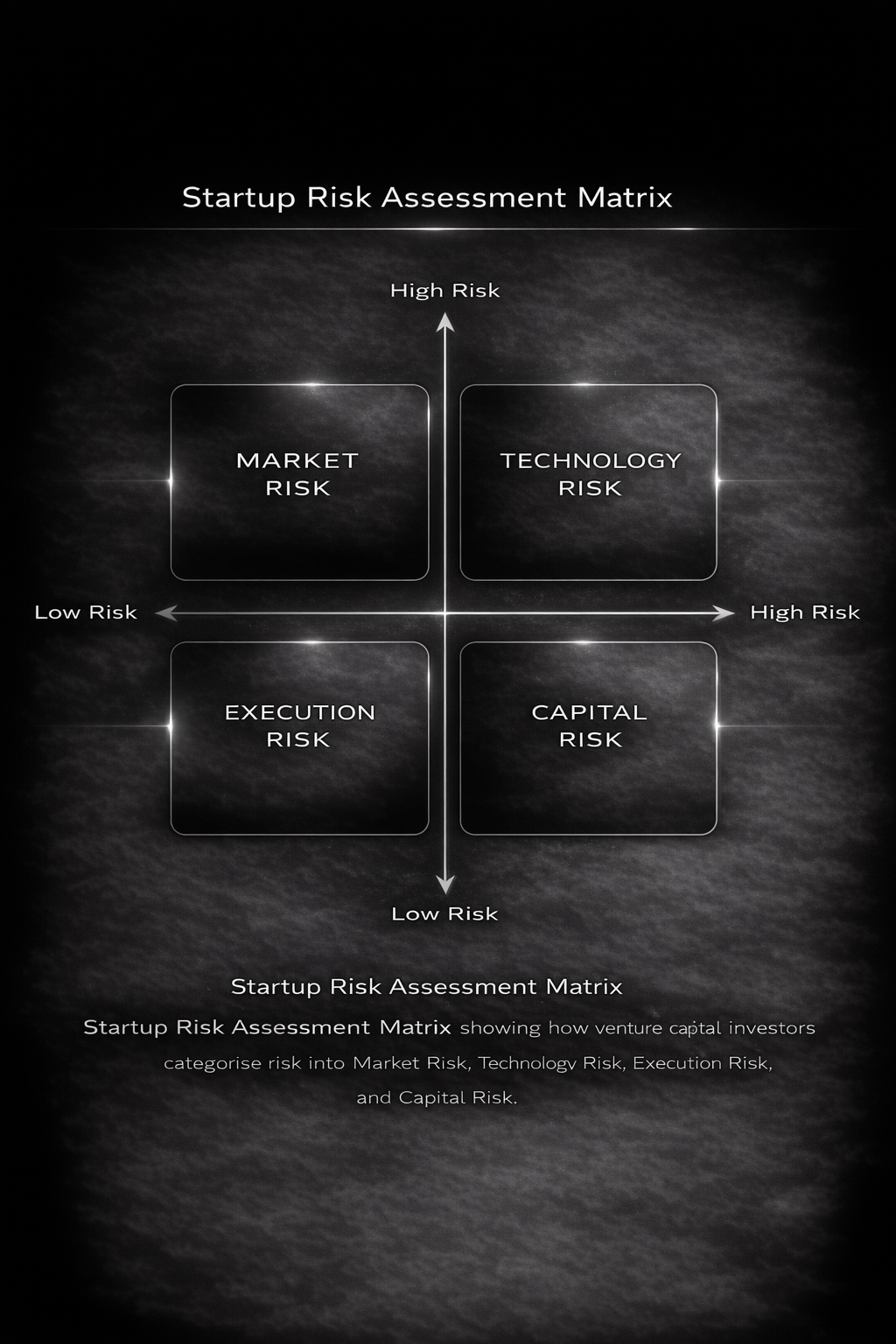
Startup Risk Assessment Matrix illustrating the four major risk categories venture capital investors analyse when evaluating startup opportunities.
Why Venture Capital Investors Reject Most Startups
Venture capital firms review thousands of startup opportunities every year. Only a very small percentage receive funding. The majority of startups are rejected long before they reach an investment committee.
Understanding why investors reject companies is essential for founders who want to raise institutional capital.
The most common reason investors decline an opportunity is market size. Venture capital funds are structured to generate very large returns. Because most portfolio companies fail or produce modest exits, the successful companies must be capable of generating extremely large outcomes. If the market opportunity is too small, the startup cannot produce venture-scale returns regardless of execution quality.
Weak traction is another major cause of rejection. Investors expect clear signals that a startup is gaining adoption. These signals vary depending on stage, but they often include user growth, early revenue, customer retention, and engagement metrics. If a company has spent significant time in the market without demonstrating momentum, investors often conclude that demand is limited.
Founding team concerns also frequently lead to rejection. Venture capital investors place enormous weight on the ability of founders to navigate uncertainty and execute under pressure. Investors evaluate whether the team has the experience, resilience, and decision-making ability required to build a high-growth company.
Competitive dynamics are another major consideration. If a market is already dominated by well-funded incumbents, investors may conclude that the startup will struggle to establish a meaningful position. Venture capital firms prefer markets where emerging companies have the potential to reshape industry structure.
Some startups are rejected because the technology does not create a meaningful advantage. Investors look for products that deliver significant improvement over existing solutions. If a company’s product can be easily replicated or replaced, investors may view the opportunity as too fragile.
Capital intensity is another factor that affects investment decisions. Some startups require extremely large amounts of capital to reach profitability. When investors believe that a company will require repeated financing rounds without clear milestones, they may decide that the risk-return profile does not justify investment.
These factors explain why venture capital firms decline most opportunities they review. Investors are not simply evaluating whether a company is interesting or promising. They are evaluating whether the startup fits the specific return model required by venture capital.
How Founders Improve Investor Confidence
Although venture capital investors reject many startups, founders can significantly improve their chances of raising capital by addressing the core evaluation criteria used by investors.
The first step is building clear evidence of market demand. Investors want to see that customers actively value the solution being developed. Early revenue, user growth, customer testimonials, and usage data all provide signals that the product solves a meaningful problem.
Founders also improve investor confidence by demonstrating a deep understanding of the market they are entering. Investors expect founders to articulate how the industry operates, how customers make purchasing decisions, and where the largest opportunities exist within the market structure.
Another critical factor is strategic positioning. Startups that clearly define their competitive advantage are easier for investors to evaluate. This advantage may come from proprietary technology, unique data assets, network effects, regulatory positioning, or strong distribution channels.
Operational discipline is another important signal. Investors pay close attention to how founders manage resources, structure teams, and prioritise product development. Companies that demonstrate thoughtful decision-making and efficient execution are more likely to attract investor interest.
Transparency during the fundraising process also plays an important role. Investors expect founders to provide clear information about financial performance, company structure, and key risks. When founders communicate openly about both strengths and challenges, investors gain greater confidence in the leadership team.
Ultimately, the startups that attract venture capital funding are those that present a compelling combination of market opportunity, product differentiation, and execution capability. When these elements align, investors are far more likely to move forward with investment discussions.
Frequently Asked Questions
What do venture capital investors look for in startups?
Venture capital investors typically look for large market opportunities, strong founding teams, differentiated products, and evidence of early traction. Investors evaluate whether a startup has the potential to scale rapidly and produce venture-scale returns.
How do investors evaluate startups?
Investors evaluate startups through a combination of market analysis, product assessment, traction metrics, team evaluation, and risk analysis. This evaluation process often involves partner discussions and internal investment committee review.
What traction do investors expect from startups?
Traction expectations vary depending on the stage of the company. Early stage startups may demonstrate traction through user growth or product engagement, while later stage companies are expected to show revenue growth, customer retention, and scalable business models.
What happens during venture capital due diligence?
During due diligence, investors examine a startup’s financial data, legal structure, product technology, customer relationships, and market position. The purpose of due diligence is to verify the claims made by the founders and confirm that the investment opportunity meets the firm’s risk and return requirements.
Capital Framework
Capital is not raised through narrative alone. It moves through structure, sequencing and disciplined execution. Capital Framework sets out the principles and structural progression required before institutional capital will engage.
Beyond Analysis
Capital Intelligence provides the structural research layer behind the applied capital sequencing within MoonshotNX. Founders who require structured assessment can engage the Capital Readiness Audit or review the Funding & SPV framework for deployment pathways.
Archive Structure
Capital Intelligence is maintained as a structured methodology archive. Articles are updated periodically to reflect regulatory shifts, capital deployment trends, and evolving institutional standards.
Each entry is designed to stand independently while contributing to a coherent analytical framework.